
Last updated November 18, 2026
Radiant Barrier Installation Troubleshooting: Common Problems and How to Fix Them
A radiant barrier installed correctly in a Las Vegas attic should drop attic air temperature by 20 – 30°F on a 110°F day. When it doesn’t, the foil almost never failed. Something around it did. In our experience across North Las Vegas, the actual culprit is one of three conditions: a compromised air gap, dust bonded to the reflective surface, or an attic floor that was never insulated enough to let the barrier matter. All three are diagnosable with a thermometer, a flashlight, and a ruler. This guide walks through each one, shows you how to test for it, and tells you which problems you can patch and which require the foil to come down.
Quick Answer
Most radiant barrier failures in North Las Vegas come down to a lost air gap (foil touching a surface), dust buildup that raises emissivity from 0.05 to 0.25 – 0.40 over 3 – 7 years, or inadequate attic floor insulation that masks the barrier’s benefit entirely. You can identify which one you have by checking the gap with a ruler at three rafter bays and comparing attic air temperature against ceiling temperature. Penetration gaps around HVAC boots and attic hatches are patchable with high-temp foil tape; foil installed flat against the roof deck is not, and needs professional re-installation.
Table of Contents
- How do I check the air gap behind my radiant barrier?
- Why does dust ruin a radiant barrier, and can it be cleaned?
- Is my insulation making the barrier irrelevant?
- How do penetration gaps defeat a radiant barrier?
- When is foil against the roof deck beyond patching?
- What tools do I actually need to troubleshoot this?
- Can I fix it myself or do I need a pro?
- Common mistakes to avoid
- When to call a professional
How do I check the air gap behind my radiant barrier?
A radiant barrier works by reflecting radiant heat across an air space. The gap is the whole mechanism. If the foil is touching a surface on the hot side, heat conducts straight through it and the shiny face does nothing. The general industry rule is a minimum ¾-inch gap between the foil and the nearest surface on the hot side; below that, reflectance drops fast, and at zero gap you have a conductor wrapped in foil.
Here’s the diagnostic, and it takes about ten minutes:
- Pick three rafter bays spread across the attic – one near the ridge, one mid-slope, one near the eave.
- Shine a flashlight up along the foil where it spans between rafters.
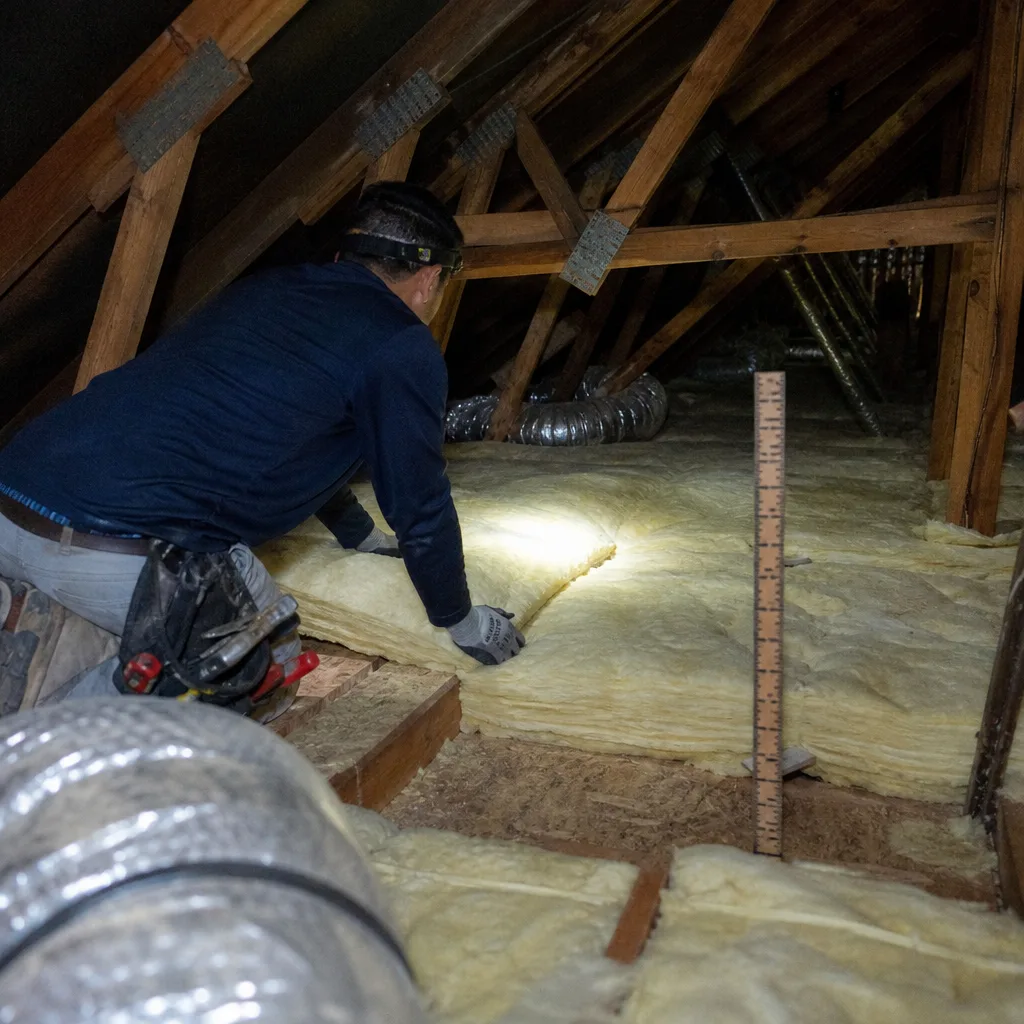
- Insert a ruler perpendicular to the foil and measure the clear distance to the nearest surface (typically the roof sheathing above).
- Record each measurement. If any of the three reads under ¾ inch, the barrier has lost its gap in that zone.
- Look for sagging between staples, foil that has torn loose, or staples pulled free by heat cycling.
In North Las Vegas attics, summer temperatures routinely push past 150°F at the ridge. Staples fatigue. Foil sags. We’ve walked attics in the Aliante and Eldorado neighborhoods where the barrier was installed tight to the deck at the ridge and gapped properly at the eave – a partial failure that shows up as uneven cooling in the rooms below. If the gap has closed across a few bays, re-stapling the foil back to the rafters usually restores it. If the bays need more space, foil-laminate spacers or strapping can hold the gap. What you don’t want to do is pull the foil tighter thinking you’re smoothing it – that flattens the gap you’re trying to protect.
Why does dust ruin a radiant barrier, and can it be cleaned?
Radiant barriers are graded by emissivity – the rate at which a surface gives off heat. A clean foil face runs around 0.05, which means it emits almost nothing. But dust settles on any horizontal or face-down surface in an attic, and that dust layer becomes the surface. Within 3 – 7 years in a dusty environment, the effective emissivity on a face-down installation can climb to 0.25 – 0.40. At that point you’ve lost most of the reflective advantage even though the foil underneath is intact.
North Las Vegas is a dust town. The wind-blown particulate, combined with construction debris from surrounding lots and standard attic ventilation drift, accelerates the problem. If your attic has unfiltered soffit vents pulling desert air across the foil, dust accumulates faster than the national average.
To check whether your barrier has degraded:
- Look at the foil face with a flashlight held at a shallow angle – dust reads as a dull, matte film.
- Wipe a 6-inch section with a clean white cloth. A brown or grey smudge means dust has bonded to the surface.
- Check whether the dust is loose (wipes clean) or baked on (won’t wipe off after a couple of passes).
Light, loose dust is sometimes cleanable with a dry microfiber or a low-pressure air pass – but you have to be careful up there, and the cost of a proper cleaning crew rivals what a fresh foil layer costs. If the dust is bonded, cleaning isn’t viable; the surface is permanently degraded and the right move is replacement. In our experience, most face-down radiant barriers in North Las Vegas past their seventh summer need replacement rather than cleaning to recover meaningful performance.
Is my insulation making the barrier irrelevant?
This one surprises people. A radiant barrier reduces the radiant load coming through the roof deck. But if the attic floor insulation is below R-19, conductive heat transfer through that floor dominates everything else. You can have a perfectly installed, perfectly clean radiant barrier and still have a hot house, because the barrier is only solving part of the problem.
The diagnostic is a temperature comparison. Get a laser thermometer or an infrared thermometer. Measure the air temperature in the attic at midday. Then measure the ceiling surface temperature inside the living space underneath. If the ceiling surface reads more than 8 – 10°F warmer than the room air, the ceiling assembly is conducting heat into the home – and a radiant barrier on the roof deck can’t stop that.
What typically happens in North Las Vegas is a house built between 2015 and 2025 with a radiant barrier on the deck and a thin layer of builder-grade blown insulation on the floor – often in the R-13 to R-19 range. The barrier was performing as designed from day one. The insulation was never the right thickness to make the barrier’s contribution visible. Pairing the barrier with attic floor insulation in North Las Vegas – before it was ever paired correctly – is the fix, and it’s the case where the barrier wasn’t the problem at all. The proper order is seal the air leaks first, then bring the floor to a real R-value. We never blow insulation over an unsealed attic floor for exactly this reason; the air leaks will defeat both the barrier and the new insulation.
How do penetration gaps defeat a radiant barrier?
Every hole cut through the roof assembly – HVAC boots, wire chases, plumbing vents, the attic hatch – is a place where the barrier was interrupted. If the foil isn’t detailed around those penetrations, hot attic air leaks past the barrier and bypasses it. The room below gets the full heat load regardless of what the foil is doing a foot away.
What it looks like: an HVAC boot rising through the foil with a circle of raw sheathing or torn foil around it, a gap you can see daylight through, or an attic hatch that sits above the barrier line. In North Las Vegas attics, the boot penetrations in particular are worth checking because the flex duct running to them often rests against the foil, pressing it flat and compressing the gap on the way to the boot.
To close these, use foil tape rated for high-temperature service – the standard HVAC foil tape sold at any supply house has a service range up to 250 – 300°F, which is fine for attic boots but you should check the temperature rating on the roll. Standard duct tape degrades within a season on a North Las Vegas roof. Wrap the boot collar with the foil tape in a continuous lap, tape the wire chases closed, and seal the attic hatch with a batt-and-foil cover or a dedicated insulated hatch. Small penetrations – ¼ inch or less – can usually be closed with a dab of high-temp foil tape as a patch.
When is foil against the roof deck beyond patching?
The single condition that can’t be fixed by patching is a radiant barrier installed in full contact with the roof deck, with zero air gap across the majority of the roof area. When that happens, the foil acts as a conductor, not a reflector. Heat from the sun hits the shingles, conducts through the sheathing, conducts through the foil, and radiates straight into the attic. The shiny surface is irrelevant because there’s no gap for it to reflect across.
This is more common than you’d expect, especially in homes built during the 2015 – 2025 boom where the barrier was stapled tight to the underside of the sheathing as a radiant barrier-plus-vapor-retarder product. The original spec may have called for a gap, but the installer stapled it flush. Partial correction – spotting back a few bays – doesn’t achieve a meaningful result across the whole roof area, because the bays left in contact still conduct the full heat load.
What this looks like from the diagnostic side: you measure the gap at three or more bays and every one is at zero or near-zero, and the attic air temp is running 15°F or more above the outside air temp even with a properly insulated floor. That’s the signal to call a pro and plan for removal and re-installation with a proper reflective layer and gap. It’s not a patching job.
If you want to see what this repair looks like side by side with attic insulation in North Las Vegas, we can walk you through it on a free estimate.
What tools do I actually need to troubleshoot this?
You don’t need a truck full of test equipment to sort through the three main failure modes. The tools below cover almost every case we diagnose:
- A laser or infrared thermometer – for comparing attic air temperature against ceiling temperature. A basic IR gun from a hardware store is fine; the point is the comparison, not precision to the tenth of a degree.
- A 12-inch metal ruler – for measuring the air gap at each rafter bay. Bring a tape measure too for reach.
- A bright LED flashlight – angled light reveals dust film and staples pulled loose from the rafters.
- A white microfiber cloth – for the dust wipe test. A clean cloth shows the film color clearly.
- A notebook or phone camera – record gap measurements per bay and photograph dust conditions. The photos become the record you compare against if you bring in a pro.
Skip the thermal imaging camera unless you’re planning to do a full envelope assessment. A $30 IR gun answers the “is the ceiling hot” question, which is what you need for the barrier diagnostic. The thermal camera tells you about wall and window leaks too, which is a separate scope – useful, but not part of the radiant barrier troubleshooting. If the diagnostic points to a full envelope rebuild, Envelope Insulation North Las Vegas home lays out the line of service.
Can I fix it myself or do I need a pro?
Some problems are patchable. Some are not. The split is roughly this:
- Patchable: a small air gap lost in a few bays (re-stapling or spacer), penetration gaps around HVAC boots and hatches (foil tape), and light dust on an accessible face-up installation (wipe-down, carefully).
- Professional re-installation: foil installed flat against the deck across the majority of the roof, dust bonded to the surface (face-down install past 5 – 7 years), and any attic where the gap has failed at scale.
The safety side matters here. Attics in North Las Vegas run 140 – 160°F in summer, the deck is steep-pitched on most of the homes we see, and the barrier zone is often the tightest part of the roof. A fall from a roof deck is the leading cause of serious injury in this trade, and heat exposure at those temperatures causes heat stroke faster than most people realize. If your diagnostic says the foil needs to come down and go back up, that’s a job for technicians with proper fall protection and attic heat protocols.
One more point: if the barrier passed the diagnostic but the house still runs hot, you may have an air leakage problem that no foil will fix. That’s where spray foam insulation in North Las Vegas often enters the picture – as a sealing layer, not a foil replacement. Materials from Owens Corning and Icynene are common on these jobs, and they’re chosen per assembly rather than per brand.
Common Mistakes to Avoid
- Pulling the foil tighter to “smooth it out.” Tighter foil means less gap. It’s the opposite of what you want. Leave slack where it can sag to create the gap, and staple only enough to hold it.
- Using standard duct tape on penetrations. It peels off a hot roof in one Las Vegas summer. Use high-temp foil tape rated for the surface temperature.
- Skipping the ceiling temperature check. People diagnose the barrier by feel instead of by number. If you haven’t measured ceiling vs. room air, you don’t know if the barrier is the problem or the insulation is.
- Cleaning a bonded dust layer. If the dust doesn’t lift with a light cloth pass, it’s fused to the surface and cleaning won’t restore emissivity. Replace the barrier instead of spending the money on a cleaning crew.
- Insulating over the ceiling before sealing the attic floor. Blowing new insulation on top of unsealed penetrations traps the leaks under the batting and makes both the barrier and the new insulation less effective. Seal first, then insulate.
- Assuming a 2015 – 2025 build got the barrier right. Every barrier installed during that boom should be re-checked. Stapled-flush failures are common in the newer North Las Vegas subdivisions, and the warranty paperwork won’t tell you.
- Treating “the barrier” and “the ceiling assembly” as the same thing. A barrier is one component. The attic floor insulation, air sealing, and ceiling drywall are separate. Diagnose each on its own.
When to Call a Professional
Bring in a professional if any of the following is true: the gap test shows foil touching the deck across most of the roof (contact failure, not patchable), the dust wipe test shows bonded film on a face-down installation past 5 – 7 years, the ceiling-vs-room temperature differential is more than 8 – 10°F even with a clean and properly gapped barrier (insulation or air sealing problem, not a barrier problem), or the attic is too hot or the deck too steep to safely access. Also call if you’ve done the diagnostics and can’t isolate which failure mode is dominant – that usually means more than one is present, and the fix has to address them in order.
Envelope Insulation North Las Vegas offers free estimates in North Las Vegas – call (833) 630-4008. Every estimate is a written price before any work starts, and on applicable jobs we publish before-and-after blower-door readings so you can see the actual air leakage change from the work. Materials come from Owens Corning, Johns Manville, Knauf, Rockwool, CertainTeed, Icynene, Demilec, and GreenFiber, with no proprietary lock-in.
Frequently Asked Questions
Compare attic air temperature to outside air temperature at midday. A working barrier in a North Las Vegas summer should keep attic air within 20 – 30°F of outside air; a failed barrier shows attic air 40°F or more above outside. Then compare ceiling surface temperature to interior room air – more than 8 – 10°F warmer points to an insulation or air sealing problem masking the barrier’s effect. Call (833) 630-4008 if you want a free diagnostic.
Sometimes, if the dust is loose and the installation is face-up and accessible. If the dust is bonded – which is the norm on face-down installs past 5 – 7 years in a dusty climate like North Las Vegas – cleaning won’t restore the original 0.05 emissivity, and replacement is the better spend. Call (833) 630-4008 for a free walk-through and we’ll tell you which case you’re in.
Not on its own. If attic floor insulation is below R-19, conductive transfer through the ceiling dominates, and the barrier’s benefit gets masked. The right order is air seal, then bring the floor to a real R-value, then evaluate whether the barrier needs repair or replacement. Call (833) 630-4008 for a free estimate on the whole assembly.
Replacement pricing varies with roof pitch, attic access, and how much of the old foil has to come down, which is why a written price is the only honest number you’ll get. A free estimate includes a written price before any work starts. Call (833) 630-4008 to schedule one.
Only if the barrier is the actual cause. If the ceiling-vs-room air differential is more than 8 – 10°F, the problem is more likely insufficient insulation or unsealed penetrations, not the barrier. We diagnose before we quote, and the written price reflects what the diagnostic actually found. Call (833) 630-4008.
Yes, small penetration gaps around HVAC boots, wire chases, and the attic hatch are patchable with high-temp foil tape (rated to 250 – 300°F service) in a single afternoon. Anything requiring access into the tight roof assembly, or any gap in a bay with zero clearance, needs a pro for safety and to get the outcome right. Call (833) 630-4008 if you want us to look at it first.
The Bottom Line
When a radiant barrier “doesn’t work” in a North Las Vegas attic, the cause is almost always one of three things: a lost air gap, dust that bonded to the surface, or an attic floor that was never insulated enough to make the barrier’s contribution visible. You can diagnose all three with a ruler, an IR thermometer, and a flashlight. Patch the loose gaps and penetration holes; replace the foil that’s flat against the deck or dusted to a dull film. Seal the attic before you insulate it, always. If your diagnostic points to a rebuild, get a written price before anything starts. If you’d rather have the diagnostic run for you, call (833) 630-4008 for a free estimate. A full envelope review, including radiant barrier, attic insulation, and air sealing, is a documented job, and on applicable jobs you’ll get before-and-after blower-door readings that show what actually changed. If crawl space vapor barriers or attic cleaning come up during the walk-through, see crawl space encapsulation and vapor barrier in North Las Vegas for the full scope.
Written by the team at Envelope Insulation North Las Vegas.