
Last updated November 18, 2026
The Complete Guide to Insulation in North Las Vegas
A freshly blown R-38 attic in a North Las Vegas home with 8 ACH50 of air leakage performs closer to R-22 in real-world conditions. That gap between the number printed on the bag and the number your house actually delivers is where most insulation spending goes wrong. The R-value on the label is a lab measurement taken with no wind, no attic bypasses, and no 110°F roof deck pushing heat down through the assembly. What you actually paid for is the performance your building envelope delivers under a Mojave Desert summer. This guide walks through the sequence building science requires: audit first, air seal second, insulate third, then verify with a blower-door reading. We’ll cover North Las Vegas material choices, real installed R-values at summer attic temperatures, rebate eligibility tied to documented performance, and what a complete job file should contain before you sign anything.
Quick Answer
Insulation in North Las Vegas works only when air sealing comes first. Seal the attic floor – top plates, recessed lights, and every penetration – then insulate to a verified R-38 or better, and confirm the result with a before-and-after blower-door test. Skip the sealing step and even a well-installed R-38 batt or blown job loses a meaningful share of its rated value to leakage and radiant heat.
Table of Contents
- Why Sequence Matters More Than R-Value
- How Mojave Desert Heat Changes Which Insulation Is Worth It
- The Air-Sealing-First Sequence
- Material Comparison: Batts, Blown Fiberglass, Spray Foam
- ACH50 Targets for Clark County Homes
- What a Complete Job File Should Contain
- NV Energy Rebates and Documented Performance
- When to Call a Professional
Why Sequence Matters More Than R-Value
Ask ten North Las Vegas homeowners what insulation they need and nine will quote an R-value. That’s the wrong first question. R-value measures how well a material resists conductive heat flow. It says nothing about how much air moves through the assembly, and in this climate air movement is often the bigger loss. A 1,800-square-foot North Las Vegas house built in the 2000s typically leaks somewhere between 6 and 10 ACH50 as found – air changes per hour at 50 pascals of pressure, the standard blower-door metric. Get that number down before you bury the attic floor in fiberglass, and every dollar of insulation you add performs nearer to its rating.
The core physics is straightforward. Insulation works by trapping still air. If air keeps moving through the material – pushed by stack effect, pulled by HVAC return leaks, or driven by pressure differences between the attic and the living space – the trapped air gets replaced and the insulation can’t do its job. In North Las Vegas, the pressure difference between a 110°F attic and a 76°F house is enormous through summer. Unsealed top plates and can lights turn into small exhaust vents, and your R-38 becomes a filter for hot attic air rather than a barrier against it.
That’s why we seal first, then insulate – in that order, every time. We’ve measured the difference. A North Las Vegas home in the Aliante area with a pre-work reading of 4,200 CFM50 (cubic feet per minute at 50 pascals) dropped to 2,100 CFM50 after we sealed the attic floor and added R-38. The R-value didn’t change between the two readings – what changed was how much air was carrying heat around it. Homeowners who skip sealing and go straight to blown insulation often see half that improvement, or less.
How Mojave Desert Heat Changes Which Insulation Is Worth It
North Las Vegas roof decks regularly read 150°F to 165°F on an August afternoon. Under that deck, attic air socked against the insulation surface builds a radiant load that gets transmitted down through the assembly into the ceiling drywall. This is why radiant barrier installation matters in Southern Nevada in a way that it doesn’t in, say, Portland or Denver – the solar flux is brutal and the attic air temperature is high enough that radiant heat flow dominates the assembly’s heat gain.
Two things follow from the Mojave numbers. First, the difference between R-30 and R-38 is real but modest compared to the difference between “sealed” and “not sealed.” Second, the material you install should hold its R-value at attic temperature, not just at the 75°F lab condition. Fiberglass and mineral wool lose a small amount of R-value as attic temperature climbs. Spray foam holds up better thermally at high temperatures because its closed cells trap blowing agent rather than plain air. Whether that premium is worth it in your North Las Vegas home depends on what’s happening in the attic – if your ducts run through the attic, if you have knee walls, or if the roof deck is close to the ceiling, the calculus shifts.
Radiant barrier applied to the underside of the roof deck can drop attic air temperature by 20°F to 30°F in North Las Vegas summers before any insulation is touched. That reduces the driving force across the ceiling assembly. It’s not a substitute for insulation or air sealing, but on a home with poor ceiling insulation and a low-slope roof, it changes what “worth the premium” means.
The Air-Sealing-First Sequence
This is the part of the job most North Las Vegas insulation quotes leave out, or list as an optional add-on. It’s not optional. Here’s the sequence a Haven Standard job follows, from first call to final documentation.
- Home energy audit – a full walkthrough with a blower-door test to measure current leakage (CFM50), thermal imagery of the ceiling plane, and a written report of what’s actually missing. You leave with a number, not a guess.
- Written price and written scope – before any work starts, you get a flat price, the materials specified by brand and R-value, and the scope of air sealing. Haven Standard Clause 1 is non-negotiable on this point.
- Attic air sealing – top plates at every wall, recessed can lights boxed and sealed, plumbing and electrical penetrations foamed, duct boots sealed to drywall, bath fan housings sealed, attic hatch weatherstripped and insulated. This step is where the ACH50 number actually moves.
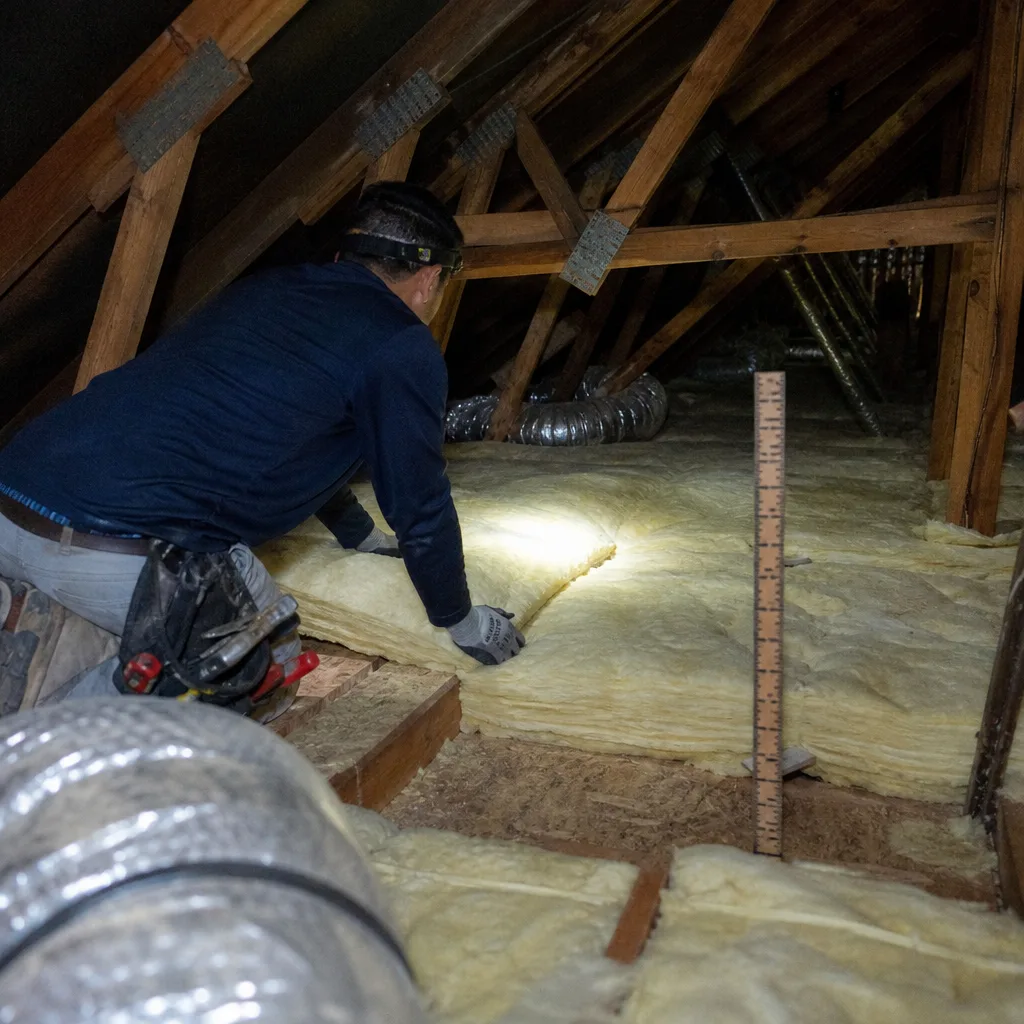
- Insulation installed to spec – blown, batt, or spray foam per the written scope, installed to a measured depth (we photograph the ruler).
- Post-work blower-door test – a second reading to quantify what the sealing accomplished. Typical North Las Vegas results land in the 2.0-4.0 ACH50 range for homes that started at 6-10.
- Documented Photo Record – photos of sealed penetrations, installed depth, and the before/after blower-door numbers delivered to you in writing.
Notice what’s not on that list: blowing insulation over an unsealed attic floor. We won’t do it. Adding R-38 over an 8 ACH50 attic is like wrapping a leaky bucket – it looks finished and it doesn’t hold water. Details on the sealing step live on our Attic Insulation in North Las Vegas page.
Material Comparison: Batts, Blown Fiberglass, Spray Foam
Here’s where North Las Vegas homeowners ask the most questions, and where the market provides the least useful answers. Below is what each material actually delivers in a Las Vegas summer attic – measured R-value per inch at approximately 130°F mean temperature, not the lab number.
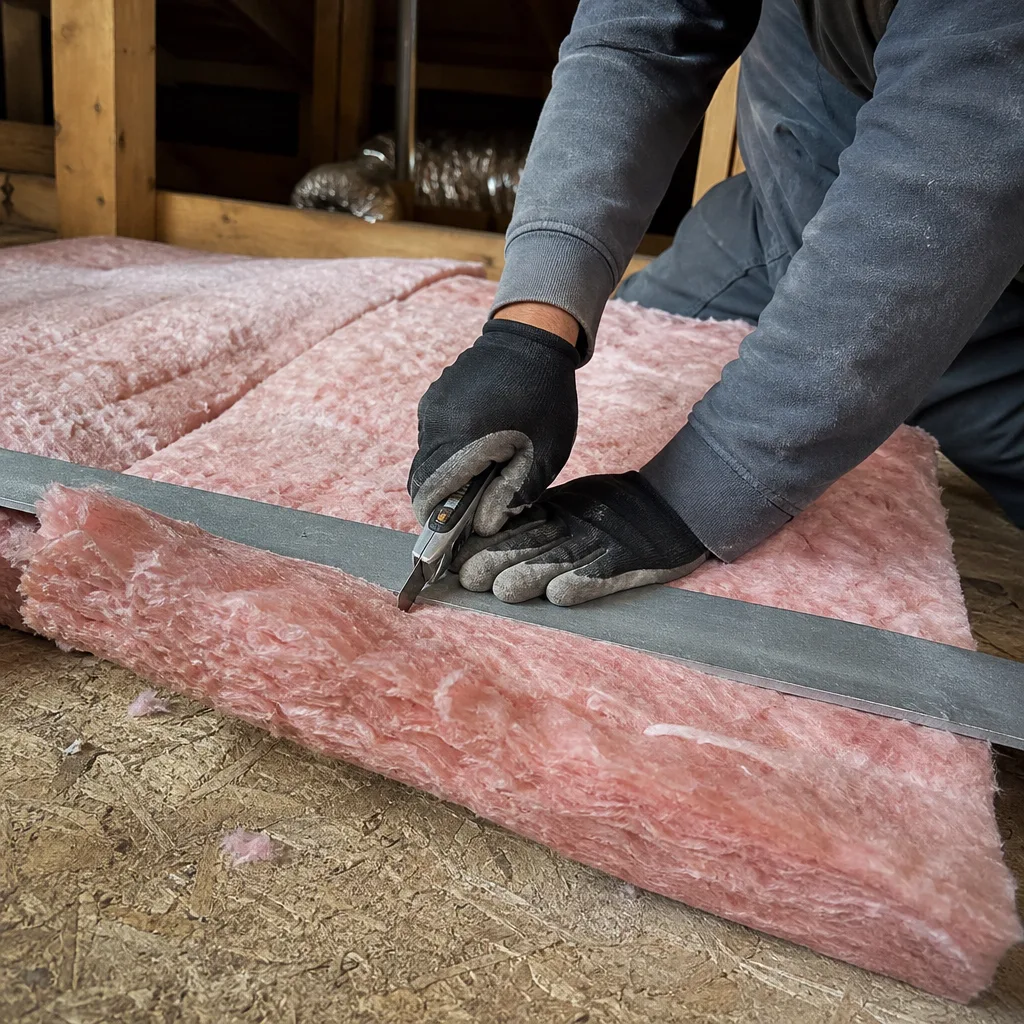
- Batt insulation (Owens Corning or Johns Manville fiberglass) – R-3.0 to R-3.3 per inch in the lab; nearer R-2.8 to R-3.0 per inch at summer attic temperatures. Fine for clean, open, accessible attics. Easy to install poorly – gaps around penetrations and compressed edges cut effective R-value by 15-25% if installation is sloppy.
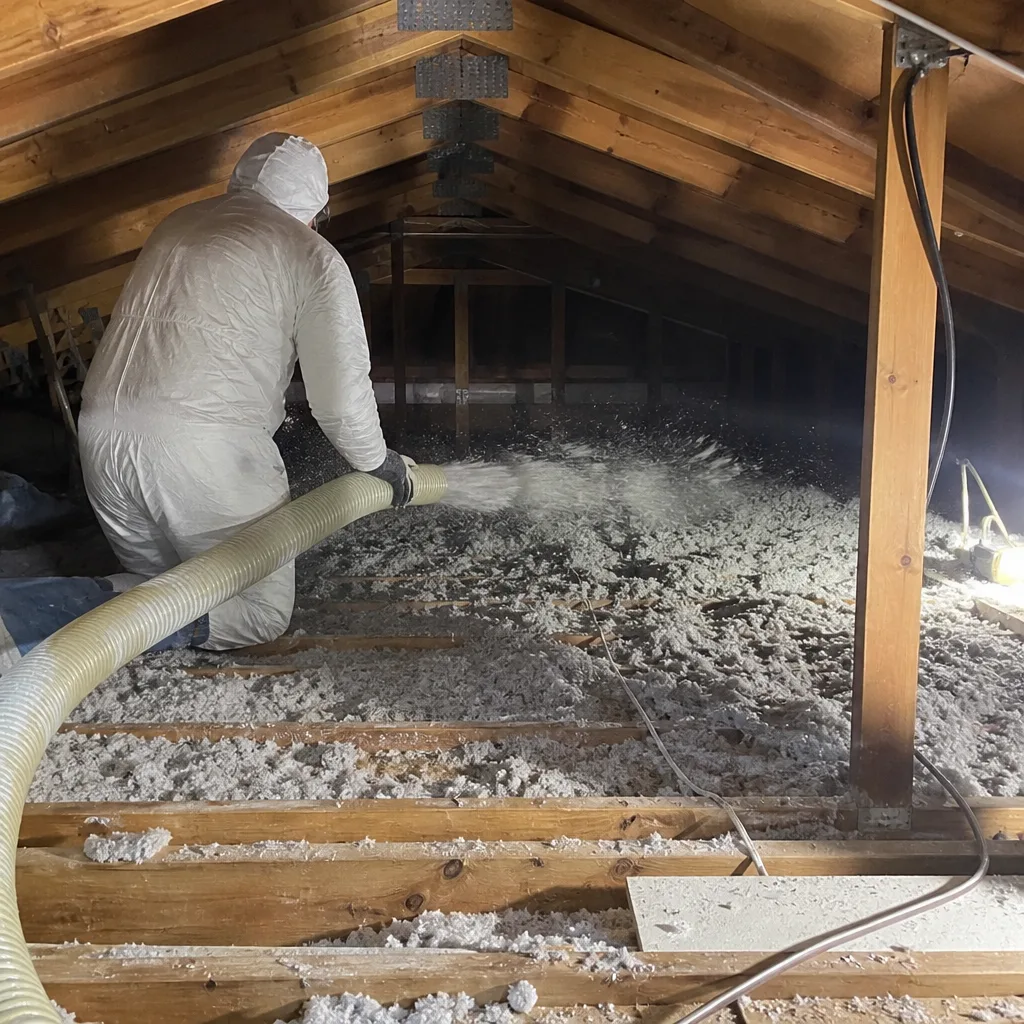
- Blown fiberglass (Knauf, Johns Manville) – R-2.5 to R-3.0 per inch installed at proper density; R-38 typically requires 13-15 inches of depth in a North Las Vegas attic. Fills around penetrations and irregular framing well. Loses R-value if it settles, which it can do over 10+ years – ask for a depth reading, not a bag count.
- Blown cellulose (GreenFiber) – R-3.2 to R-3.8 per inch installed, denser than fiberglass, better air resistance. Good for homes where a full air seal followed by a dense fill is the plan. Heavier and slightly more expensive than fiberglass.
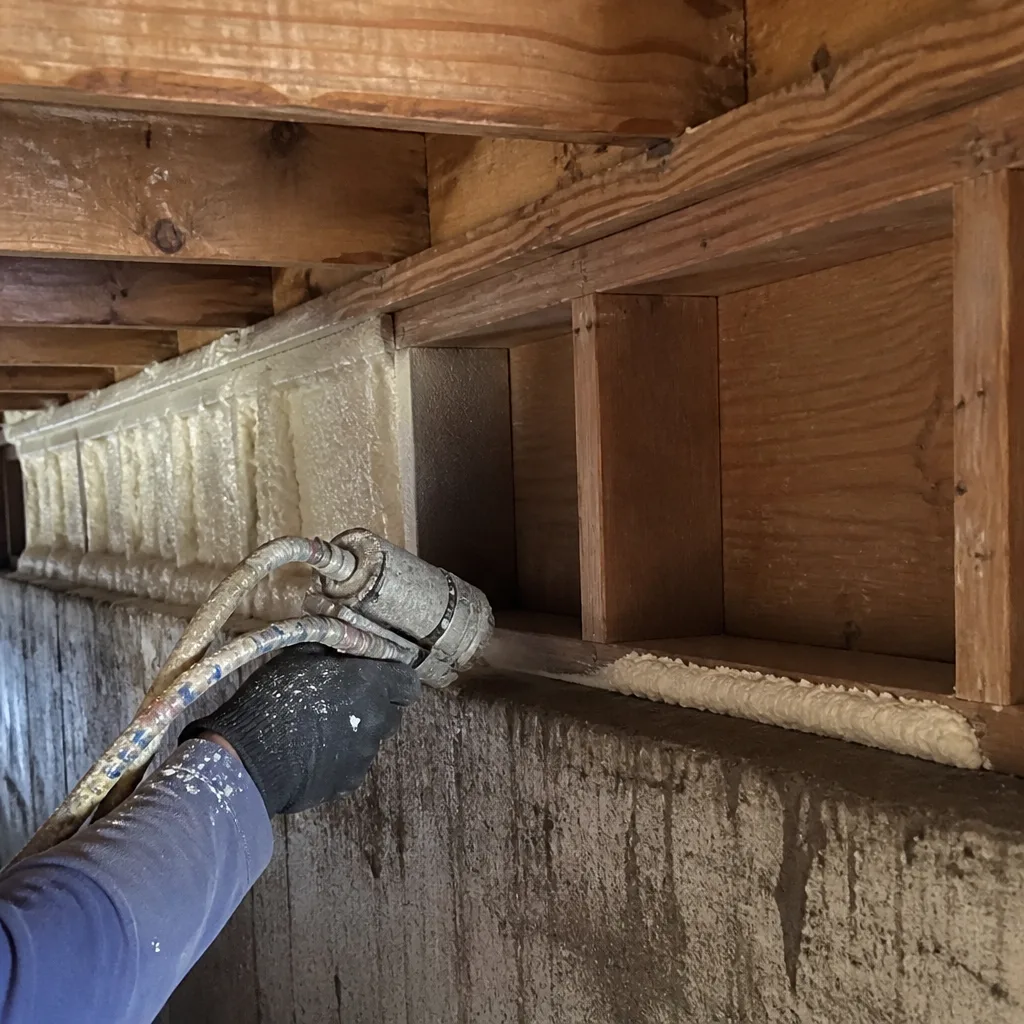
- Open-cell spray foam (Icynene, Demilec) – R-3.5 to R-3.7 per inch. Seals as it insulates, so on a cathedral ceiling or a knee-wall assembly where you can’t reach the air barrier directly, it does two jobs at once. Softer and lower density, so it needs covering in some applications.
- Closed-cell spray foam – R-6.0 to R-7.0 per inch. The highest R per inch on the market, and structurally rigid. Used in North Las Vegas mostly at rim joists, knee walls, and roof decks where thickness is limited. Highest per-square-foot cost of the four.
For most vaulted-ceiling and bonus-room-over-garage situations in North Las Vegas, closed-cell spray foam is the only way to hit a meaningful R-value in the available depth. For flat-attics with proper ventilation, blown fiberglass or cellulose over a full air seal is the cost-effective choice. Our Spray Foam Insulation in North Las Vegas page walks through where foam earns its premium and where it doesn’t.
ACH50 Targets for Clark County Homes
ACH50 – air changes per hour at 50 pascals of test pressure – is the single number that tells you how tight your North Las Vegas home actually is. It’s measured by a blower door: a calibrated fan mounted in an exterior doorway that depressurizes the house and reports leakage as a rate of air exchange. Lower is tighter.
Rough benchmarks for Clark County homes, based on our blower-door work across North Las Vegas:
- Above 10 ACH50 – leaky. Air sealing is the highest-value first step, full stop.
- 7 to 10 ACH50 – typical for 1990s and 2000s production homes in North Las Vegas that have never been sealed. Meaningful savings available.
- 4 to 6 ACH50 – moderate. Air sealing plus insulation upgrades usually deliver a measurable improvement.
- 2 to 3 ACH50 – tight for a North Las Vegas home. Good target for a retrofit project.
- Under 2 ACH50 – very tight, typically only achieved with spray foam and full envelope work. Beyond this range, mechanical ventilation needs to be considered so the house doesn’t under-ventilate.
Two notes on the numbers. First, the target is not zero – a house needs some fresh air exchange, and sealing past 2 ACH50 without adding mechanical ventilation is a mistake in this climate (and most others). Second, the reading is meaningless without a before-and-after pair. An insulation contractor who tells you your house is now “much tighter” but doesn’t hand you the two blower-door figures hasn’t proved anything. We publish both on every job where the test applies.
What a Complete Job File Should Contain
A finished insulation job in North Las Vegas should leave you with a documented file – not just a receipt and a verbal “let us know if anything comes up.” Here’s what belongs in it, and what we require on every Haven Standard job.
- Pre-work blower-door reading (CFM50 and ACH50) – labeled with the date and test conditions, not just a single number with no context.
- Post-work blower-door reading – the directly comparable value. The difference between the two numbers is the performance change you paid for.
- Thermal imagery – pre- and post-work infrared photos of the ceiling plane and any wall assemblies covered. These show what the camera sees: cold or hot spots that stay cold or hot after the work indicate a missed area.
- Installed-depth photos – a tape or ruler in the blown insulation at multiple points, showing the depth delivered. This is how you verify the written scope of R-38 was actually installed to 13-15 inches and not shorted at 9.
- Written scope of air sealing – the specific penetrations sealed, by location. “Sealed top plates” is too vague; “sealed top plate at every interior wall, all eight recessed lights boxed and sealed, plumbing penetrations foamed” is a document.
- Material spec sheets – confirm the brand and product actually installed (Owens Corning vs. Johns Manville vs. Knauf matters less than brand consistency with what was quoted, but it should match).
- Permit card if applicable – North Las Vegas and Clark County permit requirements vary by scope. Any permitted work should leave you with the inspection record.
- Written warranty – the terms in writing before work starts. Our 365-Day Done Right Promise is the floor; the written warranty delivered with the scope is the actual promise on paper.
If a contractor can’t tell you what will be in the file on day one, you’re going to be guessing on day three. Under Haven Standard Clause 1 – Have it in writing – the scope, price, and warranty come before anyone lifts a tool.
NV Energy Rebates and Documented Performance
NV Energy rebate eligibility for insulation work in North Las Vegas depends on what you can document after the job, not just on what material got installed. The program’s insulation incentive is tied to measured improvement – usually a jump in ceiling R-value or a set reduction in air leakage – and in either case the contractor has to produce the paperwork the rebate administrator accepts. Blown-in rebate amounts typically require an R-value increase with documented pre- and post-installation depth, and air-sealing rebates require verifiable blower-door numbers.
Here’s where the sequencing pays off again. A North Las Vegas homeowner who seals first and insulates second can qualify for both air-sealing and insulation incentives, using the pre-work blower-door (before sealing) and the post-work reading (after insulation) as evidence for both. A homeowner who blows insulation over an unsealed attic has a depth reading but no meaningful air-leakage reduction to show, so the air-sealing incentive is off the table.
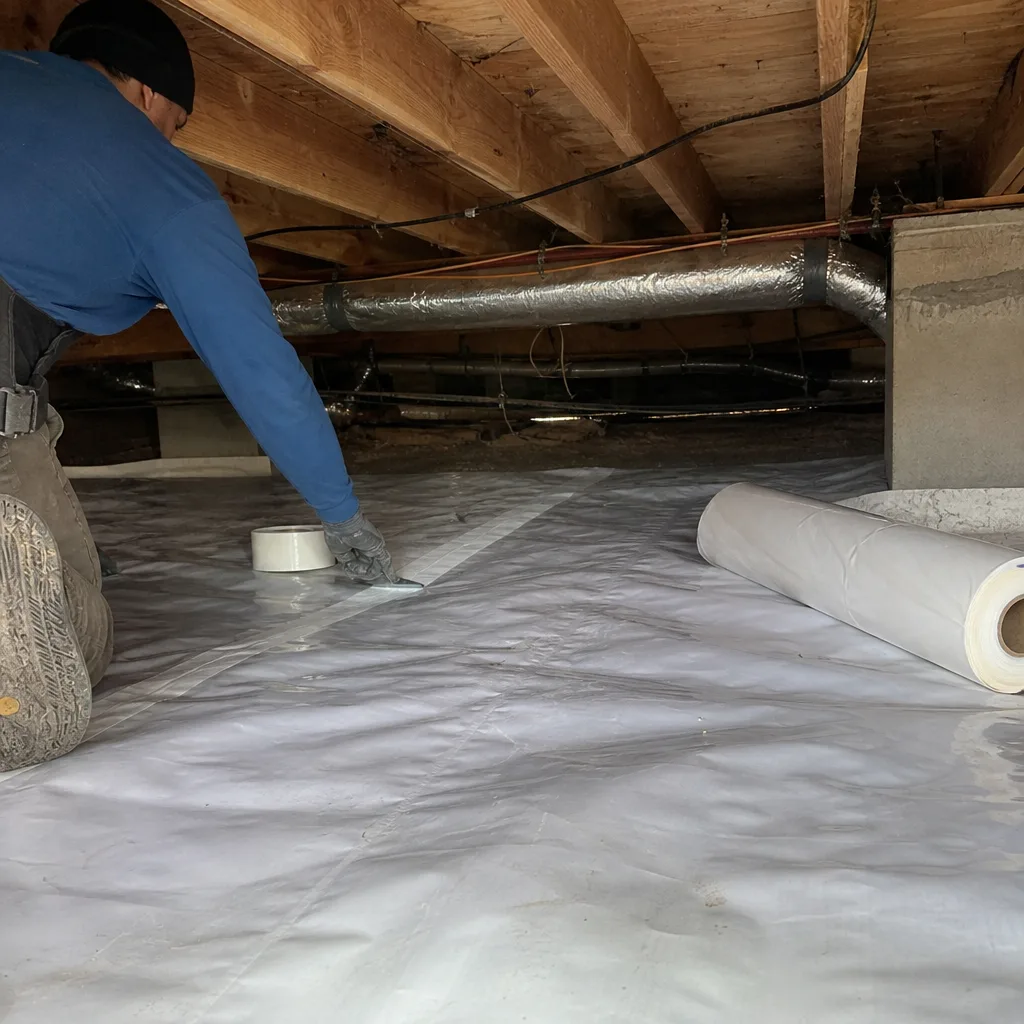
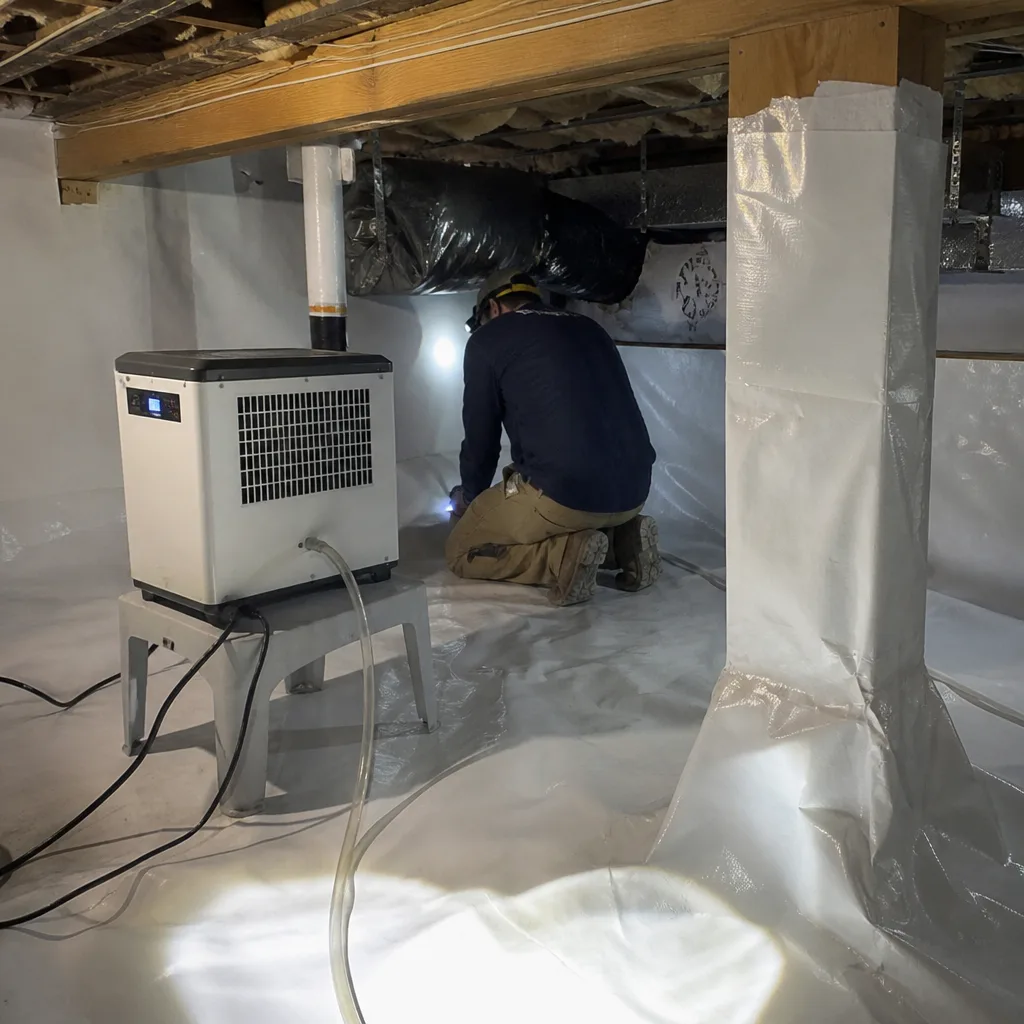
Rebate amounts change with program cycles, so we won’t quote a number here – we walk through current eligibility in the written estimate. What we can tell you: the reading in the job file is what unlocks the check. If the file doesn’t have it, neither do you. Crawl space work in North Las Vegas is often rebatable under the same program, and the details live on our Crawl Space Encapsulation & Vapor Barrier in North Las Vegas page.
Common Mistakes to Avoid
- Insulating over an unsealed attic floor. The most expensive mistake in the category. The new material looks impressive and delivers a fraction of its rated performance because the air barrier is still open. If a North Las Vegas contractor quotes insulation without listing air sealing as a line item in the same scope, that’s the tell.
- Trusting the bag number instead of the installed depth. R-38 blown fiberglass requires 13-15 inches in the attic. A job that installs 9 inches and calls it R-38 has shorted the work by roughly 30%. Ask for photos of a tape measure in the insulation.
- Skipping recessed can lights. Old non-IC-rated cans in North Las Vegas attic ceilings leak directly into the attic and can overheat when insulated against. Every can needs boxing and sealing, or replacement with IC-rated cans, before any insulation covers them.
- Ignoring the radiant load in a Mojave attic. Insulation alone doesn’t stop radiant heat from a 160°F roof deck. In a north-facing-ceiling assembly, radiant barrier or reflective decking can move the needle. In a south-facing ceiling with a ventilated attic, it may not – the determining factor is attic air temperature, not sales language.
- Covering bath fan exhausts and HVAC equipment. A bath fan discharging into the attic, or an air handler buried in blown insulation, is a documented failure mode. Both need proper venting and clearance before insulation goes in, not after.
- Expecting a blower-door improvement when none was measured. A sealed-and-insulated job that reports “significantly improved efficiency” without two numbers hasn’t measured anything. Ask for the CFM50 before and the CFM50 after, in writing.
- Choosing a material for its R-per-inch without checking assembly compatibility. Closed-cell foam at R-7 per inch looks great on paper, but in a knee-wall or attic floor assembly that doesn’t need structural rigidity, it’s a premium you don’t recoup. Match the material to the assembly, not to the marketing.
When to Call a Professional
Some insulation decisions are genuinely straightforward – a clean, empty, accessible attic, no recessed lights, no ductwork running through the ceiling. Most North Las Vegas homes aren’t that house. If any of the following describes your situation, this is a professional-sequenced job, not a weekend project:
- Recessed can lights in the ceiling plane (overheating risk if sealed incorrectly)
- Ductwork or an air handler in the attic
- Knee walls, cathedral ceilings, or bonus rooms over garages
- Any history of rodent activity in the attic (removal and proofing before reinstalling)
- Moisture staining, bath fan discharge into the attic, or visible mold
Envelope Insulation North Las Vegas offers free estimates in North Las Vegas – call (833) 630-4008. A live person answers, and you’ll get a written price before any work starts.
Frequently Asked Questions
R-38 is the practical target for most North Las Vegas attics, though R-49 is worth considering in exposed or low-slope assemblies where the extra depth fits. More important than the R-value is whether the attic floor is air sealed first – a verified R-38 on a sealed attic consistently outperforms an unsealed R-49. Call (833) 630-4008 and we’ll spec it against your actual framing depth.
Attic insulation in North Las Vegas typically runs $1,800 to $4,500 for a 1,500-2,000 square foot home, with air sealing adding $600 to $1,500 depending on the number of penetrations, can lights, and top plates. Spray foam in a knee-wall or vaulted assembly runs higher – $3,500 to $8,000 depending on thickness. Call (833) 630-4008 for a written price; estimates are free.
Yes, if the job seals first and measures after – and the bill reduction is documented in the blower-door pair, not just promised. North Las Vegas homes that start at 8-10 ACH50 and land at 3-4 after a sealed and insulated job typically see meaningful summer savings. The exact figure depends on your HVAC, thermostat behavior, and window load, but the blower-door reduction is the leading indicator.
Sometimes, but only after the existing attic floor is air sealed and any wet, compressed, or contaminated material is removed. Blowing new insulation over an unsealed floor just buries the leaks. Our first step is always a blower-door test and a look at what’s already in the attic – then a written scope that says exactly what gets removed, sealed, and added. Call (833) 630-4008 to schedule that audit.
A typical 1,500-2,000 square foot attic takes one to two days including the air-sealing step, blower-door tests, and photo documentation. Insulation removal and replacement jobs (for attics with rodent activity or old contaminated material) run longer, sometimes three to four days. The written estimate carries the schedule before anyone starts.
Closed-cell spray foam gives R-6 to R-7 per inch and is used in North Las Vegas where assembly depth is limited – rim joists, vaulted ceilings, bonus rooms. Open-cell gives R-3.5 to R-3.7 per inch and is the value play when depth isn’t scarce and you mainly need the air-sealing the foam provides. Which one fits your house is a sequencing question, not a preference. Call (833) 630-4008 for a written comparison against your actual assembly.
The Bottom Line
North Las Vegas insulation decisions succeed or fail on sequence. Audit first, seal second, insulate third, verify with a blower-door pair, and demand the job file. The R-value on the bag is a lab number; the ACH50 reading after the work is what actually paid you back. If a quote skips air sealing, skips the blower door, or skips the photo documentation, it’s a partial job priced as a complete one – and in a Mojave summer, the performance gap between “partial” and “complete” shows up as a bill. Under The Haven Standard, we seal first, insulate second, and publish the numbers so you can see what changed. Learn more on our Envelope Insulation North Las Vegas home page, and call (833) 630-4008 for a free estimate.
Written by the team at Envelope Insulation North Las Vegas.