
Last updated November 18, 2026
The Complete Blown-In Insulation Guide for North Las Vegas Homeowners
Adding R-38 blown-in cellulose to an attic with 15 unsealed can light penetrations will improve thermal resistance and do almost nothing to your HVAC bill. That isn’t a materials problem. It’s sequencing. The R-value on the bag measures how well a material resists heat flow through conduction. It says nothing about air movement, and in a North Las Vegas attic, air movement is usually where the money leaks out. This guide explains why blown-in insulation is always step two, what step one looks like in practice, how cellulose and fiberglass compare in our climate, and what a complete post-install measurement should show you before you pay.
Quick Answer
Blown-in insulation in North Las Vegas is a loose-fill product installed on the attic floor to reach the R-38 energy code minimum for Climate Zone 3B – but it only performs to its label after every attic bypass has been air sealed first. Without sealing the can lights, top plates, and duct penetrations, conditioned air bypasses the insulation entirely and the R-value you paid for never translates into a lower summer bill.
Table of Contents
- Why Blown-In Insulation Is Always Step Two
- The Stack Effect and Why Your Ceiling Leaks in Both Directions
- What Attic Air Sealing Actually Looks Like
- Cellulose vs. Fiberglass for Climate Zone 3B
- How Deep Does Blown-In Insulation Need to Be for R-38?
- What a Post-Install Measurement Should Include
- The Attic Hatch and Pull-Down Stairs: The Gap Everyone Forgets
- What Blown-In Insulation Costs in North Las Vegas
Why Blown-In Insulation Is Always Step Two
Insulation is a thermal barrier. It resists heat moving through solid material by conduction. On a still day with a sealed ceiling, it does that job well. But an attic floor is not solid. It’s punctured by recessed can lights, plumbing vents, wiring holes, the tops of interior walls, and the gaps around a dropped furnace flue. Every one of those punctures is an opening where air moves freely past the insulation, carrying heat with it. The insulators’ word for those openings is “bypass,” and they’re the reason two identical North Las Vegas homes with the same R-38 in the attic can have summer bills hundreds of dollars apart.
We’ve opened attics in the Aliante and Providence communities where the previous crew blew 13 inches of cellulose over a floor with more than a dozen open can lights and never sealed one of them. The R-value was there. The performance wasn’t, because a can light housing that isn’t rated for insulation contact (IC-rated) leaks conditioned air like an open window, and loose-fill poured over it changes nothing about the airflow.
The order of operations is not negotiable: seal first, insulate second. Any crew that starts loading the blower before the caulk gun and spray foam have finished is skipping the part that actually moves your bill.
The Stack Effect and Why Your Ceiling Leaks in Both Directions
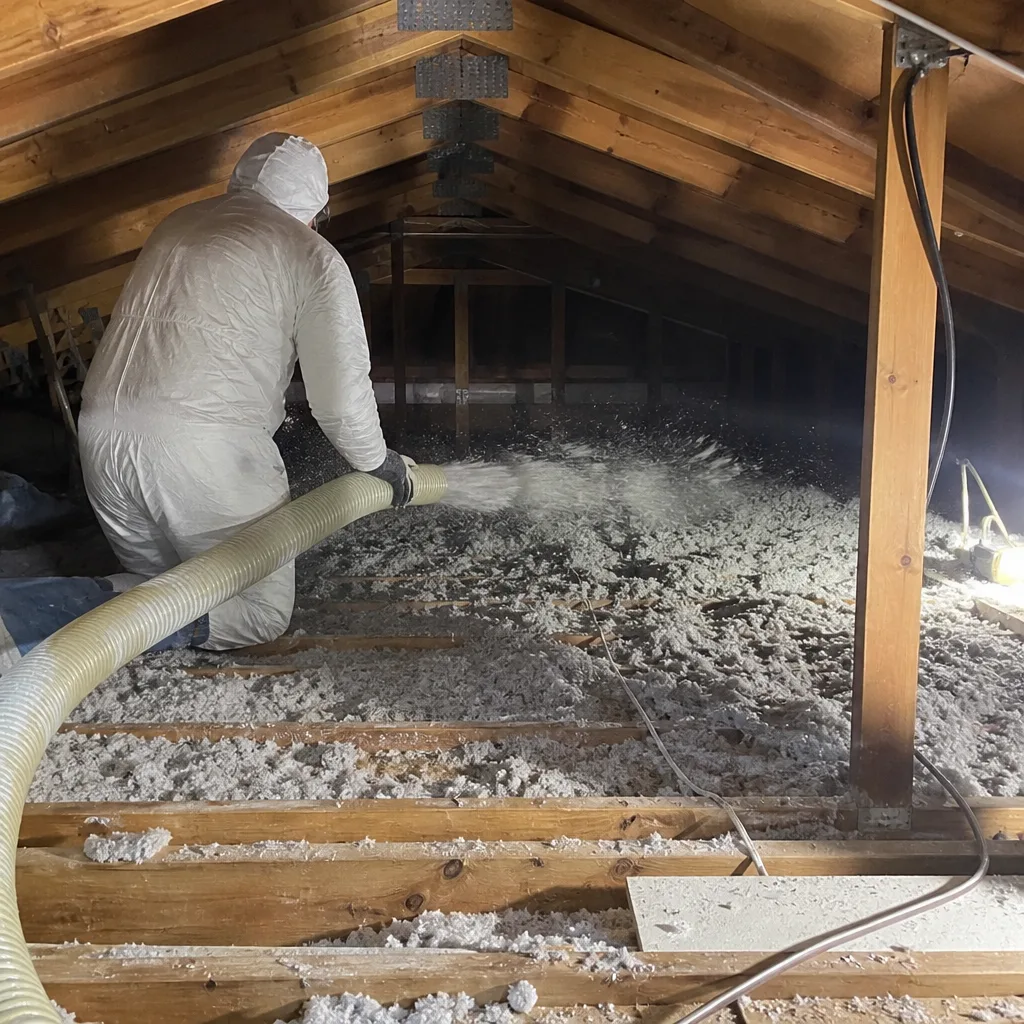
Here’s the mechanism, and it explains why North Las Vegas attic leaks cost you twice in our climate.
In summer, the attic can reach 150°F or higher on a July afternoon. The living space below is at 78°F. That temperature difference drives heat straight down through the ceiling – the standard conduction problem insulation is designed to slow. But the same gaps that let heat through also let hot, dusty attic air leak into the house, because the attic is running at a higher pressure than your conditioned rooms and air always moves from high pressure to low. Your HVAC then has to remove both the conducted heat and the leaked air, which carries latent heat and dust.
In winter, the stack effect reverses the flow. Warm air inside your house rises, finds the same leaks at the ceiling, and pushes out into the cold attic. That escaping air is the expensive part: you already paid to cool or heat it, and now you’re venting it through a can light. A blower-door test – a pressurization reading that shows, in one number, how much air your building envelope is losing – measures that escape directly. We’ve seen North Las Vegas homes read 4,200 CFM50 before sealing and 2,100 after. That halving is the air sealing, not the insulation.
What Attic Air Sealing Actually Looks Like
Air sealing is not spraying foam at random. It’s a checklist of specific bypasses, in a specific order. Here’s what a complete sealing pass covers before any insulation goes down:
- Top plates. The tops of every exterior and interior wall are sealed where the ceiling drywall meets the framing.
- Recessed can lights. Each one is sealed, and any non-IC-rated can is either replaced with an IC-rated one or given a fire-rated cover box.
- Duct penetrations. Every hole where a duct, vent, or furnace flue passes through the ceiling is sealed. Leaky supply ducts in an attic dump cooled air you paid for.
- Plumbing and wiring holes. All penetrations from the house below are sealed with caulk or expanding foam.
- Interior wall top plates and interior partial walls. The gaps above interior walls are often the biggest hidden leaks, and they sit directly over the rooms you’re trying to condition.
- Chimney and flue chases. Sealed with a fire-rated material so the chase itself doesn’t become a leak.
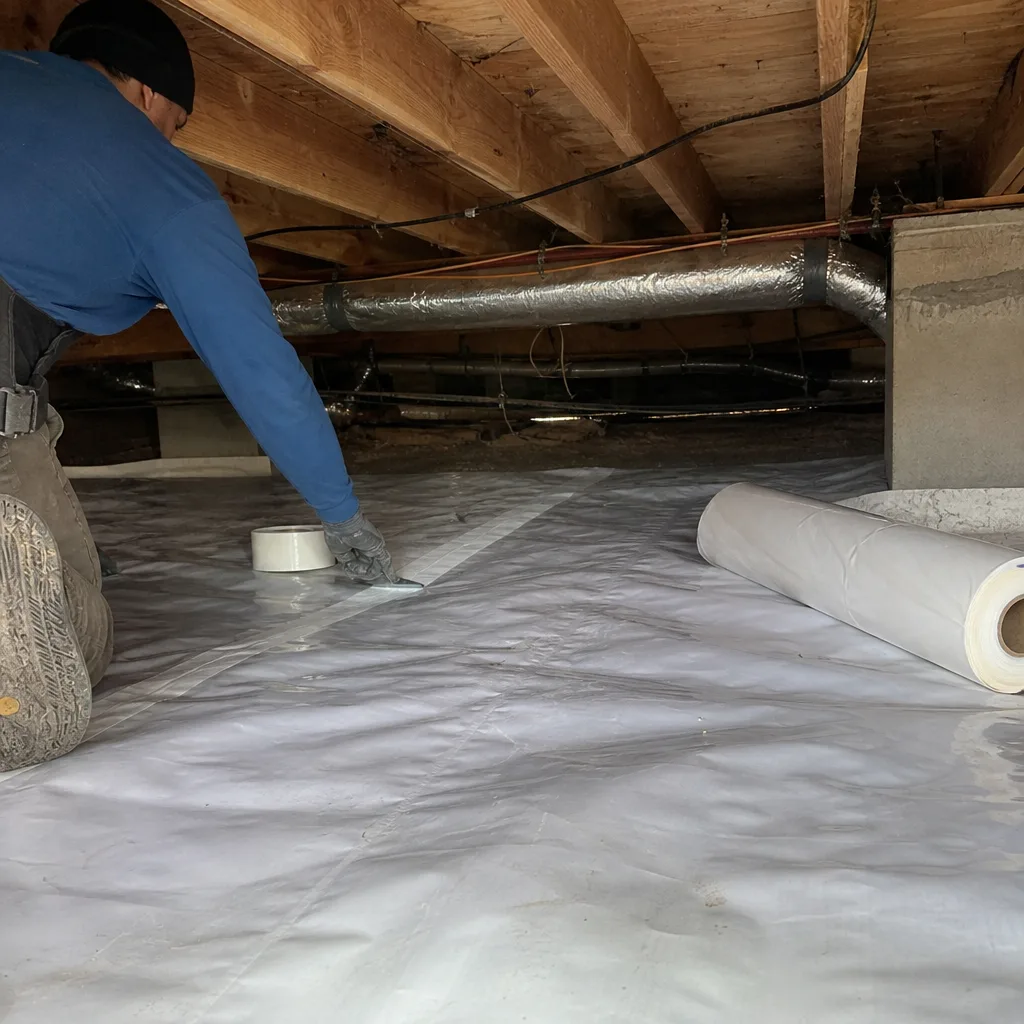
Only after that checklist is signed off does the blower come out. In some cases the envelope work extends beyond the attic floor – walls, sill plates, and the crawl space if your house has one. That’s when it’s worth reading our guide to Crawl Space Encapsulation & Vapor Barrier in North Las Vegas, because the same air-sealing logic applies below the floor as above it.
Cellulose vs. Fiberglass for Climate Zone 3B
North Las Vegas sits in Climate Zone 3B – hot and dry. That means the code minimum for an attic floor is R-38, and it means moisture performance matters less than heat performance except in one specific place: near an evaporative cooler, where a roof-mounted or side-mounted unit can drive moisture into the ceiling assembly. Otherwise, the comparison is mostly settled R-value, fire rating, and cost.
Here’s the comparison most installers won’t put in writing:
- Settled R-value per inch. Blown cellulose holds about R-3.2 to R-3.7 per inch once settled. Blown fiberglass lands lower, roughly R-2.2 to R-2.8 per inch, which is why it needs more depth for the same R-value.
- Moisture sensitivity. Cellulose is treated with fire retardant and can absorb moisture if a leak goes undetected, so it’s less forgiving near an evaporative cooler or an active roof leak. Fiberglass doesn’t hold water but loses R-value when wet.
- Fire rating. Most blown cellulose is treated to Class 1 fire rating, and it’s dense enough to choke off the airflow that feeds a fire better than loose fiberglass. Fiberglass is naturally noncombustible.
- Cost per square foot. Blown fiberglass generally runs a bit less on material per square foot, but because it needs more depth to hit R-38, the installed cost difference narrows. The labor and air-sealing portion is identical either way.
We specify GreenFiber cellulose for most North Las Vegas attic floor jobs and reserve fiberglass for cases where moisture exposure is a genuine concern. Materials come from GreenFiber, CertainTeed, Owens Corning, Johns Manville, and Knauf – not a single proprietary product, so we’re not locked into one price.
How Deep Does Blown-In Insulation Need to Be for R-38?
Depth is where the biggest gap between what’s promised and what’s delivered shows up, because the number on the invoice (R-38) is not the number you can see with a tape measure. Here’s what each material actually needs to hit R-38 on the attic floor:
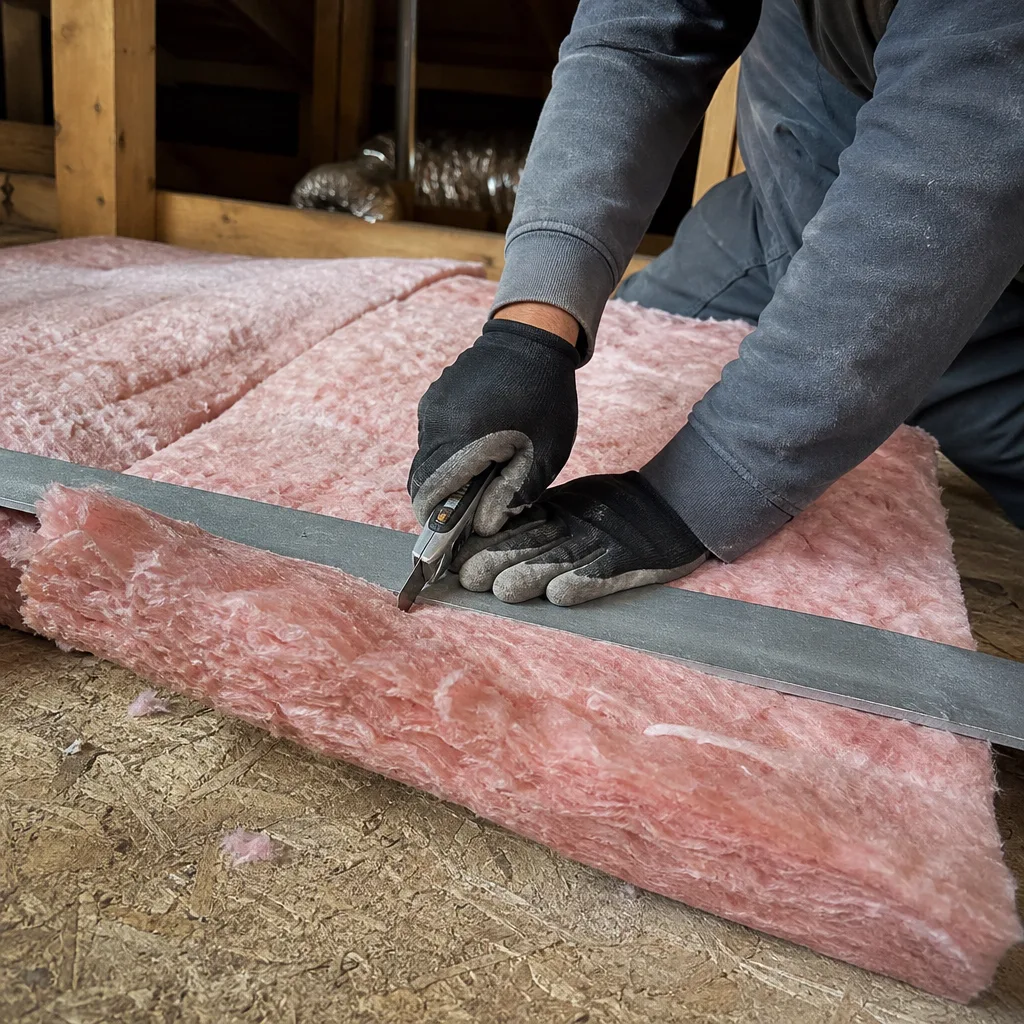
- Fiberglass batts: 10-11 inches.
- Blown-in fiberglass: 12-13 inches measured after settling.
- Blown-in cellulose: 10-11 inches measured after settling.
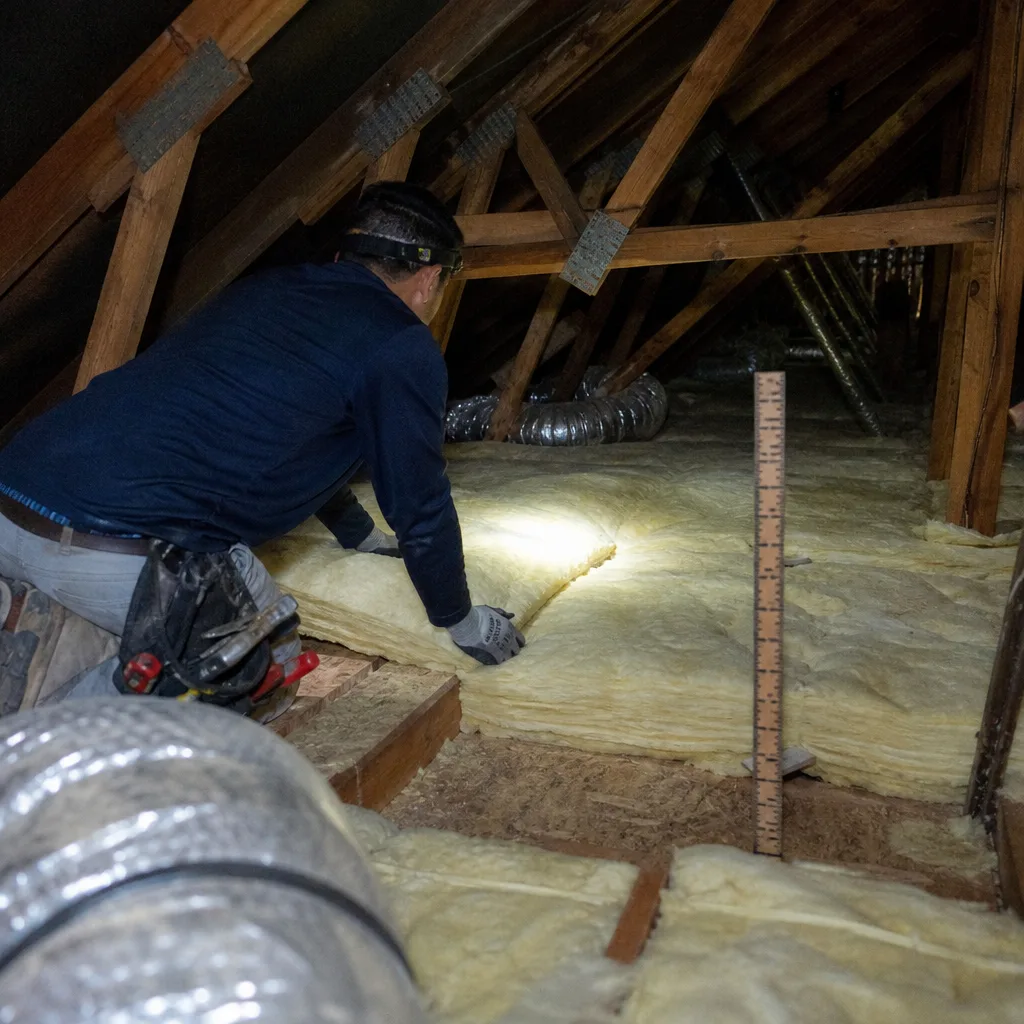
Settling is the key word. Blown fiberglass is puffy when it comes out of the hose and drops several inches in the months after installation, which is why the installed depth target is set higher than the final R-value suggests. Cellulose settles much less. Either way, “we blew R-38” is not verifiable unless someone puts a straightedge and a ruler into the attic afterward and records the reading – which is exactly what depth markers are for.
Depth markers are simple: a marked stake, or printed rulers taped to joists, set at the finished depth target so the installer can see at a glance whether the fill is uniform. In our experience the best measurement is a ruler pressed into the fill at several points in each quadrant of the attic, because loose-fill always drifts thicker in some areas and thinner in others. A job that reads 11 inches near the hatch can read 7 inches over a corner where the installer couldn’t reach. If you want a fair reading on your own, do it well away from the access.
What a Post-Install Measurement Should Include
The paperwork is the job. Here’s what a complete post-install record covers in a North Las Vegas home:
- Depth verification at multiple attic locations. Ruler readings at several points, north to south and east to west, not a single spot near the hatch.
- Blower-door number before sealing. A CFM50 reading, taken before any air sealing begins, that documents the home’s starting leakage.
- Blower-door number after sealing, before insulation. This reading isolates the air-sealing improvement on its own. It’s the number that says “here is what the sealing did for you.”
- A documented photo record. Photos of the sealed bypasses, the depth markers, and the finished attic so you can see what changed without crawling up there.
Why separate the two readings? Because the same homeowner who pays for both sealing and insulation deserves to know which one moved the needle and by how much. A CFM50 drop from 4,200 to 2,100 is the air sealing. The depth reading is the insulation. Combined, they tell you what the R-38 actually buys you in comfort and dollars.
If you’re not sure whether your attic is sealed or just insulated, an energy audit is the way to find out before spending money on fill. Our Envelope Insulation North Las Vegas home page walks through the full envelope service line, including audits.
The Attic Hatch and Pull-Down Stairs: The Gap Everyone Forgets
Here’s the most common gap we find after a blown-in job in North Las Vegas, and it’s one homeowners never see. The attic hatch or pull-down stair is a hole in your thermal envelope – often a 2-by-2-foot opening, then a 2-by-3-foot one, that sits right in the middle of your ceiling and gets zero insulation unless someone deliberately builds a cover for it. We’ve measured North Las Vegas houses where the attic floor read a solid R-38 across the field and the hatch assembly read about R-3.
The fix is a rigid insulated box of the proper R-value over the hatch, with weatherstripping so it seals tight, plus insulation on the stairway panel itself. It’s a small line item and a big gap. If your contractor’s scope doesn’t mention the hatch by name, ask. A written scope should say exactly what happens to the pull-down stairs.
What Blown-In Insulation Costs in North Las Vegas
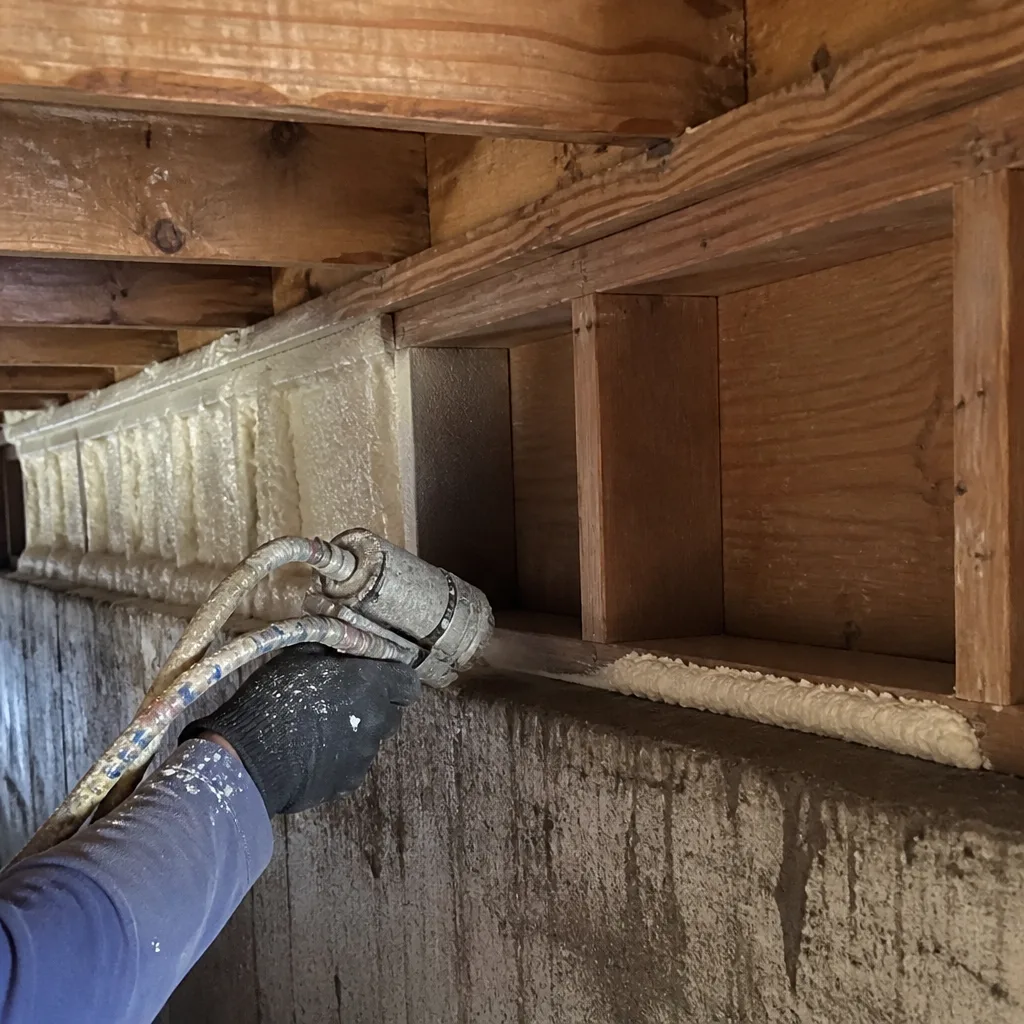
Here’s the price picture in dollars, because a range is more useful than “contact us for pricing.” Actual numbers depend on your attic’s square footage, how much old insulation has to come out, and how many bypasses need sealing. These are typical North Las Vegas ranges:
- Air sealing of attic bypasses (before insulation): $600-$1,400 for a typical 1,500- to 2,200-square-foot home.
- Blown-in cellulose to R-38, installed: $1.50-$2.75 per square foot.
- Blown-in fiberglass to R-38, installed: $1.25-$2.25 per square foot.
- Attic hatch or pull-down stair insulated cover: $150-$350.
- Insulation removal and replacement (if existing fill is wet, contaminated, or rodent-damaged): $1.00-$2.00 per square foot on top of the new install.
- Blower-door test, before and after, with written readings: usually included in the envelope scope; ask for it in writing.
A typical North Las Vegas attic floor – say 1,600 square feet with average bypass count – runs $3,200 to $5,400 for sealing plus cellulose to R-38, plus a hatch cover. That’s a wide range because “typical” isn’t a spec. What matters is that you get a written price before any work starts, and that you can see what the numbers are measuring. If you’ve already got an estimate in hand, we’ll read it with you and compare scopes line by line. Our Attic Insulation in North Las Vegas page has more on how the two layers fit together.
For homes where the attic floor has open bays, kneewalls, or a sloped ceiling detail that can’t be filled cleanly with loose-fill, we sometimes recommend a different product entirely – see Spray Foam Insulation in North Las Vegas for where that fits.
Common Mistakes to Avoid
- Blowing insulation over unsealed can lights. Non-IC-rated cans are a fire and air-leak hazard; they must be sealed and either replaced or covered before fill goes in.
- Skipping the blower-door test. Without a before-and-after number, you have no way to separate the air-sealing result from the R-value result – which means you can’t tell whether the sealing worked.
- Forgetting the attic hatch. The pull-down stairs are often the single biggest uninsulated hole in the envelope, and they’re easy to leave out of scope.
- Trusting the bag over the ruler. “R-38 installed” means nothing without depth verification at several points after settling.
- Using blown fiberglass where moisture is a real risk. Near an evaporative cooler or an active roof leak, cellulose and fiberglass both suffer; the right answer is to fix the moisture source and specify material accordingly.
- Letting a crew work around the air sealing. In North Las Vegas attics that reach 150°F, sealing skipped “to save time” means the insulation never performs to label.
- Accepting an oral price. A written scope, written price, and written warranty before anyone lifts a tool is the baseline; anything less is a future dispute.
When to Call a Professional
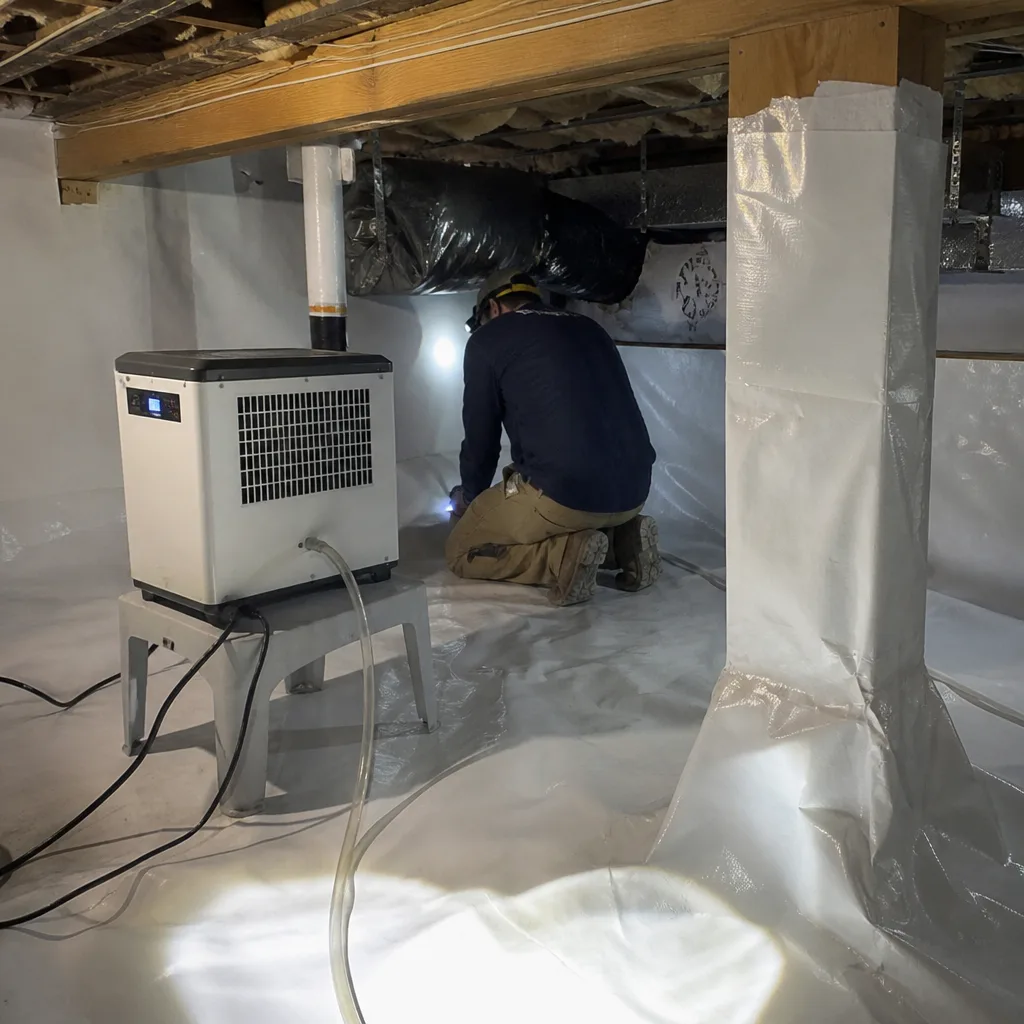
Blown-in insulation is installed on ladders, in a hot attic, around live wiring and recessed fixtures. The sealing step involves spraying expanding foam near combustible framing and sometimes replacing electrical fixtures – both are jobs for someone who knows the code and the safety constraints. Call a professional if:
- You’ve never had a blower-door test, and your summer bills are running high.
- Your attic has recessed can lights, and you don’t know whether they’re IC-rated.
- Your existing insulation is wet, contaminated, or damaged by rodents – removal comes before replacement.
- You’re considering adding fill over an existing installation without sealing first.
Envelope Insulation North Las Vegas offers free estimates in North Las Vegas. Call (833) 630-4008 to schedule one. A live person answers, and you’ll get a written price before any work starts.
Frequently Asked Questions
Blown-in cellulose to R-38 in a North Las Vegas attic typically runs $1.50 to $2.75 per square foot installed, and blown fiberglass $1.25 to $2.25, plus $600 to $1,400 for the air sealing that has to happen first. Call (833) 630-4008 for a written price specific to your attic.
Yes, in most cases – if the existing fill is dry, clean, and still has R-value to add to. It should not be blown over unsealed bypasses or wet insulation. We check the existing material first, and if it’s contaminated or compressed, removal and replacement is the honest answer. Call (833) 630-4008 for a free second opinion on any written estimate.
For attic floors, blown-in usually wins because it fills around obstructions and settles tighter than batts, and it doesn’t leave the gaps batts do around wiring and plumbing. Batts still have a place in wall cavities. In Climate Zone 3B, either material works at R-38 as long as the air sealing is done first.
Blown-in cellulose needs 10 to 11 inches after settling, and blown fiberglass needs 12 to 13 inches measured after settling, to reach R-38. Batts need 10 to 11. Depth varies across the attic, which is why markers and multiple ruler readings matter.
It can, but only if the attic bypasses are sealed first. Insulation resists heat conduction; sealing stops air leakage. A home going from 7 inches to a full R-38 with all bypasses sealed typically sees the biggest comfort change upstairs. A blower-door reading before and after documents what changed.
Most attic floor jobs take one day – sealing, inspection, insulation, and the post-install measurement all included. Larger jobs with removal or extensive bypass replacement can run into a second day. Either way, a written scope before work starts tells you exactly what’s included.
The Bottom Line
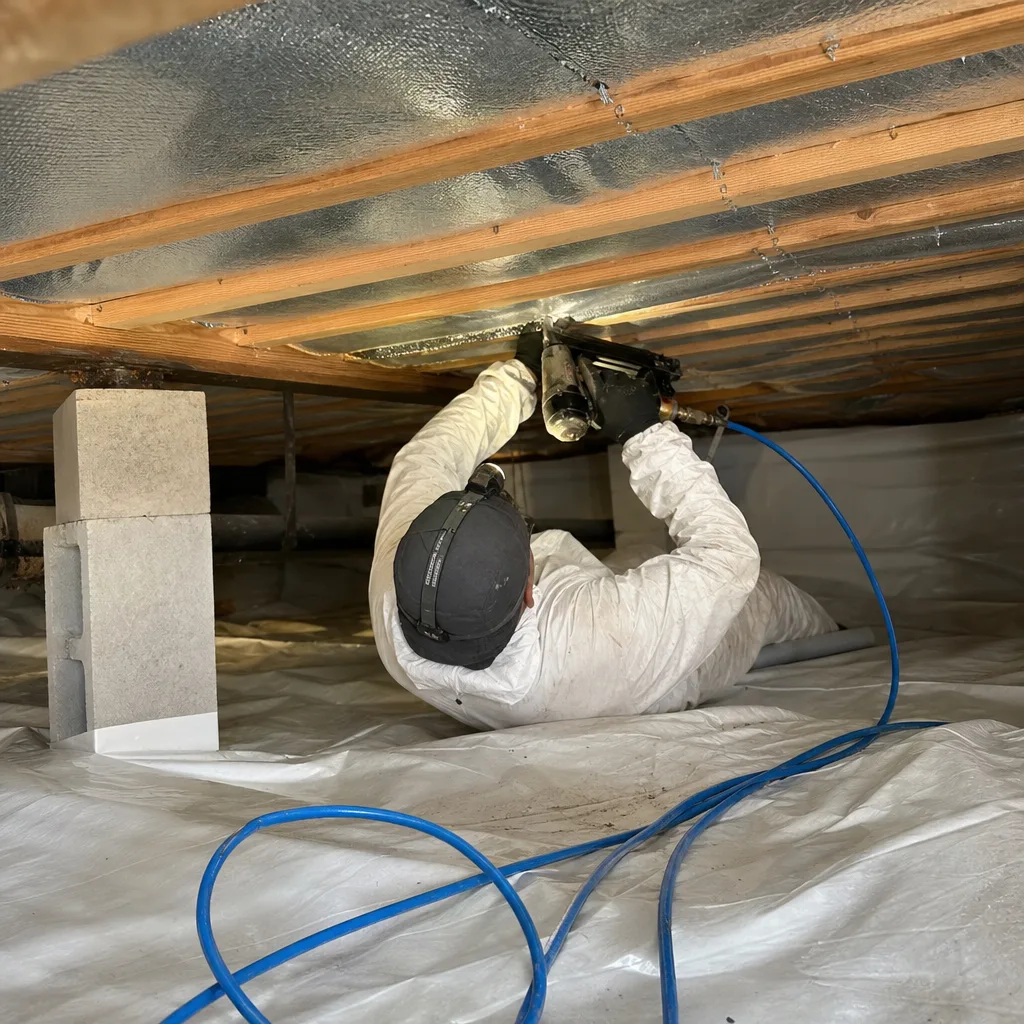
Blown-in insulation in North Las Vegas is a thermal material installed over an attic floor that’s full of holes. Seal the bypasses first – top plates, can lights, duct penetrations, interior wall tops – then blow in the fill. Verify the depth with a ruler at several points, insulate the attic hatch, and make sure you walk away with blower-door numbers before and after so you can see what the sealing did separately from the R-value. The price should be in writing before anyone starts. For a free estimate with a written scope and a documented record, call Envelope Insulation North Las Vegas at (833) 630-4008.
Written by the team at Envelope Insulation North Las Vegas.