
Last updated November 18, 2026
Blown-In Insulation Warning Signs Every Homeowner Should Know
By the time your energy bill is 20% higher than your neighbor’s, the insulation problem has usually been compounding for two to three years. The actual warning sign showed up in the attic first – most homeowners just never looked. Blown-in insulation doesn’t fail with a bang. It settles, compresses, gets pushed aside by air movement, and soaks up moisture quietly, and the diagnosis usually happens years after the damage started. This guide covers the physical, attic-visible signals that precede any comfort or billing symptom, the measurement threshold that turns a suspicion into a decision, and what North Las Vegas heat specifically does to a blown-in attic floor. You’ll finish knowing what to look at, what a normal finding looks like, and when to stop monitoring and call.
Quick Answer
The earliest warning signs of blown-in insulation failure are visible in the attic, not on your utility bill: dark streaking or staining on joists directly above a penetration, compressed or matted fill over recessed lights, and frost or moisture on the underside of the roof deck in winter. Any one of those means air or vapor is moving through the insulation layer faster than the material can handle. If spot-depth readings in three attic locations vary by more than 25% from the original install depth, the problem is significant enough to warrant a professional re-inspection.
Table of Contents
- Why Energy Bills and Drafts Are the Last Warning Signs
- The Three Attic-Visible Signals That Come First
- Wind Washing: What It Looks Like and Why R-Value Won’t Save You
- The 25% Threshold: When to Stop Monitoring and Act
- North Las Vegas-Specific Warning Signs
- What a Warning Sign Is Not
- How to Inspect Your Own Attic Safely
- Common Mistakes to Avoid
Why Energy Bills and Drafts Are the Last Warning Signs
“High energy bills” and “cold drafts” are the two symptoms every insulation guide leads with, and they’re the least useful. Both are lagging indicators. A blown-in attic floor loses performance gradually – a little settlement here, a wind-washed channel there, a compressed patch over a can light – and the house’s heating and cooling equipment absorbs the loss before you notice it. Your HVAC system runs longer each year to compensate. The bill creeps up $15, then $30. You blame the summer, then the rate increase, then the thermostat.
By the time the gap between your usage and a comparable neighbor’s home is 15 – 20%, two to three cooling seasons of degradation have usually passed. In North Las Vegas, that compression curve runs faster than in most of the country. Our summer design temperature sits around 110°F, and an attic floor that was correctly installed in 2018 can read measurably thinner by 2022 if air sealing underneath it was never done or was done incompletely.
The physical evidence, though, is sitting in the attic the entire time. Insulation doesn’t lose R-value in a vacuum. It loses performance because something moved it, wet it, or pushed air through it – and every one of those events leaves a mark you can see with a flashlight and a tape measure. The rest of this guide is about those marks.
If your home was built between 2015 and 2025, you’re in the group most likely to have an attic worth checking. Builder-grade blown-in installs in fast-growing areas north of the 215 frequently passed inspection with minimal or no air sealing at the top plates, and the material was often installed to a nominal depth rather than a verified one. Our Envelope Insulation North Las Vegas home page explains the full sequence we use – seal first, then insulate – and why the order matters more than the product.
The Three Attic-Visible Signals That Come First
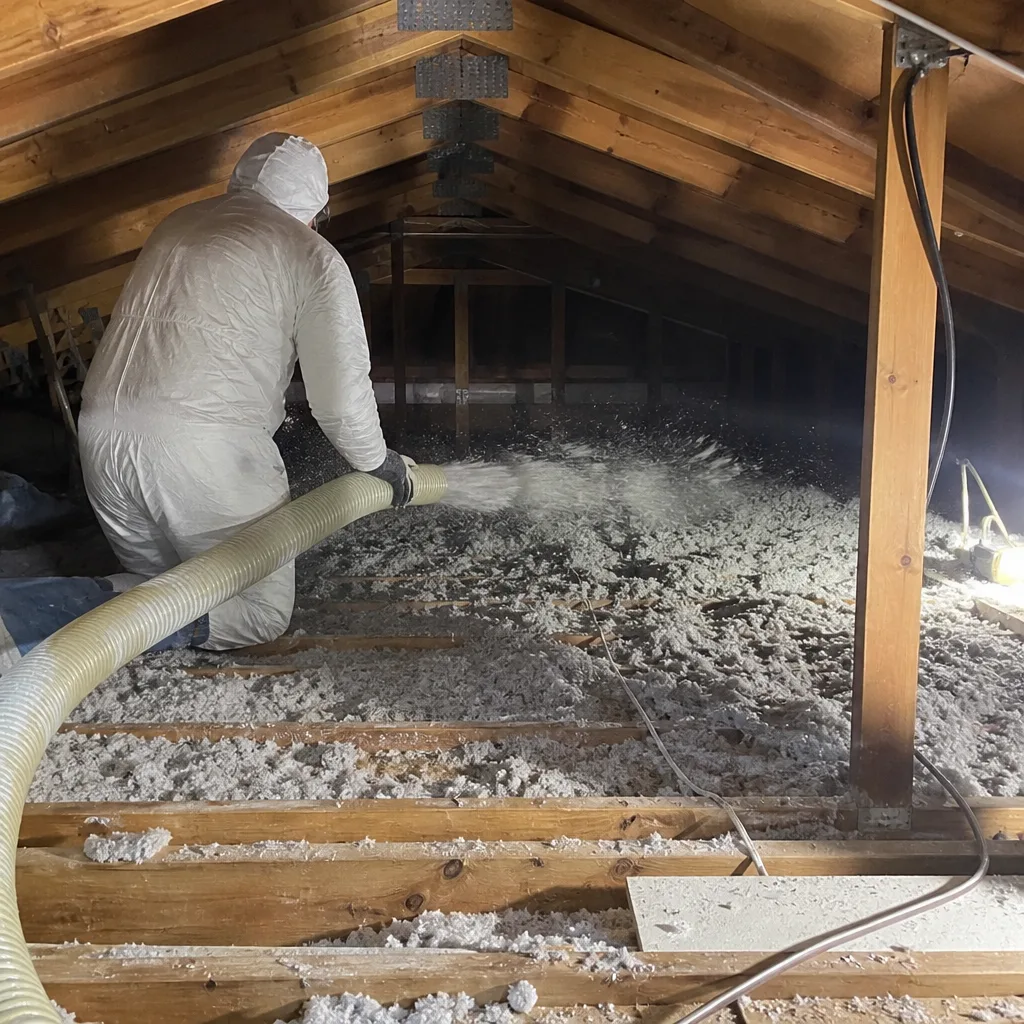
These are the indicators that show up before any comfort or billing symptom, and each one points to a different failure mode. Bring a flashlight, a tape measure, and your phone camera. Take a photo of anything that looks off, with something in frame for scale.
1. Dark streaking or staining on joists directly above a penetration
Look at the wood joists and the top plates of walls. A uniform gray-brown weathering across the whole attic is normal. What’s not normal is a dark, narrow stain on a joist directly above a recessed light, a wiring penetration, a plumbing chase, or a bath fan. That stain is the signature of air washing – warm, moist house air escaping through an unsealed hole and filtering through the wood and the insulation above it. Dust and airborne particles in that air stream deposit on the wood, darkening it over time. In cold weather, that same air stream condenses on the first cold surface it hits. In North Las Vegas, where the attic can swing from 40°F at dawn to 100°F by early afternoon in spring, this cycle repeats dozens of times a season.
2. Compressed or matted fill above recessed lights
Stand near a can light in the ceiling below and look at the insulation directly above it. Healthy blown-in fill – whether Owens Corning fiberglass or GreenFiber cellulose – sits loose and fluffy, and you should be able to push a ruler in with almost no resistance. If the fill is matted, crusted, or noticeably thinner in a ring around the fixture, two things are likely happening. First, heated air from the fixture is driving moisture and heat into the material above it, compacting the fibers. Second, that’s a penetration the builder may have boxed around but didn’t air seal. We’ve opened attics in the Aliante and Eldorado areas where a dozen recessed lights had each carved a compressed crater through 10 inches of fill, and the homeowner had never noticed a single draft.
3. Frost or moisture on the underside of the roof deck in winter
On a cold January morning, look up at the roof sheathing. A light, even haze is fine. Beads of water, dark wet patches, or actual frost on the underside of the deck – especially in the northern third of the roof – is a vapor drive problem. Moisture from the living space is migrating up through unsealed penetrations, hitting the cold deck, and condensing. The insulation below it is on its way to being wet. Wet cellulose loses R-value fast and can grow mold. Wet fiberglass loses performance and compresses under its own weight. Both are on the path to full removal and replacement if the air sealing underneath isn’t corrected.
If you find moisture on the deck, walk the attic floor next and look for sagging or dark patches in the fill. That’s the point at which monitoring stops and remediation begins. You can read more about the full replacement and removal process on our Attic Insulation in North Las Vegas page.
Wind Washing: What It Looks Like and Why R-Value Won’t Save You
Wind washing is the phenomenon most homeowners have never heard of, and it’s the one that quietly defeats an R-value the label says is adequate. Here’s the mechanism. Blown-in insulation works by trapping still air in tiny pockets between fibers. When outside air moves freely through the bottom of the fill – entering at the soffit vents, or at a gable vent, or through a gap at the top plate – and exits somewhere else, it never stops moving. The insulation layer stops being a static blanket of trapped air and becomes a filter that exterior air passes through. Heat goes with it, both directions: out in winter, in during summer. An R-49 rated attic floor that’s being wind-washed can perform closer to R-20 because the R-value assumes still air.
What wind washing looks like from the attic floor:
- A discolored trail through the fill. Dust in the incoming air deposits on the insulation as it filters through. You’ll see a streak or band of darker material running from the soffit edge or the gable vent inward toward the middle of the attic, following the path the air actually takes.
- A compacted channel. The fill along that trail sits lower and denser than the fill on either side of it. Run your tape measure at three points along the trail and three points away from it and the difference is obvious.
- Baffle failure or absence. Roof ventilation baffles – the rigid channels stapled between rafters at the soffit – are supposed to keep insulation from blocking the vent while still letting air move up the roof deck. If they’re missing, crushed, or pushed out of place, the airflow has nowhere to go but through the fill. In North Las Vegas, heat-degraded plastic baffles are common in attics more than a few summers old.
- A cold or hot spot you can feel on the ceiling. On a 110°F day, run the back of your hand along the drywall near the exterior wall in each room. A noticeably warmer strip along the perimeter is the interior signature of a wind-washed edge.
The fix isn’t more insulation on top. Blowing another 6 inches of material over a wind-washed channel buries the symptom, not the cause. The fix is air sealing the top plate and the vent edges, installing proper baffles, and then re-blowing the fill to a verified depth. That’s the sequence we hold to, and it’s the core of the service line described on our Spray Foam Insulation in North Las Vegas page when spray foam is the right tool for the rim and penetration sealing.
The 25% Threshold: When to Stop Monitoring and Act
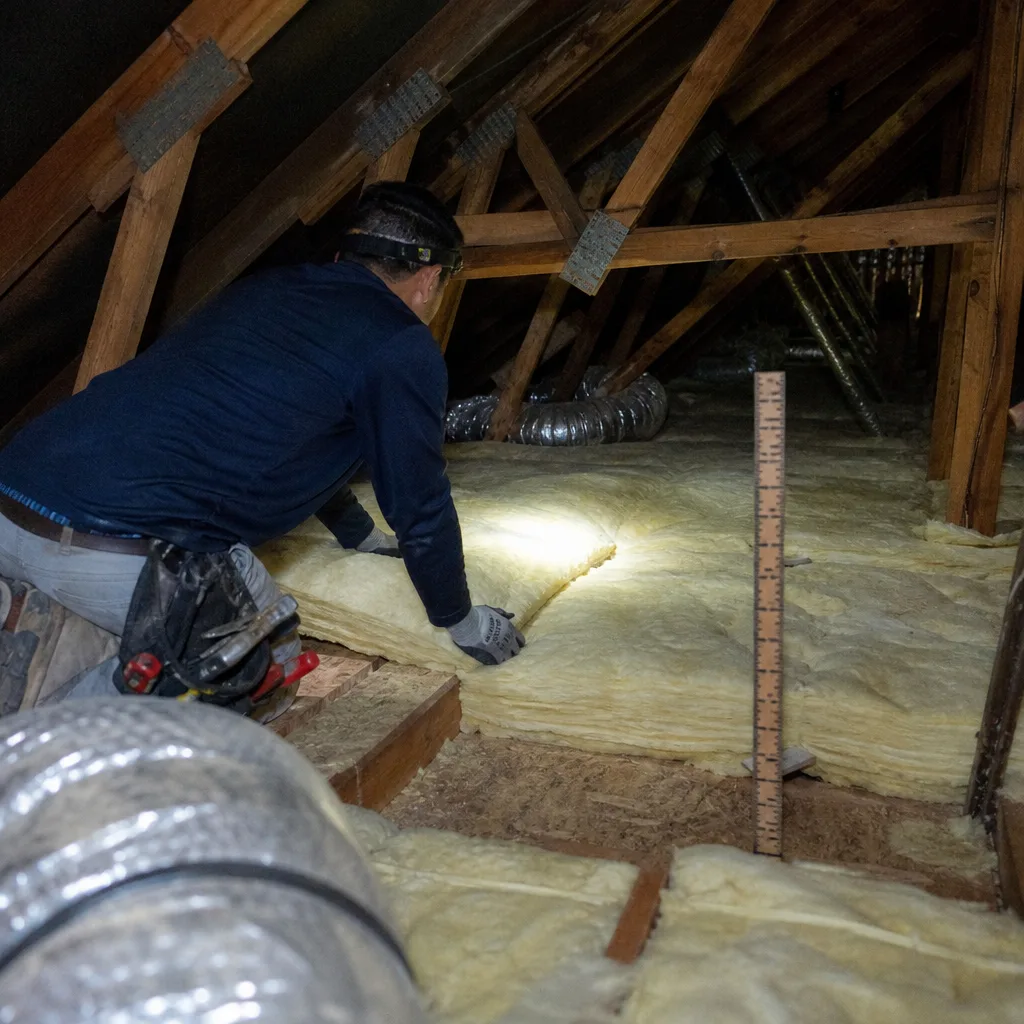
Settlement is normal. Blown-in insulation loses a small amount of depth in the first couple of seasons as the fibers settle and entrain air. What you’re trying to measure is not “has it settled at all” but “has it settled enough to matter.” The rule we use is simple and you can apply it yourself with a tape measure and a phone.
- Find three attic locations spread as far apart as the attic allows – say a spot near the center access hatch, a spot over a front bedroom, and a spot over the back of the house. Avoid anywhere under a skylight or within 2 feet of a can light.
- Push the tape measure straight down into the fill until it contacts the drywall or the joist cap below. Read the depth. Do this three times within 6 inches and take the average. Write it down.
- Compare the three averages against each other and against the install depth. The install depth is usually written on a label stapled to a truss, painted on the sheathing, or noted in your home inspection report or builder’s documentation.
If the three locations vary by more than 25% from each other or from the original depth, the settlement or displacement is significant enough to warrant a professional re-inspection. Here’s a worked example. If your home was built with 13 inches of fill, a 25% threshold is 3.25 inches of variation. A reading of 12 inches at location one, 11.5 at location two, and 8.5 at location three is not a settlement you can shrug off – that third location has lost over a third of its depth, and something localized is causing it. It’s almost always wind washing, displaced fill, or a hidden penetration.
At or below the threshold, note the readings, note the date, and re-check next fall. Above the threshold, stop monitoring. The next step is a blower-door test – a pressurization reading that shows, in one number, how much air your building envelope is losing – so you know whether the problem is missing insulation or an air-sealing failure underneath it. Those are different problems with different fixes and different costs, and guessing between them is how money gets wasted.
North Las Vegas-Specific Warning Signs
An attic in North Las Vegas runs a harder life than an attic in most of the country. The radiant heat load is nearly constant from May through September, the deck temperature can exceed 150°F on a still afternoon, and the material is cycling through expansion and contraction every day. That changes what a warning sign looks like.
The first thing to understand is the difference between thermal bridging and true insulation failure, because they look similar from a thermal camera and require totally different responses. Thermal bridging is heat moving through a continuous structural member – a metal truss, a steel beam, a furring strip – that conducts heat dramatically better than the surrounding material and bypasses the insulation entirely. In the attic, it shows up as a narrow, sharply defined warm line on the underside of the drywall that perfectly traces a metal truss or framing member, no matter how much insulation is above it. True insulation failure is a broader, diffuse warm area where the fill is thin, displaced, or wind-washed. Thermal bridging isn’t fixed by adding insulation. Insulation failure is.
What North Las Vegas specifically does to blown-in fill:
- Heat-degraded vapor barriers. Older poly vapor retarders under the fill turn brittle and crack after a decade of 150°F summer deck temperatures. Once they crack, they no longer stop vapor, and the fill above them gets wet.
- Cracked or dislodged HVAC ducts. Flexible duct runs through a 140°F attic lose their seal at the connections faster than in a temperate climate. Insulation that appears intact can be sitting under a duct leaking 45°F air, and the fill around it takes on condensation and compresses.
- Radiant-heat curling at the ceiling plane. Drywall seams in the hottest part of the ceiling can telegraph through the paint as fine lines each summer. That’s not an insulation failure on its own, but it’s a marker that the ceiling plane is absorbing more heat than it should.
- Rat and roof-rat activity through the fill. Rodent runs through blown-in material leave wide, obvious troughs and pulverized insulation dust. That’s a biological problem before it’s an insulation problem, and remediation means removal. We cover the sequence in our Crawl Space Encapsulation & Vapor Barrier in North Las Vegas guide because the crawl space feeding the attic is where rodents often get in first.
What a Warning Sign Is Not
Half the calls we get about “discolored insulation” turn out to be normal material aging, not a failure. Distinguishing the two saves a lot of unnecessary work.
Uniform discoloration on the top surface of cellulose is normal oxidation. Cellulose is treated paper fiber, and like any paper it darkens over time when exposed to air and light. The color change is cosmetic. The insulation underneath performs the same. The test is uniformity: if the entire top surface of the fill has aged to the same tone, that’s oxidation. If the discoloration is localized above one specific penetration, or follows a band from a soffit vent, or forms a ring around a can light, that’s evidence of air movement. Localized plus directional is the signature you act on. Uniform is the signature you note and move on.
Other things that are not warning signs on their own:
- A small amount of dust on top of the fill. Normal.
- A slight settling of the fill in the first two years. Expected. Measure against the threshold before you conclude anything.
- Fiberglass with visible color variation within a single batts. Manufactured variance, not failure.
- A musty smell in the attic in July. Could be a leak from above the deck, could be a vapor issue below the deck. It’s worth a look but it’s not conclusive.
We see a version of this in older North Las Vegas homes where a 1980s or 1990s remodel blew new insulation over the original material without removing it. The original layer has already done its settling. The new layer will settle on its own timeline. The two layers are at different densities, and the interface between them can read as a “compressed channel” when in fact nothing is wrong. A tape measure alone won’t tell you which is which, but a photo of the full profile will. Our documented photo record on every visit exists for exactly this reason: so you can point to what was found and when, rather than relying on a verbal description six months later.
How to Inspect Your Own Attic Safely
You can do a useful walkthrough of the attic floor yourself in about 15 minutes, and you don’t need any special tools. What follows is inspection only. Any corrective work – air sealing, re-blowing, removing compromised material – belongs to a trained professional.
- Turn off the attic light circuit, then turn on a battery-powered headlamp. Attic wiring is often exposed and unsecured. Don’t rely on a code-compliant fixture being the only hazard up there.
- Walk on the joists or the floored walkway only. The drywall ceiling will not support your weight. If your attic has no floored path, lay an 18-inch board across the joists and move it as you go.
- Take a photo of the full attic floor before touching anything. This is your baseline. Take a photo of every joist bay in a sweep from one end to the other.
- Use a tape measure and a notebook (or your phone), not memory. Depth readings that aren’t written down get rounded up in the retelling.
- Take a photo of any label, marking, or paint line on the trusses. That’s often the only record of the original install depth.
- Look, don’t touch. Don’t push on recessed light trim, don’t move insulation off a penetration to see what’s under it, and don’t reach into fill near gas appliances or the furnace flue area. Get a photo and stop.
- If you see moisture, frost, rodent activity, or damaged wiring, close the hatch and call a professional. Those are out of scope for a homeowner walkthrough.
Our technicians have up to 10 years of experience reading exactly these signals, and the walkthrough they do is the same diagnosis applied more precisely. If what you find concerns you, the free second opinion on a written estimate is a real offer, not a sales pitch.
Common Mistakes to Avoid
- Adding insulation before air sealing. If there are unsealed penetrations, blowing more fill over them traps the same warm, moist air that was filtering through before. The number on the label goes up, the performance doesn’t, and the moisture problem gets worse because it’s now trapped. Seal first, then insulate. That’s the order, always.
- Judging by R-value alone. An attic floor rated R-49 that’s wind-washed can perform closer to R-20. The installation number isn’t the performance number, and the blower-door result is the only way to know which one you actually have.
- Re-blowing over a wind-washed channel. We’ve been called to North Las Vegas attics where a previous contractor blew 4 inches of new material directly over a wind-washed soffit channel. Three summers later the fill was washed and compacted again, and the homeowner had paid twice for the same non-fix.
- Trusting a visual “looks fine” pass. Blown-in insulation can look intact at the surface and be failing 2 inches down. The reading that matters is the depth, measured in multiple locations, not the appearance of the top.
- Assuming the attic doesn’t need checking because the house is new. Construction between 2015 and 2025 in North Las Vegas was fast, and builder-grade installs often hit the code minimum without a verified air-sealing pass. A 2019 build can easily have a 2024 problem.
- Cleaning up rodent contamination with a shop vacuum. Roof rat droppings carry hantavirus and other pathogens. Rodent-compromised fill has to come out, the space has to be sanitized, and the entry points have to be closed before any new insulation goes in. This is a professional call.
- Fixing the symptom instead of the measurement. “It feels better” after a re-blow isn’t a result. A documented before-and-after blower-door reading is. Ask for the numbers on paper before you sign anything.
When to Call a Professional
Call a professional if you find any of the following: moisture, frost, or dark wet spots on the underside of the roof deck; matted or compressed fill above any recessed light or penetration; a wind-washed channel from a soffit or gable vent; spot-depth readings that vary by more than 25% from each other or from the original install depth; rodent runs, droppings, or pulverized insulation dust; or a uniform loss of fill depth that brings the effective value under current code minimums for this climate zone. Also call if you’ve measured depth, gotten readings you don’t understand, and want to know whether the problem is missing insulation or missing air sealing. Those two answers carry very different price tags, and a blower-door test is the only way to separate them. Envelope Insulation North Las Vegas offers free estimates in North Las Vegas – call (833) 630-4008 to schedule one.
Frequently Asked Questions
Look for three things in the attic: dark staining on joists above a penetration, matted fill above recessed lights, and moisture or frost on the roof deck in winter. Any of those indicates an active problem regardless of what the utility bill says. If you only have time to do one check, take depth readings in three locations and compare them against the install depth – a spread above 25% is the threshold we treat as significant.
No. R-value is measured under still-air conditions, so a well-installed R-49 floor that’s being wind-washed can perform closer to R-20. Air sealing the top plates and penetrations before the fill goes in is what makes the R-value real. That’s why the before-and-after blower-door reading matters more than the number on the material label, and it’s why we won’t blow new insulation over an unsealed attic floor.
Yes. Uniform discoloration across the top surface of cellulose caused by oxidation is normal and cosmetic. What’s not normal is discoloration that’s localized to a specific penetration or that forms a directional band from a soffit or gable vent. The uniform/localized distinction is the single most useful diagnostic in an attic inspection, and the 150°F summer deck temperatures in North Las Vegas accelerate the aging appearance without necessarily indicating failure.
Wind washing is air moving continuously through the bottom of the insulation layer, which turns the material from a still-air blanket into a filter. Heat leaves with the moving air in either direction, no matter what the R-value says. You spot it as a darker, more compacted trail through the fill running from a soffit or gable vent inward, and often as missing or crushed baffles at the vent. It’s common in North Las Vegas attics where heat-aged plastic baffles have failed.
Not if there’s moisture, rodent contamination, or an active air-sealing failure underneath. Adding insulation over a wet layer traps the moisture. Adding it over a wind-washed channel just buries the symptom. Removal and replacement are warranted when the fill is wet, contaminated, or physically displaced from its original location. When the fill is dry and in place but the air sealing was never done, the right fix is to air seal and then top up the fill to a verified depth.
A diagnostic attic inspection typically runs in the low hundreds of dollars, and a full air-seal-plus-re-blow on a typical 1,500 – 2,000 square foot attic floor in North Las Vegas usually lands in a range that depends on the depth required, the extent of air sealing, and whether removal of existing material is needed. We won’t quote a figure without seeing the attic, because the difference between “seal and top up” and “remove and replace” is significant. Every job starts with a written price before any work begins, and you can get a free second opinion on any written estimate you already have. Call (833) 630-4008 to schedule.
The Bottom Line
Blown-in insulation doesn’t fail overnight, and the failures that matter start in the attic years before they reach your utility bill. The three signals worth checking every fall are staining on joists above penetrations, matted fill above recessed lights, and moisture on the roof deck. Wind washing is the quiet defeat of R-value and it has a signature: a dark, compacted trail from the vents. Use the 25% depth threshold to decide between monitoring and acting, and don’t confuse uniform oxidation with localized evidence of air movement. In North Las Vegas’s climate, that timeline compresses. The measurement that tells you whether you have a problem is a blower-door reading, and the fix that lasts is air sealing before insulation, every time. If any of these signs are showing up in your attic, we can walk the space with you and give you a written price and a documented photo record before any work starts.
Envelope Insulation Co. operates under The Haven Standard: a Written Price Before Any Work Starts, a Documented Photo Record on every visit, and the 365-Day Done Right Promise on all completed work. Our technicians have up to 10 years of experience, and calls are answered by a live person 24/7. If you’re in the North Las Vegas area and you’ve found one of these warning signs in your attic, call (833) 630-4008 for a free estimate.
Written by the team at Envelope Insulation North Las Vegas.