
Last updated November 18, 2026
How Long Does Crawl Space Encapsulation & Vapor Barrier Take? Timelines and What to Expect
A 1,200 sq ft crawl space with standing moisture and a failed rim joist takes three to four times longer than the same footprint with dry soil and intact framing. Yet most online timelines quote a flat “1-2 days” for both jobs. That gap is why homeowners in North Las Vegas get surprised by change orders and rushed liners. This guide breaks encapsulation into its actual phases, gives honest hour ranges for each, and shows you what a realistic schedule is built from. The answer depends on what your inspection finds, not on what fits a one-day sales pitch.
Quick Answer
Most straightforward crawl space encapsulation jobs run 2 to 4 days for 1,000 to 1,500 sq ft, with liner installation itself taking 6 to 10 hours. Add 24 to 72 hours for soil drying before any liner goes down, plus one to three extra days if you have standing water, mold remediation hold periods, or pest-damaged framing. A realistic range for a typical North Las Vegas home is 2 to 7 days from first inspection to final seam inspection.
Table of Contents
- The Six Phases of an Encapsulation Job, With Hour Ranges
- Why Drying Time Is Non-Negotiable
- The Conditions That Add Days
- What a Written Pre-Job Inspection Should Document
- What “Done” Actually Looks Like
- Crawl Space Size vs. Crawl Space Condition
- North Las Vegas Timelines: Climate and Soil
- When to Call a Professional
The Six Phases of an Encapsulation Job, With Hour Ranges
Encapsulation is not a single task. It’s a sequence, and each phase has its own clock. Here’s how the work actually breaks down on a 1,200 sq ft crawl space.
- Inspection and moisture mapping (1-2 hours). We measure soil moisture, check joist and rim board condition, and locate every penetration. This is the hour most contractors skip, and it’s the one that decides the rest of the schedule.
- Debris removal and old insulation (2-4 hours). Failed batts, fallen vapor barrier, and construction debris come out before anything goes in.
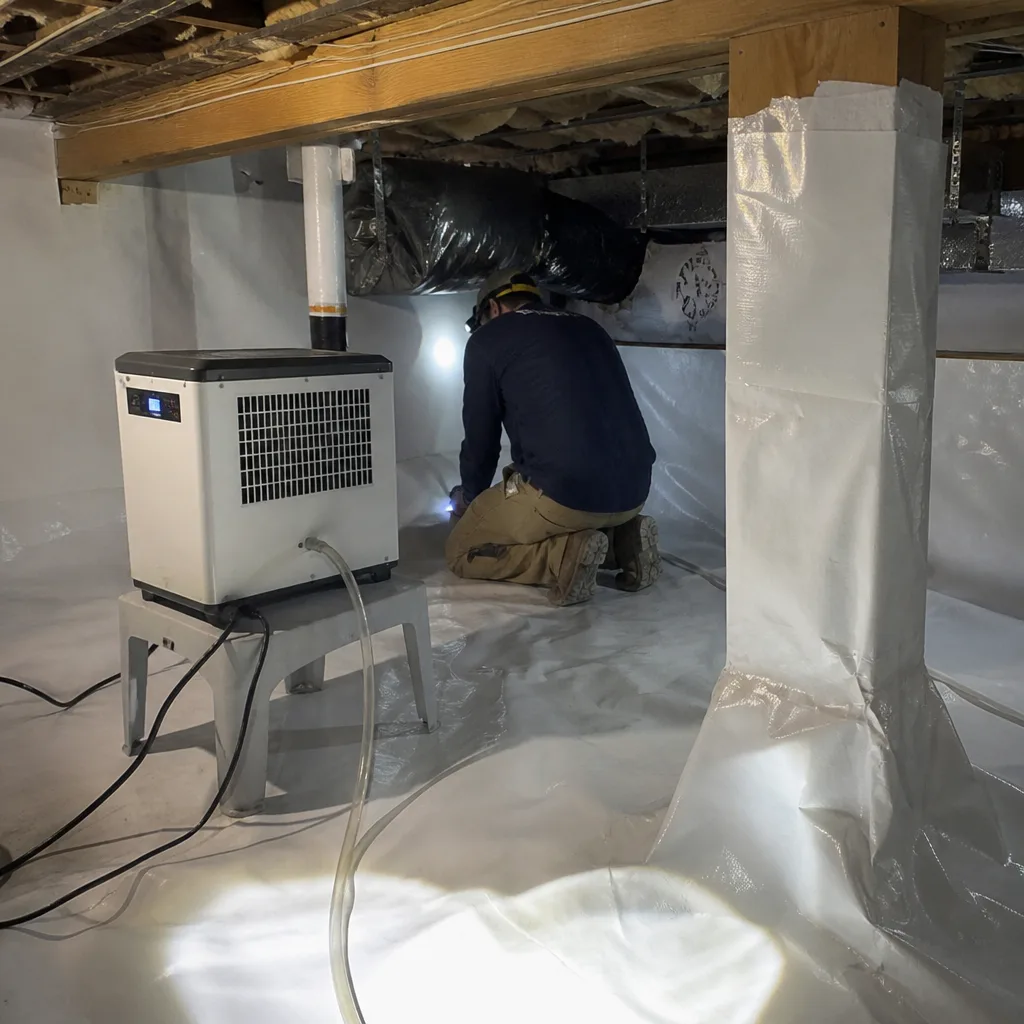
- Moisture remediation and drying (24-72 hours). Standing water is pumped out, soil is dried, and any mold treatment gets its hold period. This is the phase that changes “1 day” into “4 days.”
- Wood treatment and framing repair (2-6 hours). Borate treatment on exposed wood, sistering or replacing joists that pests or rot have compromised.
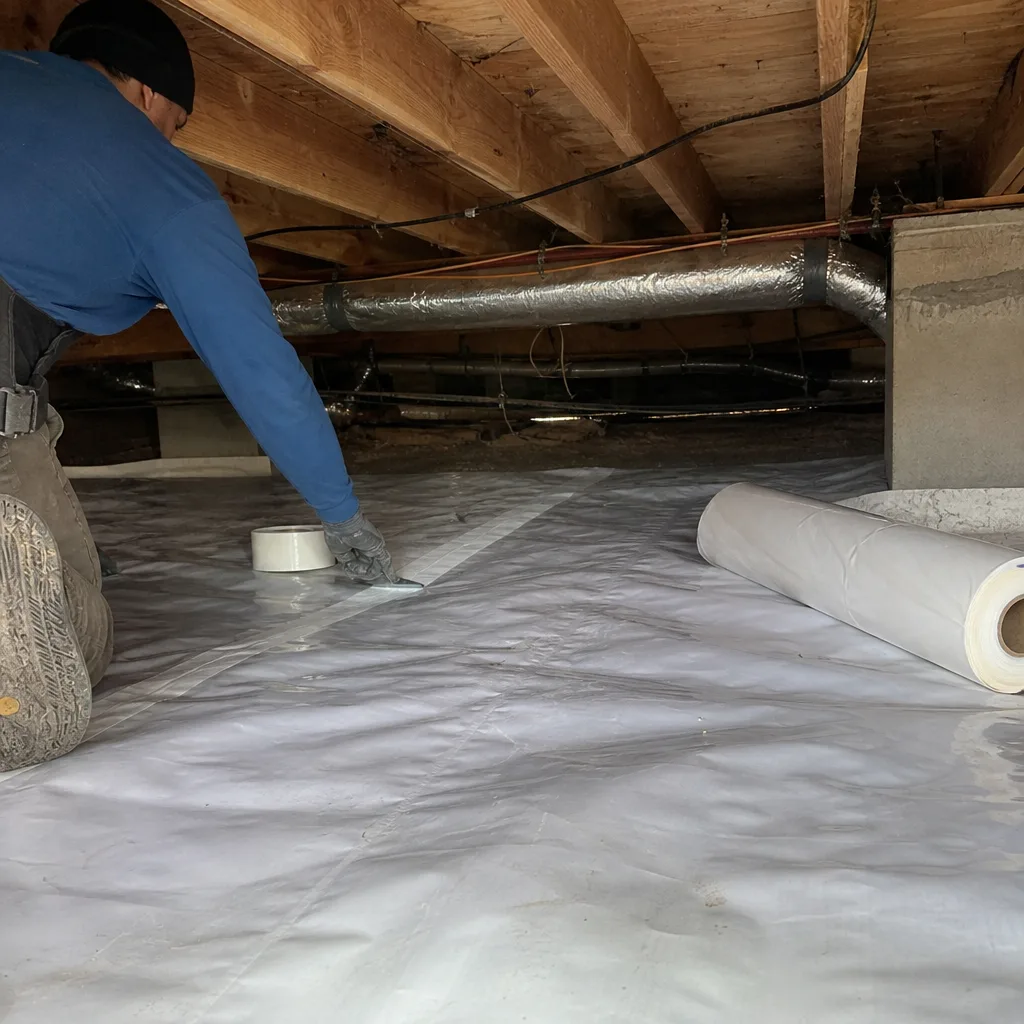
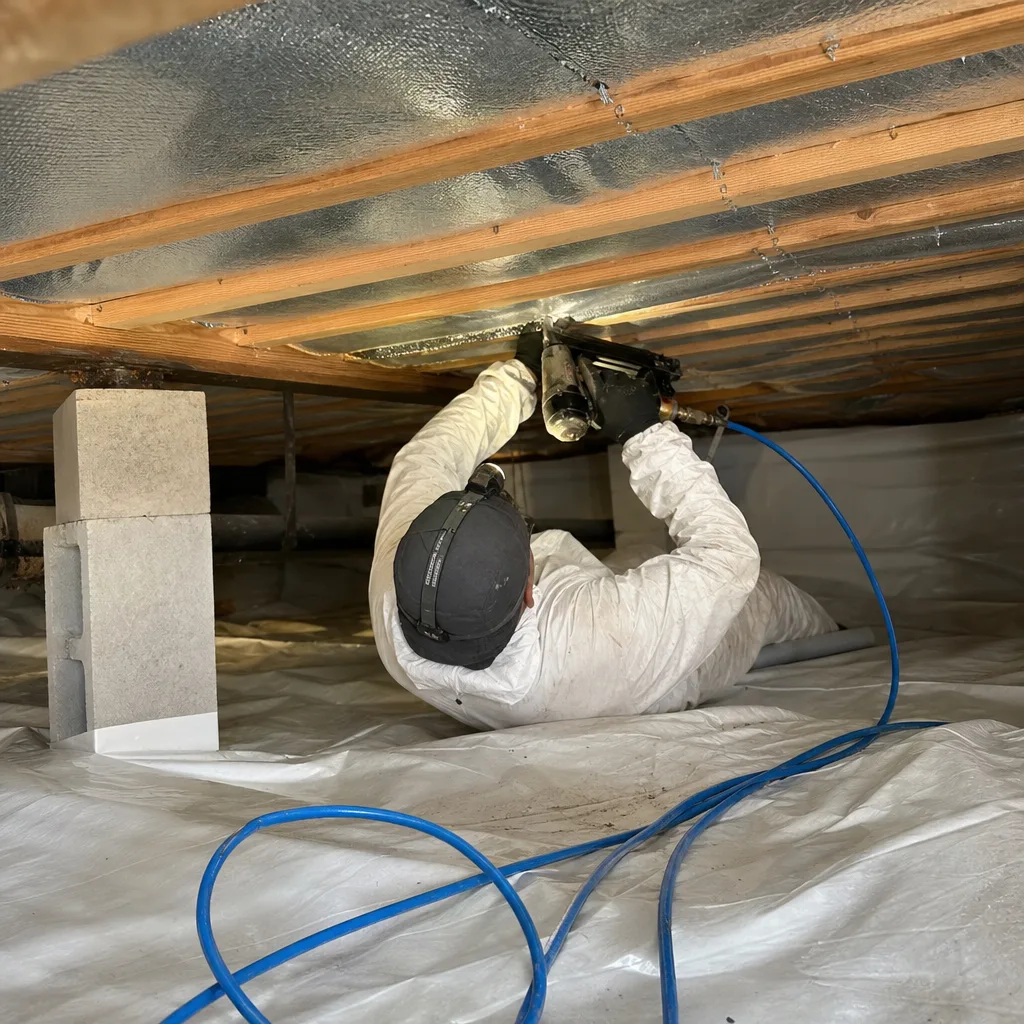
- Liner installation (6-10 hours). Liner goes up the walls, across the floor, and is cut around piers, pipes, and foundation vents.
- Seam taping, vent sealing, and inspection (2-4 hours). Every seam gets taped, every penetration gets sealed, and we walk the job with a moisture meter before we call it done.
Add those up and you get 12 to 24 working hours on a clean job, spread across two to three days to allow for curing and drying. On a job with moisture issues, the same footprint can stretch to a full week. For a deeper look at the specific service we run in North Las Vegas, see our page on Crawl Space Encapsulation & Vapor Barrier in North Las Vegas.
Why Drying Time Is Non-Negotiable
This is the single biggest source of timeline disagreement between contractors. A liner laid over damp soil traps moisture underneath it. That moisture has nowhere to go but up, into your joists and subfloor. We’ve seen it: a perfectly sealed crawl space with a liner laid over soil at 22% moisture content will show warped hardwood floors and cupped subfloor within two cooling seasons.
The fix is time. Damp soil typically needs 24 to 72 hours of active drying with a dehumidifier and air circulation before a vapor barrier goes down. Soil moisture content needs to read below the manufacturer’s threshold (usually around 15-16% on a pin meter) before the liner is cut and laid. If you skip that step, here’s what happens:
- Trapped moisture wicks into framing. Wood rot starts at sustained moisture content above 20%, and the liner gives it nowhere to escape.
- Mold growth accelerates. Mold needs three things: moisture, organic material, and stillness. A sealed, damp crawl space delivers all three.
- The liner itself fails. Pinhole punctures from trapped vapor pressure and delamination of the tape bond are common over wet soil.
- You pay twice. Removing a failed liner, drying the space, and starting over typically costs more than the original job did.
In our experience, the drying phase is where honest timelines earn their keep. If a contractor quotes you “one day, liner and all,” ask them what soil moisture reading they’re expecting before the liner goes down. If they can’t answer, that’s your signal.
The Conditions That Add Days
Here’s the honest list of what we find in North Las Vegas crawl spaces that pushes a two-day job to a week. Each of these adds specific time.
- Standing water or active seepage (adds 2-4 days). Pumping, drying, and identifying the source takes time. The source itself might need a drainage fix before encapsulation can hold, and that’s a separate scope.
- Failed insulation removal (adds 4-8 hours). Old batts that have absorbed moisture and collapsed weigh more, tear more, and take longer to pull down than dry material.
- Mold remediation hold periods (adds 1-3 days). Treatment has to sit, and clearance reading has to be confirmed before the space is sealed. This is a health-safety hold, and no legitimate contractor compresses it.
- Pest-damaged joists requiring repair (adds 1-2 days). A joist with a rodent-gnawed top plate or termite galleries has to be sistered or replaced before the liner goes up. Structural repair is its own scope.
- Failed rim joist (adds 1-3 days). Rim joists see the most moisture in a crawl space because they’re the coldest surface. Repair means removing the rotted section, treating the wood, and reframing before encapsulation.
- Narrow access or tight working space (adds 2-6 hours). A 16-inch access hatch means every roll of liner gets handed through by two people instead of three.
North Las Vegas soil has its own quirk: caliche layers under some neighborhoods (particularly in the older sections near downtown) hold moisture against the foundation longer than surrounding sandy soil does. That extends the drying phase, sometimes by a full day. This is exactly the kind of thing an inspection catches before a liner is purchased.
What a Written Pre-Job Inspection Should Document
Before a single roll of liner is bought, you should have a written report that functions as a scope baseline. If you later get a change order for “unexpected conditions,” that report is what proves whether the conditions were actually unexpected. Here’s what it should include:
- Square footage of the crawl space footprint, measured, not estimated. Liner is priced per square foot, and the measured figure is the one that governs.
- Soil moisture readings in at least four locations, with the meter type named. A number and a meter brand (“23% at the southeast corner, pin meter”) beats “some moisture present.”
- Photos of every joist, rim board section, and pier. You should be able to see what the inspector saw.
- Penetration count. How many pipes, piers, and vents will need sealing. This directly drives the seam-taping labor hours.
- Existing insulation condition and removal scope. “Failed and to be removed” is a line item. If it isn’t written, it isn’t quoted.
- Any pest activity evidence and the framing repair scope if needed. Written as a separate scope so the encapsulation price stays honest.
- A written price, a written scope, and a written warranty. Under Haven Standard Clause 1, our customers get all three before anyone lifts a tool. A verbal estimate is not a scope baseline.
A proper inspection takes one to two hours and usually costs nothing. Under our own practice, every visit includes a Documented Photo Record you keep.
What “Done” Actually Looks Like
“The liner is on the ground” is not a finished job. Encapsulation is a vapor barrier, which means it only performs when every square inch of it is continuous. Here’s the checklist we use to verify a job is complete.
- Seam overlap at 6 to 12 inches. Some liner manufacturers specify 12 inches minimum. Anything less gets flagged, because a 4-inch overlap can fail tape bond under humid conditions.
- Tape bond inspected, not just applied. We press each length of tape with a roller and check that the bond line is continuous. Tape lifting at the ends is a failure point.
- Penetrations sealed at every pipe, duct, and pier. The sealant and mastic at each penetration should be visible and covered under the same warranty as the liner.
- Foundation vents sealed. Vent sealing is part of the encapsulation scope. The space is conditioned now, not ventilated.
- Access hatch sealed and insulated. The crawl space door has to seal as well as the liner does.
- Final moisture reading documented. The last reading should be below the manufacturer’s threshold, and it should be written down so you have it.
The verification step is 2 to 4 hours of the total. It’s also the phase that separates a job that lasts fifteen years from one that fails in three, which is why we don’t compress it. Under the 365-Day Done Right Promise, if we find a lifting seam or a missed penetration in that window, we come back and fix it.
Crawl Space Size vs. Crawl Space Condition
Homeowners ask about square footage because it’s the number they know. But in our experience, size is the smaller variable. A 1,500 sq ft crawl space with dry soil and intact framing takes about 2.5 days. A 900 sq ft crawl space with standing moisture and a failed rim joist takes 4 to 6 days. Condition beats size every time.
Here’s a rough size-to-hours map, assuming a clean job:
- Up to 800 sq ft: Liner installation 4-6 hours; total 1.5-2 days.
- 800-1,200 sq ft: Liner installation 6-8 hours; total 2-3 days.
- 1,200-1,800 sq ft: Liner installation 8-12 hours; total 3-4 days.
- 1,800 sq ft and up: Liner installation 12-16 hours; total 4-5 days.
Those are per-crew hours. If condition findings push into structural repair, mold remediation, or extended drying, the whole schedule floats upward. The honest takeaway: ask for a condition-based estimate, not a size-based one. A written price before any work starts is the baseline, and the scope on that paper should list which condition findings actually drove the final number.
North Las Vegas Timelines: Climate and Soil
North Las Vegas crawl spaces live in a specific humidity cycle that affects timing. Our summer monsoon season (July through September) drives ambient humidity high enough that crawl-space moisture readings spike 10 to 20 points in a single week. That means a job that would dry in 24 hours in March might need 60 hours in August. Schedule a North Las Vegas encapsulation in the cooler months and you can compress the drying phase; schedule it in monsoon season and you should plan for the long end of the range.
Winter is different. Our mild winters mean crawl spaces rarely freeze, but our nights drop below 40°F regularly, and borate wood treatments have their own temperature application range (usually above 40°F on the surface). A treatment applied at 38°F won’t penetrate properly, so an honest contractor will tell you to wait for warmer weather or extend the treatment phase a day to allow for warming. This is why “same weekend” pricing is often a red flag in North Las Vegas in January.
We also see a lot of 1990s and 2000s construction in North Las Vegas with original batts still in the rim joist cavity. Those batts are almost always compromised by now, and their removal is part of the job. If your neighborhood experienced any of the flash flooding that our region gets (particularly areas with older storm drainage), check the perimeter for signs of water entry before any encapsulation is scheduled. Our broader Envelope Insulation North Las Vegas home improvement service line includes home energy audits that will surface that exact question in about two hours.
Common Mistakes to Avoid
- Quoting from a photo instead of an inspection. A photo can’t give you a soil moisture reading. Any written price based solely on photos is a placeholder, not a quote.
- Laying liner before drying is complete. This is the mistake that costs the most time and money in the long run. A soil reading of 20% or above means drying continues, full stop.
- Accepting a flat “1-2 day” timeline without asking about condition findings. If it doesn’t vary with what’s down there, the contractor isn’t inspecting – they’re selling.
- Skipping the written warranty. A warranty in writing, not verbal, is what protects you if a seam starts lifting. Which is also why we publish the 365-Day Done Right Promise in writing on every job.
- Ignoring rim joist repairs before encapsulation. Enclosing a rotted rim joist traps the rot. It’s a structural item that has to be fixed first, not “dealt with later.”
- Sealing the foundation vents without conditioning the space. Encapsulation is a closed system. If the crawl space isn’t connected to your home’s HVAC, the vents don’t get sealed in the same way. Get this confirmed in the scope.
- Not asking what the final moisture reading is. Ask for the number at the last verification. If they can’t produce it, the verification never happened.
If you’re also scheduling other insulation work at the same time, our page on Attic Insulation in North Las Vegas covers how attic and crawl space work can share a crew and a schedule.
When to Call a Professional
Encapsulation is not a DIY project, and the reasons are practical more than philosophical. Crawl spaces are confined, often have standing water at the start, and involve sealing around gas lines and electrical penetrations. Get one of those wrong and you’ve created an unsafe or non-compliant condition. If your inspection reveals:
- Standing water or active moisture seepage
- Visible mold or a persistent musty smell
- Rotted or pest-damaged framing
- Existing liner that has failed or is lifting
- Low ceiling clearance (under 36 inches) that limits access
…you should have the space professionally inspected before you buy any liner material. If you’re also looking at spray foam on the rim joists or kneewalls at the same time, see Spray Foam Insulation in North Las Vegas for how the two scopes interact.
Envelope Insulation North Las Vegas offers free estimates in North Las Vegas – call (833) 630-4008. Every estimate includes a written price, a written scope, and a written warranty before any work begins, and our free second opinion on any written estimate applies if you already have a competing quote in hand.
Frequently Asked Questions
Two to four days for most 1,000-1,500 sq ft crawl spaces in North Las Vegas, including drying time. A job with standing moisture, failing insulation, or a damaged rim joist can stretch to five to seven days. The liner installation itself is usually completed in a single 6 to 10 hour day. Call (833) 630-4008 for a written estimate specific to your space.
Only on a very small crawl space (under 600 sq ft) with dry soil and intact framing, and even then, the drying phase must already be complete or verified beforehand. A same-day encapsulation on a moist crawl space is a red flag, not a bargain. Ask any contractor what soil moisture reading they measured before the liner went down.
Damp soil typically needs 24 to 72 hours of active drying to drop below the 15-16% moisture threshold where vapor barriers perform correctly. Skip that wait and the trapped moisture wicks into your joists and subfloor, causing rot and mold. This isn’t an upcharge, it’s a requirement, and a contractor who skips it is not doing the job. Call for a written scope that names the drying phase explicitly.
No. Condition beats size. A 900 sq ft space with standing moisture and a failed rim joist can take 4 to 6 days, while a 1,500 sq ft space with dry soil and intact framing takes about 2.5 days. In our experience, condition findings add more schedule time than footprint ever does.
Mold requires a remediation hold period (usually 1 to 3 days) with a clearance reading before encapsulation can proceed. The remediation itself is a separate scope from the encapsulation, and a legitimate contractor will put it on the estimate as a line item, not bundle it into a single opaque price. Call (833) 630-4008 for a written estimate that separates the two.
A properly installed 12-mil liner with correct seam overlaps, tape bond inspection, and sealed penetrations typically lasts 15 to 25 years. The liner itself isn’t the variable – installation quality is. Our 365-Day Done Right Promise covers lifting seams and missed penetrations for a full year after completion, with a written warranty delivered before anyone starts.
The Bottom Line
The real timeline for crawl space encapsulation in North Las Vegas runs 2 to 7 days, and the variable that moves it isn’t square footage – it’s what the inspection finds. Standing water, failing insulation, mold hold periods, and rim joist repairs each add real days to the schedule. Drying time of 24 to 72 hours is a hard prerequisite before any liner goes down. A written pre-job inspection report, a written scope, and a written warranty are what turn that schedule from guesswork into a baseline you can hold a contractor to. If you want that in writing before any material is purchased, Envelope Insulation North Las Vegas does exactly that on every job. Call (833) 630-4008 for a free estimate, and we’ll bring the photo record and the moisture readings with us. Your written price, written scope, and written warranty are ready before the first roll of liner gets cut.
Written by the team at Envelope Insulation North Las Vegas.