
Signs Your Attic Needs More Insulation in North Las Vegas, NV
The fastest answer: if you can see the tops of your ceiling joists above the insulation through the attic hatch, or a second-floor room stays hot until 9 or 10pm, your attic insulation has settled below its rated R-value and needs an upgrade. In North Las Vegas, those two clues show up together in the 2001-2008 tract home, and they mean the original R-19 batts have compressed over 15 to 20 summers in a 150°F attic. Call (833) 630-4008 if you want a documented assessment of exactly where yours stands.
Most “signs your attic needs more insulation” articles list high energy bills, hot rooms, and a constantly running AC. Those are real, but they describe the endpoint of insulation failure, not its early indicators. In North Las Vegas, the useful signs are more specific and show up years before the second-story bonus room hits 90°F by 4pm.
What makes North Las Vegas tract homes fail insulation faster than most
North Las Vegas is one of the fastest-growing big cities in the country, and its housing splits sharply. The 1990s and 2000s master-planned subdivisions in Aliante, Eldorado, and the northern belt are stucco-on-frame tract homes with a known era of insulation: original R-13 to R-19 batts, blown flat or fallen off slope planes, and unsealed penetrations under a summer sun that pushes attic temperatures past 150°F on south- and west-facing planes. The older single-story ranch and block homes near downtown and the Nellis corridor are a different problem entirely; many were built with no attic insulation or R-11, and their failures look structural rather than thermal.
Our technicians spend most of their summer in both ends of that stock. When the design assumption for a 2005 build no longer matches the climate load it now faces, the insulation is where the gap shows. If you’re weighing a full upgrade, the work we do on the building envelope starts at the same place: measuring what’s actually there.
Four early signs a North Las Vegas attic is losing its R-value
These are the indicators generic articles skip, and they map to the specific build era and climate of North Las Vegas.
1. A second-floor room that cools down only after 9 or 10pm
This is the signature of North Las Vegas tract homes. Vaulted-ceiling designs common in Eldorado and Aliante install batts against a sloped ceiling plane, and over time those batts sag away from the slope, leaving an air gap that lets the 150°F attic transfer heat straight into the room. The HVAC runs all day, but the room doesn’t recover until after sundown and the attic starts to cool. That timing is the tell. An equipment problem doesn’t wait for the sun to go down; a thermal envelope problem does.
2. You can see joists above the insulation at the hatch
The simplest check doesn’t require entering the attic. Shine a strong flashlight through the hatch opening and look for a uniform, level surface. Well-performing attic insulation reads as an even blanket, and you can’t see the tops of ceiling joists or truss bottom chords. If the joists stand above the insulation surface, the R-value has settled below the minimum threshold, and the air sealing in those exposed joist bays is now compromised, not just the R-value. R-19 batts that started flush can lose a meaningful share of depth as they compress under dust and settle, and every exposed bay becomes a gap the conditioned air escapes through.
3. NV Energy summer bills that climb year over year without a rate change
Insulation fails gradually. Compare your July bills across three summers; if the square footage and family haven’t changed and the rate hasn’t moved, a year-over-year increase points to progressive insulation degradation rather than a single failure event. Nevada’s dry climate means little moisture-driven breakdown, but blown grit and dust settle into the insulation and monotone sun degrades anything exposed, so slow decline is the expected pattern in North Las Vegas.
4. Can lights that feel warm to the touch
Touch a recessed can light on your ceiling on a hot afternoon. If the trim is noticeably warm, unboxed fixture penetrations are pulling conditioned air into the attic continuously. In a sealed attic retrofit this is one of the first items we look at, because a can light without an air-sealed box is a permanent hole in the ceiling plane.
The sign that’s not about the attic but is caused by it, and the older-home version
An HVAC system that short-cycles, meaning it turns on and off every 8 to 12 minutes instead of running 15 to 20 minute cycles, is signaling that heat load exceeds the system’s design capacity. In a North Las Vegas summer that is almost always an attic insulation and air-sealing deficit before it is an equipment-sizing problem. Replacing the AC without fixing the envelope is the most common wasted dollar we see.
For the older block homes near downtown and the Nellis corridor, the signs are structural. There may be no visible attic insulation from the hatch, bare joists with original kraft-faced batts that have dropped out of their bays, or insulation that crumbles when touched after decades of thermal cycling. Those homes often need a full attic retrofit, not a top-off.
What a documented visit turns a sign-check into
A visual check tells you something is wrong. A written scope, with a photo record of insulation depth, settled areas, can light gaps, and top-plate openings, tells a contractor exactly what to fix. That written documentation is the precondition for a written price that addresses the right problem instead of a generic top-off.
At Envelope Insulation North Las Vegas, the visit ends with a Documented Photo Record on every job, and on applicable work a before-and-after blower-door test that reports the change in a single figure, such as a home that reads 4,200 CFM50 before sealing and 2,100 after. This is why we treat air sealing as a hard prerequisite. Under insulation installation in North Las Vegas, we won’t blow insulation over an unsealed attic floor; top plates, can lights, and penetrations get sealed first, always.
Typical North Las Vegas attic work, by line item
- Attic air sealing (top plates, can lights, penetrations): usually the first cost, and the whole point of the visit.
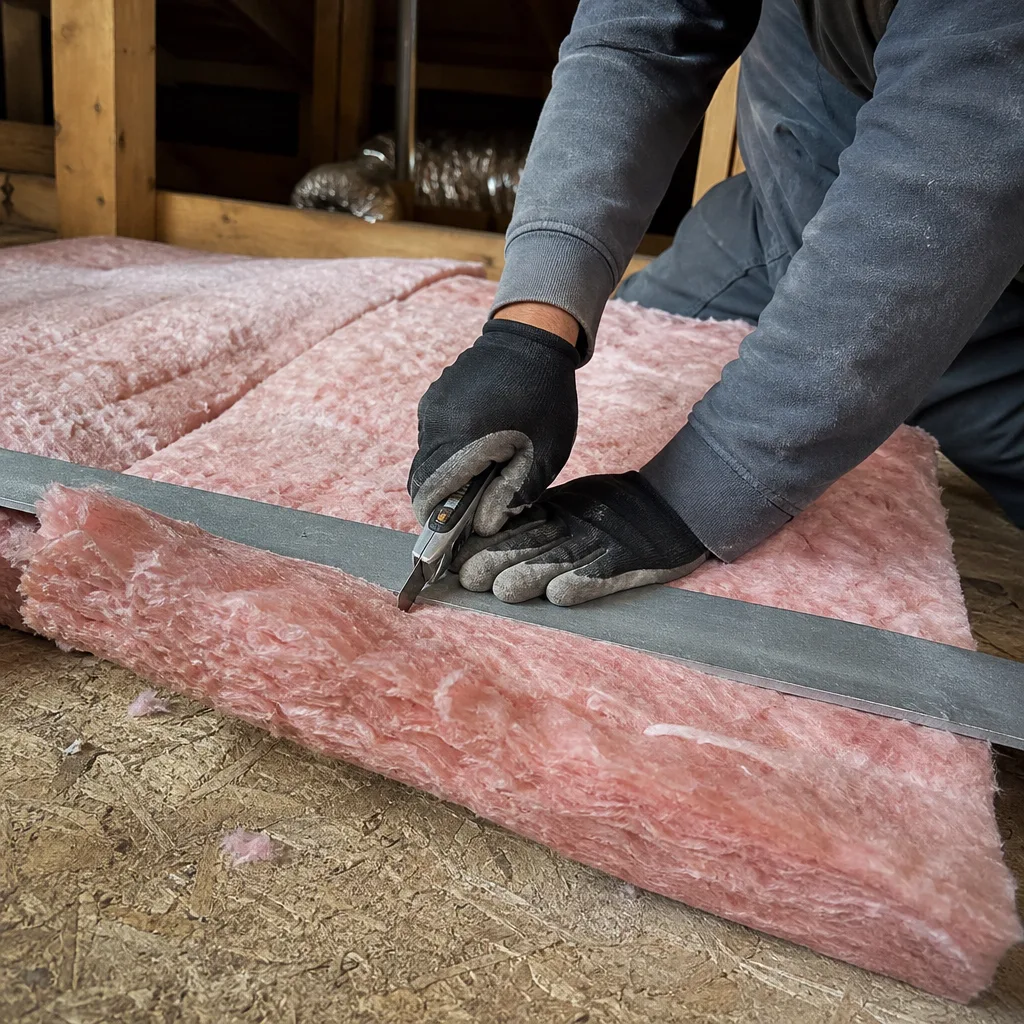
- Batt removal and replacement for crumbled or settled original batts in older homes.
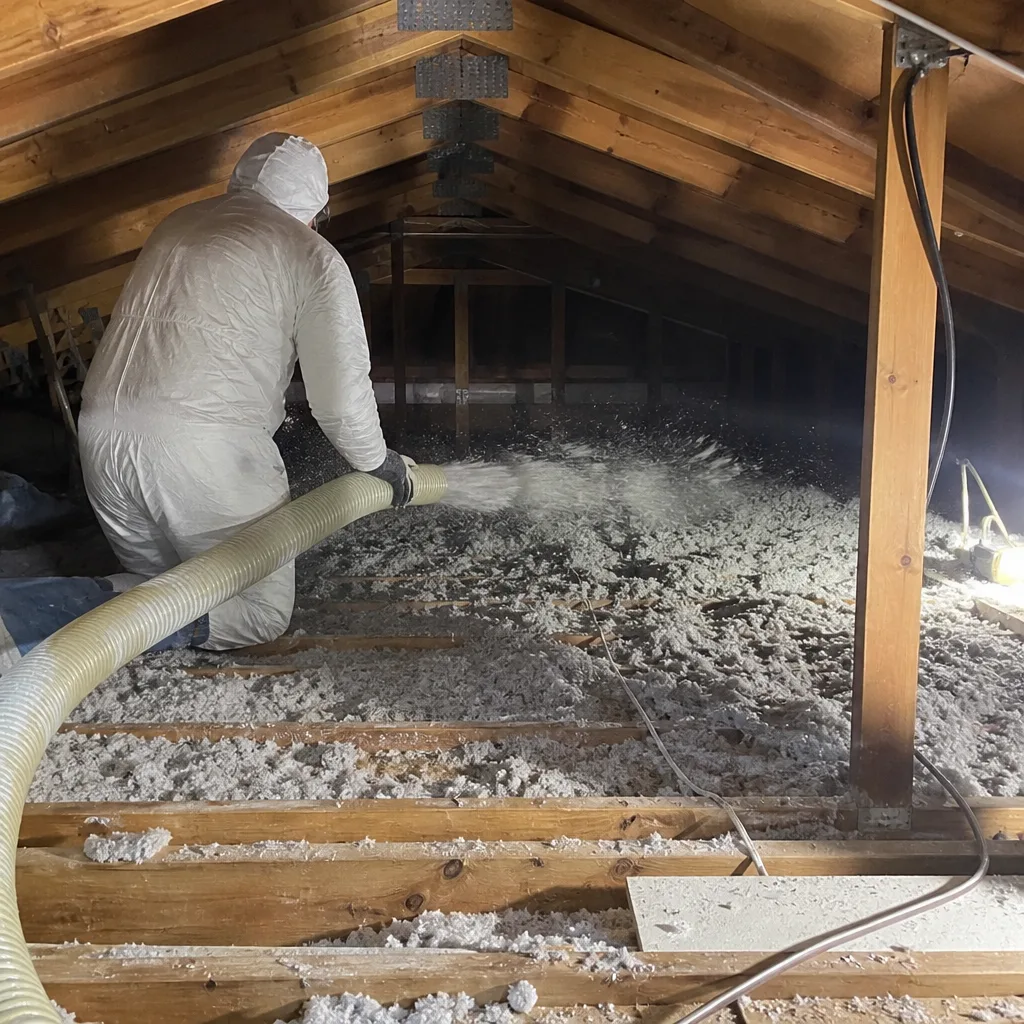
- Blown-in upgrade to reach current recommended attic R-value, using materials from Owens Corning, Knauf, and GreenFiber.
Every job gets a Written Price Before Any Work Starts, a written scope, and a written warranty before anyone lifts a tool. The 365-Day Done Right Promise applies to all completed work. If you’ve already collected a competing estimate, a Free Second Opinion will read it with you line by line.
FAQs
Shine a flashlight through the attic hatch and look for an even, level surface with no joists visible above it. If you can see the tops of ceiling joists, the insulation has settled and air sealing is compromised, so a professional assessment is the next step.
Vaulted-ceiling attics in houses like those in Eldorado and Aliante let batts sag off the slope, and heat keeps transferring into the room until the sun sets and the attic cools. That evening-only pattern is a thermal envelope sign, not an AC failure. A blower-door reading confirms how much air the envelope is actually losing.
It often can, mostly when the upgrade includes air sealing alongside the insulation, because a top-off alone leaves the leaks in place. We report the before-and-after blower-door numbers so you can see the change you paid for. Call (833) 630-4008 to discuss a written price.
The tell is timing: a room that cools after 9 or 10pm points to a settled-insulation and air-sealing deficit, while a system that can’t keep up at peak load points to equipment. In our experience across North Las Vegas, the envelope is the culprit more often than the equipment.
If you’d rather have it looked at, Envelope Insulation North Las Vegas offers a no-pressure assessment in North Las Vegas, with a written price before any work starts. Call (833) 630-4008 for a free estimate, and a live person will answer.
Written by the team at Envelope Insulation North Las Vegas, serving North Las Vegas, NV.