
Owens Corning Attic Insulation in North Las Vegas: A Homeowner’s Guide
An R-38 label on the bag means the installed fiber hits R-38. It does not mean your attic assembly performs at R-38. Stack effect – warm air rising and escaping through unsealed top plates, recessed lights, and partition walls – can erase 30 to 40% of that rated value before your first summer cooling bill in North Las Vegas arrives. Owens Corning’s own installation literature lists air sealing first. Most installers skip it. This guide covers what the spec sheet promises, what the blower-door number confirms, and how to tell the difference on your North Las Vegas home.
If you’d rather not climb into a 140°F attic to check, call (833) 630-4008 – we’ll tell you what we find.
What’s the difference between labeled R-value and actual attic performance?
Labeled R-value measures the thermal resistance of the insulation product in a lab. Whole-assembly R-value measures how your entire attic floor – fiber, drywall, framing, and every gap between them – actually resists heat transfer. They are not the same number, and in North Las Vegas the gap between them is often large.
Clark County follows the 2018 IECC, which puts North Las Vegas in Climate Zone 3B. The code minimum for an attic floor here is R-38. That’s the spec. But code minimum R-value assumes the air barrier below the insulation is intact. In most North Las Vegas tract homes built between 1995 and 2010, it isn’t. Top plates sit unsealed. Recessed cans vent straight into the attic. Plumbing chases run open from the garage ceiling to the roof deck.
Here’s what that looks like in practice. A typical 1,800-square-foot North Las Vegas home with R-38 blown in over unsealed bypasses will still run a summer electric bill $60 to $90 higher per month than the same home with the bypasses sealed first. The fiber is doing its job. The assembly around it isn’t.
Why Climate Zone 3B matters for North Las Vegas
North Las Vegas summers push attic temperatures past 150°F. That heat load drives the stack effect hard – hot air in the living space rises, finds every unsealed penetration, and dumps into the attic. Winter is milder, but the same gaps let cool morning air in. The result is a home that works against its own insulation year-round. Sealing the bypasses first is what makes R-38 behave like R-38.
Which Owens Corning product fits your North Las Vegas attic?
Owens Corning makes two products that matter most for North Las Vegas attics: AttiCat blown-in fiberglass and EcoTouch fiberglass batts. The right choice depends on your attic configuration, not on which one is “better.”
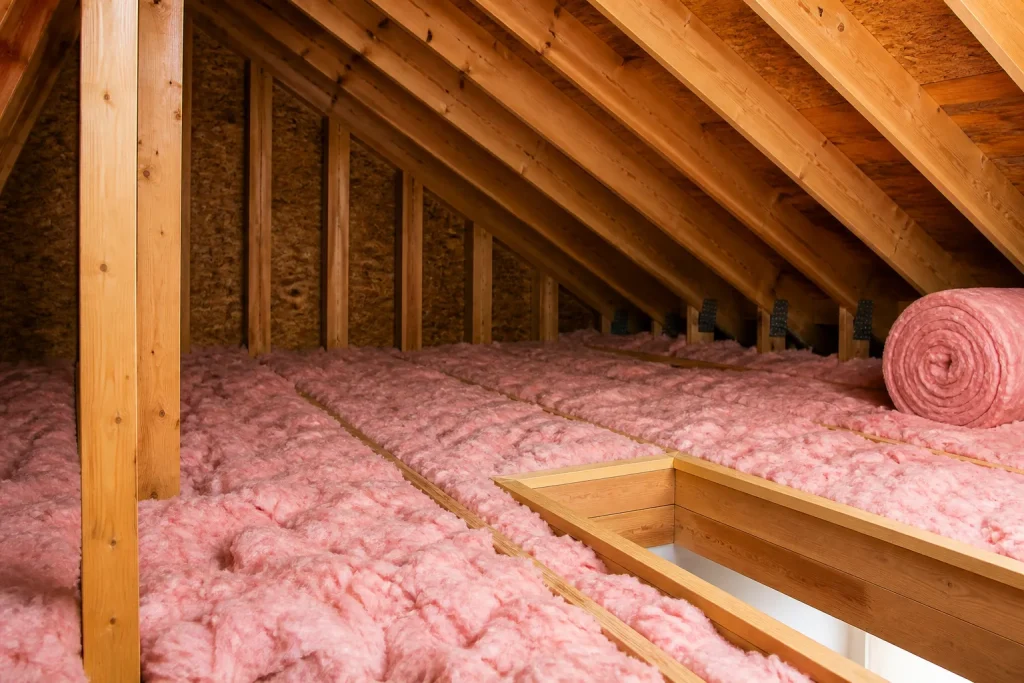
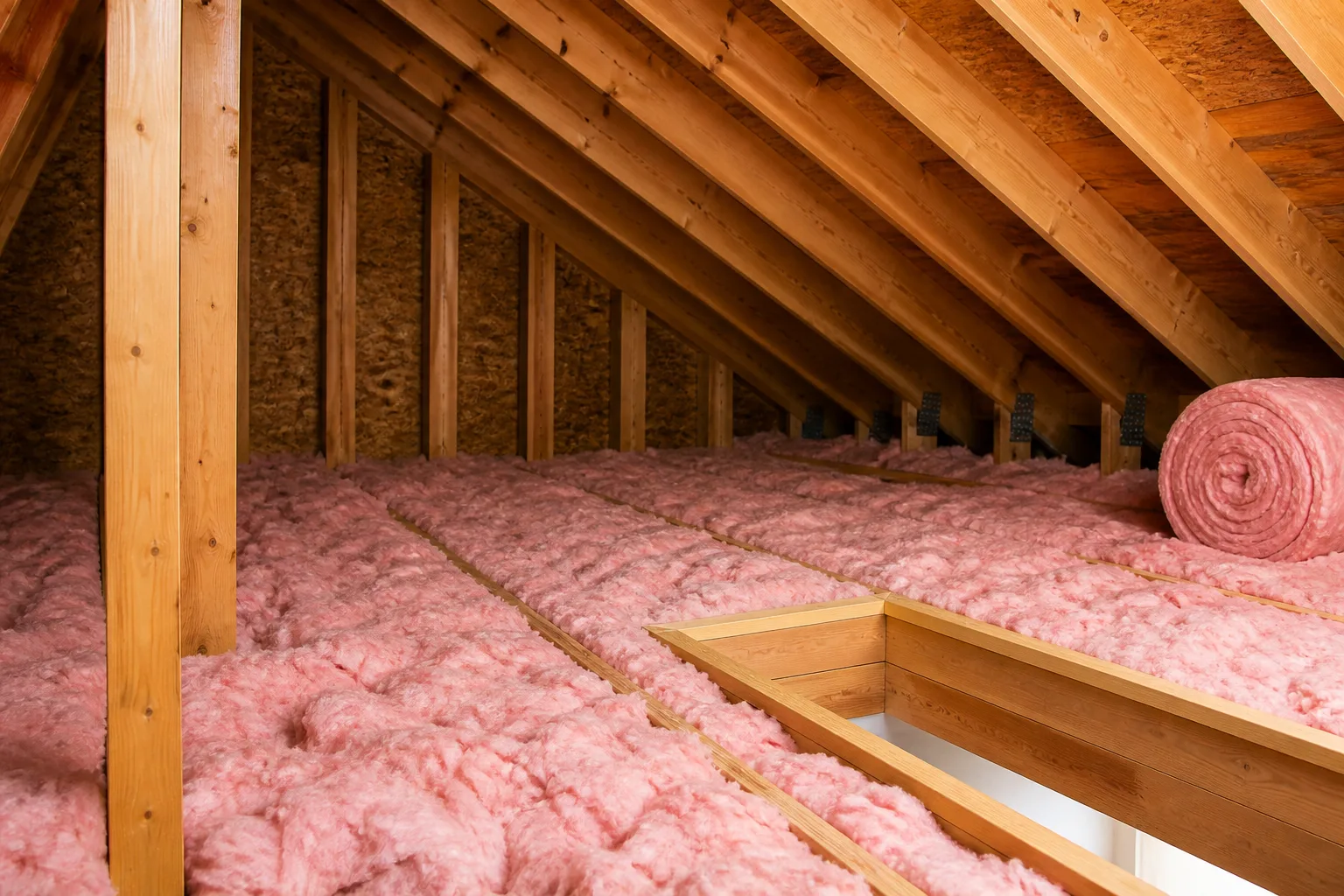
- AttiCat blown-in is the standard for open, unobstructed attic floors. It fills around ducts, joists, and irregular framing without gaps. Most North Las Vegas homes with a standard 4:12 or steeper roof pitch and a clear attic floor are a good fit. Installed depth to reach R-38 typically lands around 13 to 14 inches.
- EcoTouch batts are the better choice when you need a defined thickness in a tight space – low-slope rooflines, knee walls, or attic sections where blown fiber can’t reach full depth. Many North Las Vegas tract homes built in the 2000s use low-slope roof sections over garages and rear additions where batts outperform blown-in.
We also work with Johns Manville and Knauf fiberglass when a specific R-value or fire rating calls for it. No product lock-in – the assembly dictates the material, not the other way around. For a full breakdown of the product options, see our Attic Insulation in North Las Vegas page.
Low-slope rooflines in North Las Vegas tract homes
The low-slope sections common in North Las Vegas subdivisions – especially over garages and rear-facing additions – limit how much blown fiber you can put down before it hits the roof deck. In those sections, EcoTouch batts compressed to the right depth often deliver a more consistent R-value than blown-in that can’t reach full thickness. An installer who doesn’t account for this will quote you the same R-38 for every attic and deliver less than that in the tight spots.
What are the five attic bypasses that must be sealed first?
These are the five locations we find unsealed in roughly eight out of ten North Las Vegas attics. Every one of them needs to be air-sealed before a single bag of Owens Corning goes in.
- Top plates. The joint where the wall framing meets the ceiling framing. Every interior wall in your home has one, and in an unsealed attic, each is a direct leak from the living space to the attic.
- Recessed can lights. Older “IC” and non-IC cans vent straight into the attic. We seal the housing and the gap around it, or replace with sealed-rated cans where code requires it.
- Attic hatches and pull-down stairs. The single largest bypass in most attics. An unsealed hatch is a hole the size of a doorway, and the stack effect pulls air through it constantly.
- Plumbing chases. The open vertical shafts around drain and supply lines running from the garage ceiling or lower floors up to the attic. In North Las Vegas, these are almost always unsealed in homes built before 2010.
- HVAC penetrations. Every duct boot, register, and refrigerant line that passes through the attic floor. Each one is a gap, and each one leaks until it’s sealed.
We air-seal all five before we touch the insulation. Under our Envelope Insulation North Las Vegas home process, that’s not an optional add-on – it’s the first step, every job. This is where the difference between a rated R-38 and a performing R-38 actually lives.
What documentation should you receive from an Owens Corning insulation job?
You should walk away from any attic insulation job in North Las Vegas with four documents in hand. If an installer can’t produce all four, you don’t have a verified install – you have a bag count and a promise.
- Pre-install blower-door reading in ACH50. A blower-door test – a pressurization reading that shows, in one number, how much air your building envelope is losing – taken before any work starts. This is your baseline.
- Post-install blower-door reading in ACH50. The same test repeated after air sealing and insulation. For a typical North Las Vegas home, a drop from around 8 ACH50 to 4 or below is a solid result. The number is the proof.
- Installer certification. The card or certificate showing the crew that did the work is trained on the Owens Corning product they installed. This is what makes the manufacturer warranty valid.
- Depth ruler photos. Photos of a marked ruler standing in the blown-in fiber, taken in multiple locations across the attic, showing the actual installed depth against the R-38 target. Not a bag count – a depth measurement.
We publish before-and-after blower-door numbers on every job where they apply, and the photo record comes standard. On a recent job near Aliante, the pre-install reading was 7.9 ACH50 and the post was 3.6 – that’s the number the homeowner can point to, not a claim we made about it.
Owens Corning certification vs. permit inspection: which protects you?
They protect you in different ways, and homeowners often assume one covers the other. It doesn’t. Here’s the split.
Owens Corning contractor certification verifies that the installer has been trained on the manufacturer’s products, that the installation follows the manufacturer’s spec, and that the material warranty stays intact. It’s a manufacturer-level protection. It says nothing about whether the work meets local building code, and it does not include a floor plan, a permit, or an inspection by a third party.
A local building permit inspection – required in many North Las Vegas residential insulation jobs depending on scope – verifies that the work meets the adopted code for R-value, clearance to combustibles, and egress. It’s a code-level protection. It does not verify that the installer was Owens Corning trained, and it does not check the manufacturer warranty.
You want both. Ask for the contractor certification card and the permit inspection sign-off. If a North Las Vegas installer can’t show both, you’re running on one protection where you should have two.
When to call a pro (and when it can wait)
Attic work in North Las Vegas is not a good DIY project, and we say that knowing it costs us calls. A 150°F attic, blown fiber over joists, recessed can lights tied to live wiring, and a code-required air barrier are a bad combination for a weekend project. The blower-door testing alone requires equipment most homeowners don’t have.
Call a pro if any of these apply:
- Your attic was built or last insulated before 2010 and has never been air-sealed
- You have recessed can lights in the ceiling below the attic
- Your summer electric bill has climbed more than 15% without a rate change
- You’re seeing dust streaks or discoloration around ceiling penetrations
- You’re planning to add insulation over existing material without inspecting what’s underneath
Related services in North Las Vegas: if you’re already in the attic, it’s worth checking the crawl space, too. Our Crawl Space Encapsulation & Vapor Barrier in North Las Vegas page covers what we look for down there, and Spray Foam Insulation in North Las Vegas explains where foam beats fiber in a North Las Vegas climate.
The Bottom Line
Owens Corning AttiCat and EcoTouch perform exactly as rated – if the five attic bypasses are sealed first. R-38 is the Climate Zone 3B code minimum for North Las Vegas, but the label is a product spec, not a guarantee your attic assembly hits it. The blower-door number is what tells you the truth. Ask for the pre and post ACH50 readings, the installer certification, and the depth ruler photos. If an installer can’t produce all three, that’s your answer.
If you’re in North Las Vegas and need help, Envelope Insulation North Las Vegas offers free estimates – call (833) 630-4008. We’ll give you a written price before any work starts, a free second opinion on any other written estimate you’re holding, and a documented photo record when we leave.
Frequently Asked Questions
Most Owens Corning attic insulation jobs in North Las Vegas run between $1,800 and $4,200, depending on attic square footage, existing insulation removal, and the amount of air sealing required. The air sealing step – which we do first, every time – typically adds $400 to $1,200 on a North Las Vegas home that’s never been sealed. Call (833) 630-4008 for an exact quote; the written price comes before any work starts, and estimates are free.
R-38 is the code minimum for North Las Vegas under Climate Zone 3B. It’s the baseline, not the ceiling. Many homeowners in North Las Vegas go to R-49 or R-60 for better summer performance, especially in west-facing attics that bake in the afternoon sun. The right number depends on your assembly, your existing insulation, and whether the bypasses are sealed. If the bypasses aren’t sealed, going above R-38 buys you very little.
Yes, in most cases – but only after we inspect what’s underneath. Blown fiber can go over existing fiber if the existing material is dry, undamaged, and not contaminated. We won’t blow over rodent-contaminated or water-damaged material; it has to come out first. For a North Las Vegas attic that’s never been sealed, the more important step is sealing the bypasses before adding anything on top. Call (833) 630-4008 and we’ll tell you what your attic actually needs.
A standalone blower-door test in North Las Vegas typically runs $300 to $500. When it’s part of an attic insulation job, we include the before-and-after readings as part of the documented record. The pre-install reading is your baseline; the post-install reading is the proof. Without both numbers, you have no way to verify what changed. Call (833) 630-4008 to schedule a test or ask about bundling it with an insulation estimate.
Written by the team at Envelope Insulation North Las Vegas.
Need Insulation Help?
Call Envelope Insulation North Las Vegas - the local pro we connect you with is licensed and insured, here with fast after-hours help in North Las Vegas.
(833) 630-4008