
Johns Manville Attic Insulation in North Las Vegas: A Homeowner’s Guide
Every blown-in fiberglass product settles after installation. Johns Manville publishes its settled R-value per inch in its technical data sheet; most competitors don’t. A contractor who bids depth to the installed number rather than the settled number is legally compliant but practically undershooting your attic’s R-value by one to two grades – and in a North Las Vegas summer, that gap shows up on your power bill by August. Here’s how to tell the difference before you sign anything. If you’d rather not sort through coverage charts yourself, call (833) 630-4008.
What’s the difference between installed depth and settled depth?
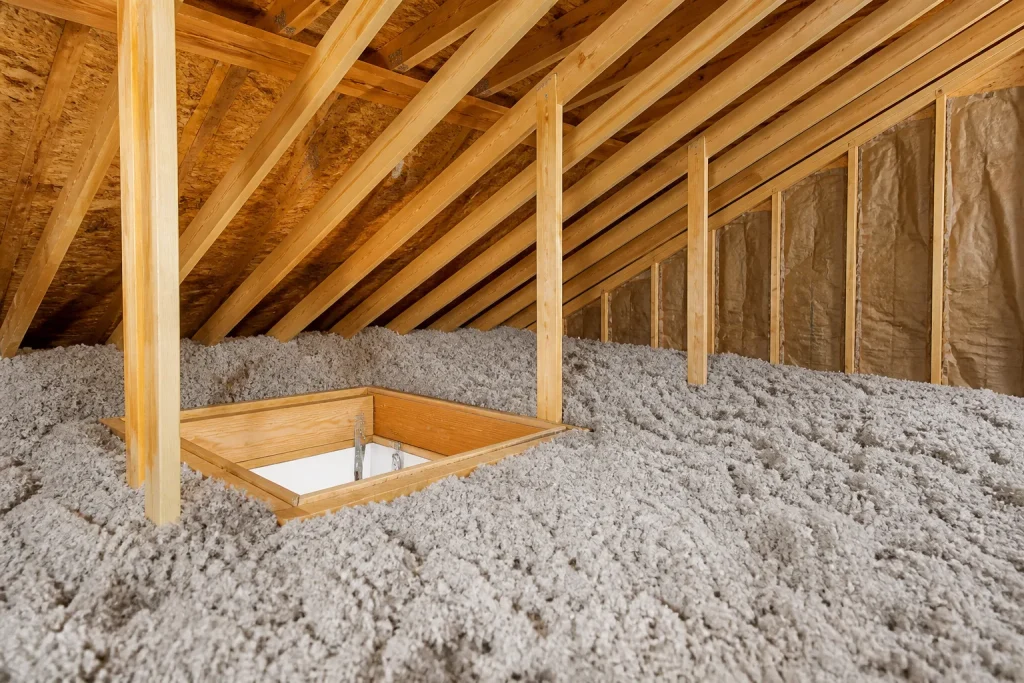
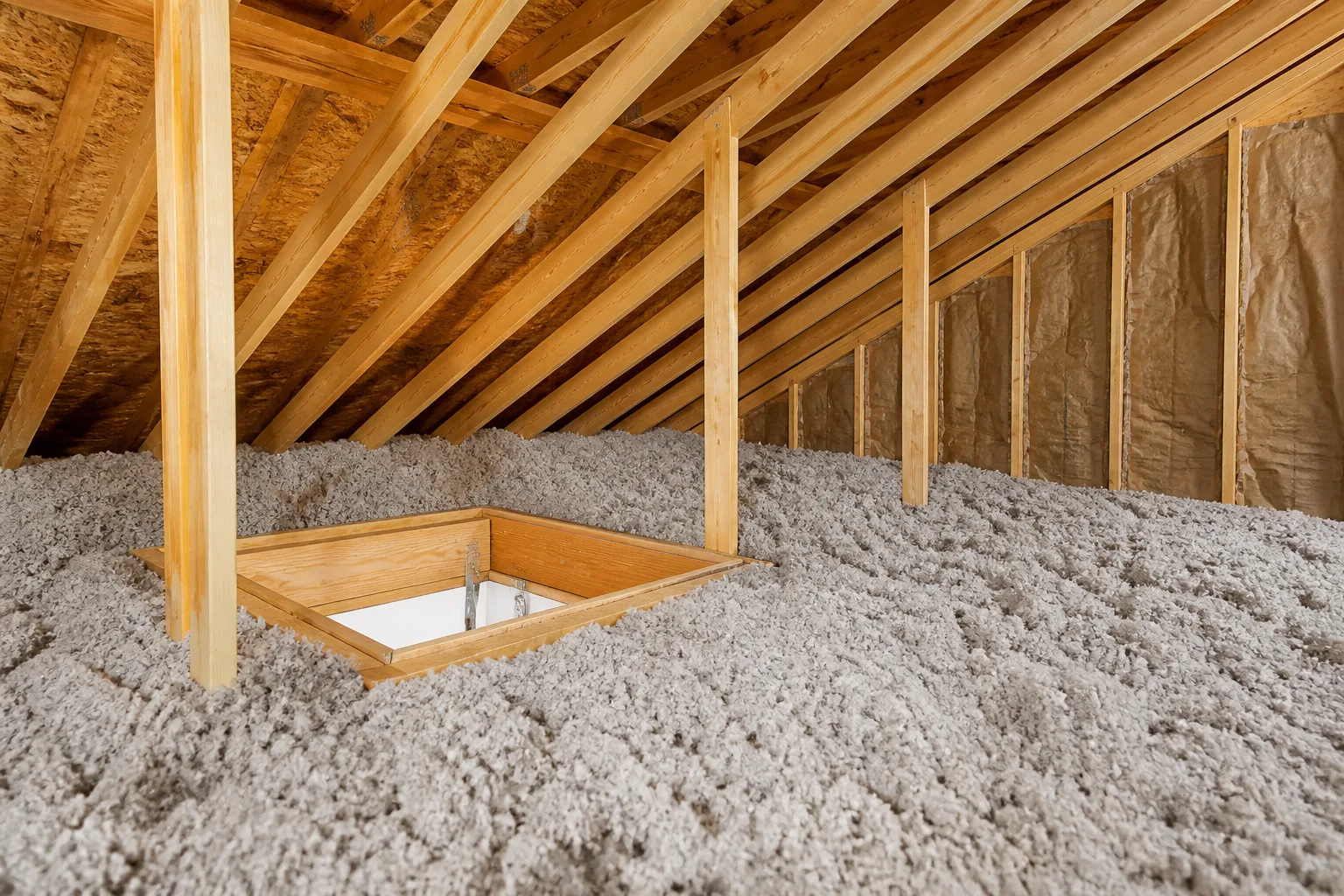
Installed depth is the thickness of the fiberglass the moment the blower stops. Settled depth is what that fiberglass compresses to after a few weeks, once gravity and thermal cycling have done their work. Fiberglass doesn’t stay fluffy. It packs down. A contractor bidding to the installed number is quoting you a ceiling you’ll never actually reach.
Johns Manville publishes both figures for its Climate Pro line. On a standard attic job, the gap between installed and settled can run a quarter-inch to half-inch per inch of depth depending on the product. At R-38 – the target most North Las Vegas homes should hit – that difference is meaningful. If your contractor installs to 13 inches and it settles to 11, you’re sitting at roughly R-32, not R-38.
What to ask for:
- The product’s technical data sheet, not the marketing brochure. The settled R-value per inch is in the data sheet.
- A coverage chart calculation showing the installed depth required to hit your target R-value after settling – not before.
- Depth stakes marked to the settled figure, not the installed figure.
In our experience, this is the single most common gap in North Las Vegas attic bids. Contractors quote depth, homeowners compare depth, and nobody checks whether the settled number was used. It’s an easy thing to miss until the first July bill lands.
Why does Johns Manville Climate Pro hold up in a North Las Vegas attic?
Attic temperatures in North Las Vegas routinely exceed 150°F in summer. That’s not a guess – it’s a measurement you can take yourself with an infrared thermometer on an August afternoon. Fiberglass has to survive that thermal cycling year after year without breaking down or losing loft.
Johns Manville markets Climate Pro as a boron-free glass composition. Boron is a common binder component in fiberglass manufacturing, and in this product JM has formulated without it. The practical upshot for a North Las Vegas homeowner is fiber durability through repeated heat expansion and contraction. Fibers that hold together keep their loft; fibers that break down compact and lose R-value faster. The difference isn’t dramatic in a single year, but it accumulates.
We’ve pulled insulation out of attics in North Las Vegas that looked like sawdust after a decade of heat exposure. That’s what fiber breakdown looks like when it happens. A product with a stable glass composition holds its settled depth longer, which is exactly what you’re paying for when you buy R-value.
Climate Pro isn’t the only product worth considering – Owens Corning and GreenFiber both make solid blown-in options, and we source from all three. The point isn’t brand loyalty. The point is that whatever product goes in, someone needs to verify the settled performance, not the sales pitch.
How does ventilation change the installation?
Johns Manville’s installation guide requires maintaining ventilation baffles and clear soffit-to-ridge airflow, which mirrors what the IECC already mandates. Baffles are the foam or plastic channels that sit between the rafters at the eaves, keeping insulation from blocking the soffit vents. If they’re missing or crushed, the attic can’t breathe.
In a colder climate, blocked ventilation causes ice dams and condensation problems. In North Las Vegas, the failure mode is different but just as serious. An attic that can’t vent properly in a 150°F summer traps heat against the roof deck and the insulation itself. That accelerates the fiber breakdown we just talked about, and it can cut years off your roof’s life. Tight, low-pitch rooflines common in newer North Las Vegas subdivisions make this worse – there’s less volume to move air through, so a blocked baffle matters more.
What to look for before insulation goes in:
- Baffles present at every rafter bay where the soffit vents, and not crushed or displaced.
- Clear airflow path from soffit to ridge, with no insulation blown over the baffle tops.
- Ridge vent or other upper ventilation unobstructed.
This is also where the air sealing work has to happen first. Blowing insulation over an unsealed attic floor traps conditioned air in the living space and wastes the product. Sealed first, then insulated – in that order, every time.
What does Johns Manville’s installation guide require before blowing?
JM’s guide calls out specific prep steps: sealing top plates, can lights, plumbing and electrical penetrations, and any other gaps between the conditioned space and the attic. These aren’t optional. They’re the difference between an insulated attic and a well-insulated attic.
Here’s the part most homeowners don’t know. A standard permit inspection will verify insulation depth and ventilation. It will not verify whether the top plates were sealed, whether the can lights got the proper covers, or whether that gap around the plumbing stack was closed. Those steps are invisible once the fiberglass is in. A job can pass inspection and still be losing air through unsealed penetrations the inspector never saw.
That’s why the documentation matters as much as the installation:
- Photos of the sealed penetrations before product goes in.
- Depth stakes photographed at a minimum of three locations, marked to settled depth.
- The installer’s coverage chart affixed to the attic access door, as the FTC R-value rule requires.
- A blower-door reading (ACH50 – air changes per hour at 50 pascals, a pressurization number that shows in one figure how much air your envelope is losing) taken before and after.
We include the Documented Photo Record on every job, and we publish before-and-after blower-door numbers on every applicable one. It’s how you verify what you paid for without crawling into a 150°F attic yourself.
What should a compliant job record include?
A completed insulation job should leave you with a paper and photo trail you can hand to a future buyer, an appraiser, or an energy auditor. If you got a verbal promise and a receipt, you didn’t get a job record.
- Coverage chart affixed to the attic access door – required under the FTC R-value rule, showing the product, target R-value, and installed amount.
- Blower-door ACH50 reading – before and after, so you can see the actual performance change.
- Depth-stake photos at a minimum of three locations – marked to settled depth, not installed depth.
- Written scope and written warranty – delivered before work starts, not after.
We operate under what we call The Haven Standard: written price before any work starts, no exceptions. It’s also why we offer a free second opinion on any written estimate – bring us a competing quote and we’ll read it with you. If the settled depth isn’t on it, that’s the first thing to question.
When to call a pro: if you’re looking at a bid that quotes installed depth, doesn’t mention baffles, or has no blower-door plan, get a second set of eyes on it before you sign. Same goes if you’re in a home built before 2015 and you have no idea what’s under that fiberglass – older North Las Vegas homes often have crawl space issues that pair with attic problems.
Related services in North Las Vegas: if the attic job is part of a bigger envelope project, see our pages on Attic Insulation in North Las Vegas, Crawl Space Encapsulation & Vapor Barrier in North Las Vegas, and Spray Foam Insulation in North Las Vegas. For the full picture of what we do, visit the Envelope Insulation North Las Vegas home page.
A quick note on comparison shopping
If you’re comparing contractor bids, the settled-thickness question is your best filter. A bid that names the product, cites the settled R-value per inch from the manufacturer’s data sheet, and shows the math for reaching R-38 is a bid worth reading closely. A bid that says “R-38” with a depth figure and nothing else is telling you it bid the installed number. That’s the difference between a job that hits its target in August and one that quietly misses it by one or two grades.
We’ve been doing this long enough (our technicians have up to 10 years of experience) to know that the settled number is where the real R-value lives. The product matters, the installation matters, and the documentation is what proves both.
The Bottom Line
Johns Manville Climate Pro is a legitimate, well-documented product – one of the few that publishes its settled R-value per inch. That documentation is only useful if your contractor actually uses it. The three things that matter most for a North Las Vegas attic:
- Seal the attic floor first. Insulation blown over unsealed penetrations wastes the product.
- Bid to settled depth, not installed depth, and verify with depth-stake photos marked to the settled number.
- Maintain ventilation baffles and clear soffit-to-ridge airflow – especially in tight modern rooflines.
If you’re in North Las Vegas and need help sorting through a bid, Envelope Insulation North Las Vegas offers free estimates and a free second opinion on any written estimate. Call (833) 630-4008. A live person answers 24/7.
Frequently Asked Questions
What R-value should attic insulation be in North Las Vegas?
R-38 is the standard target for most North Las Vegas homes, and JM’s coverage charts show the installed depth required to reach that figure after settling. North Las Vegas summers push attics past 150°F, so the settled number is what actually holds. Call (833) 630-4008 for an exact quote on your attic.
Is Johns Manville Climate Pro better than Owens Corning or GreenFiber?
They’re all solid products, and the decision usually comes down to settled performance data and installation quality. JM publishes its settled R-value per inch openly, which makes it easier to verify a job was bid correctly. We source from all three so we can match the product to the home. Call (833) 630-4008 to talk through your options.
Does insulation need air sealing before installation?
Yes – sealing the attic floor first is what makes the insulation work. Unsealed top plates, can lights, and penetrations let conditioned air escape into the attic, and blowing insulation over them just traps the loss. A standard permit inspection won’t catch this, so the photos matter. Call (833) 630-4008 if you’re not sure what your attic has.
How do I verify a North Las Vegas insulation job was done right?
You should have a coverage chart affixed to the attic access door, before-and-after blower-door ACH50 readings, and depth-stake photos at three or more locations marked to settled depth. If a contractor can’t produce those, the job record is incomplete. Call (833) 630-4008 for a free second opinion on any written estimate.
Written by the team at Envelope Insulation North Las Vegas.
Need Insulation Help?
Call Envelope Insulation North Las Vegas - the local pro we connect you with is licensed and insured, here with fast after-hours help in North Las Vegas.
(833) 630-4008