
Icynene Attic Insulation in North Las Vegas: A Homeowner’s Guide
Icynene open-cell spray foam is about 97% air by volume. That’s the same property that makes it an excellent sound damper, and the same property that makes it the wrong default choice if your air handler sits inside the thermal envelope with no dehumidification strategy. In a North Las Vegas attic that hits 160°F on a July afternoon, this is the decision most installers skip entirely. If you’d rather have a trained eye look at your attic before you commit, call (833) 630-4008.
What is Icynene, and why does open-cell vs. closed-cell matter in North Las Vegas?
Icynene is a spray foam brand, and the formula most homeowners end up with is open-cell: lower density, roughly 3.5 to 3.8 per inch of R-value, and vapor-permeable, meaning water vapor can migrate through it. Closed-cell is denser, around R-6 to R-7 per inch, and acts as its own vapor retarder.
Here’s the part that matters in North Las Vegas. This city sits in Climate Zone 3B – hot and dry. Bulk water intrusion is rare. What isn’t rare is condensation. When you spray open-cell foam on the underside of a roof deck and pull the air handler into that conditioned assembly, you’ve changed where the dew point lands. In a dry climate that’s usually fine. In a house with a big HVAC system running hard against a 160°F deck, it’s a design question, not a product question. The foam doesn’t fail. The assembly does, if nobody thought about moisture.
One clause version: open-cell lets vapor pass, closed-cell blocks it – and which one you want depends on what’s inside your roofline, not on which one has a better brochure.
How much Icynene does it take to hit R-30, and will it fit my rafters?
To reach R-30 with Icynene open-cell at roughly 3.6 per inch, you need about 8.5 inches of installed thickness. Closed-cell gets you there in about 5 inches. That gap is the whole ballgame in older North Las Vegas tract homes.
Common 1970s through 1990s construction around here often uses 2×6 rafters, which gives you about 5.5 inches of bay depth. Open-cell at 8.5 inches means foam proud of the framing, then a thermal barrier over it. That’s allowed, but it changes the look of the attic and it costs more material. Closed-cell at 5 inches sits closer to flush. Neither is wrong. They answer different questions.
- Shallow bays, tight budget: closed-cell often wins on thickness alone.
- Deep bays or scissor trusses: open-cell fits comfortably and damps sound better.
- Complex rooflines: open-cell wins on coverage – more on that below.
Why the unvented attic assembly is what actually makes Icynene work
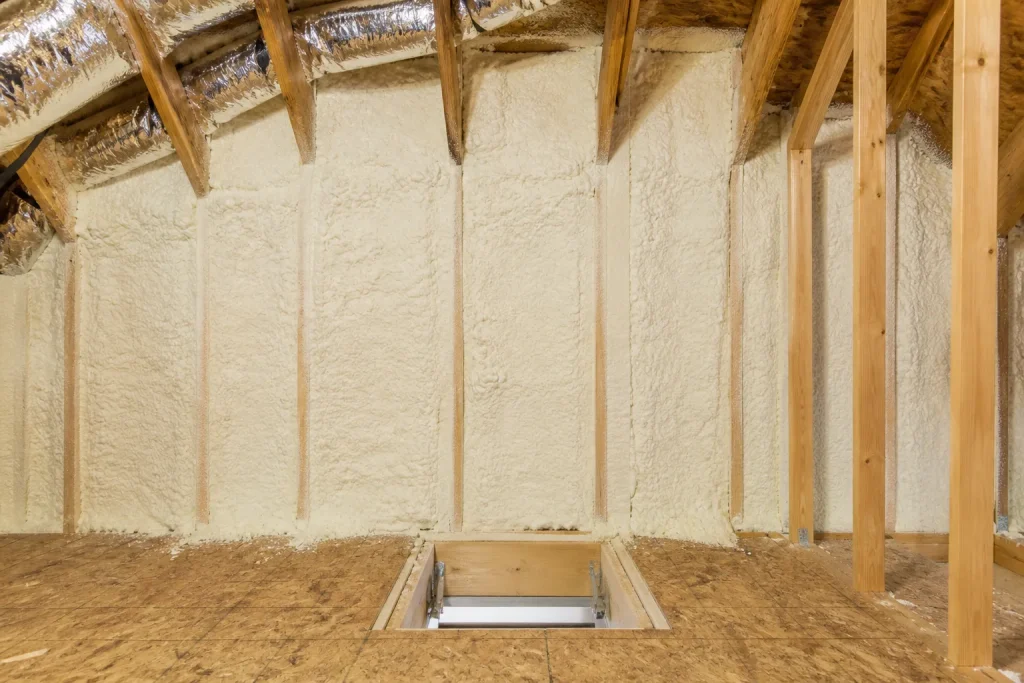
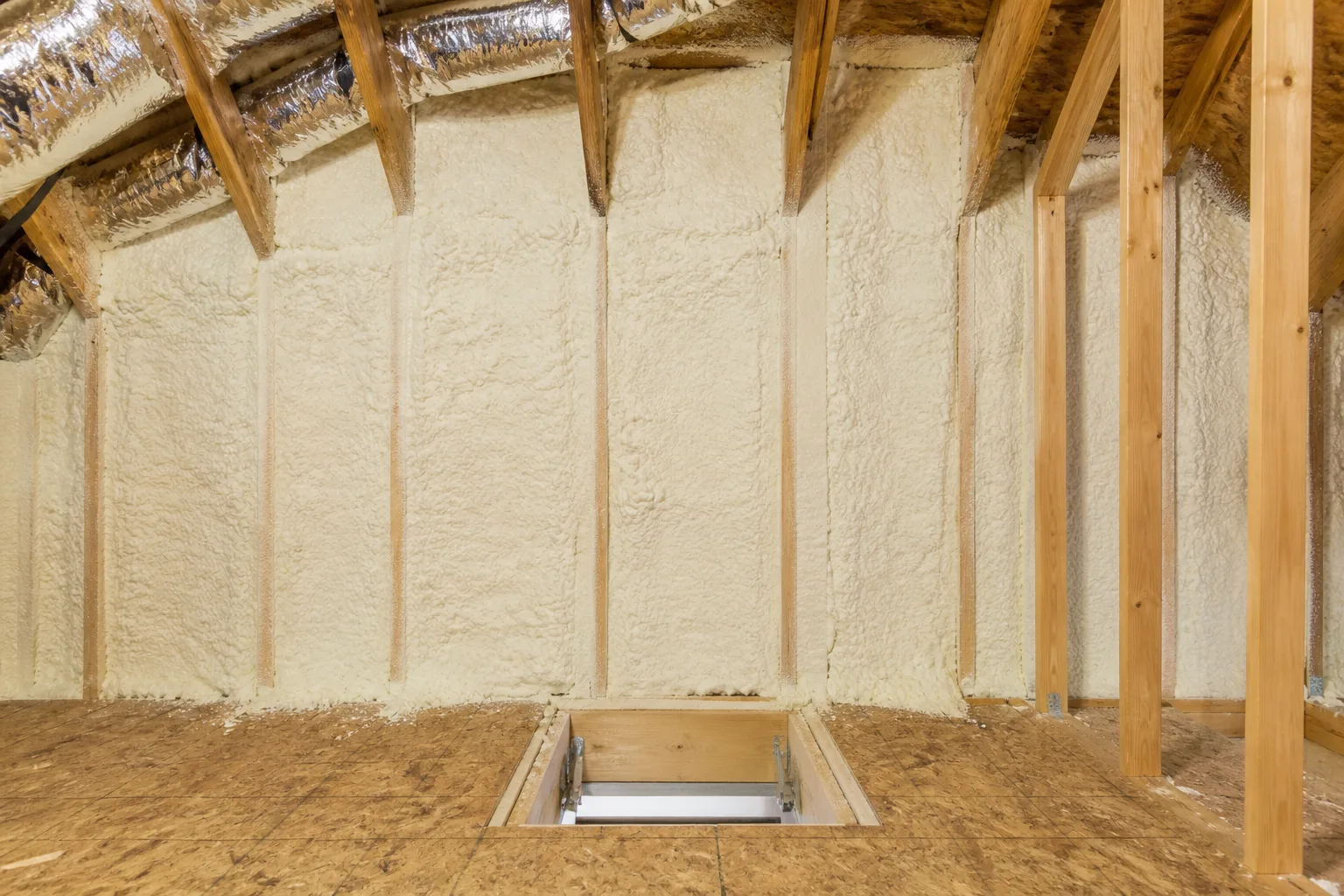
Spraying foam on the attic floor and calling the attic “conditioned” is a common mistake. A real unvented assembly has three parts, and all three have to be there:
- The air handler and ductwork sit inside the thermal envelope – foam goes to the roofline, not the floor, so the equipment is no longer baking at 160°F.
- The foam is applied continuously to the deck and gable ends, with the vents sealed.
- A blower-door test – a pressurization reading that shows, in one number, how much air your envelope is losing – confirms the assembly is airtight.
That last one is where we see the most shortcuts. We’ve pulled readings on North Las Vegas attics where the foam looked perfect and the house still leaked 3,800 CFM50 because nobody sealed the top plates and can lights before the foam went in. Sealed first, then insulated. In that order, every time. It’s not an upsell; it’s the difference between a performance improvement and a photo of white foam.
If your attic has a crawl space or knee-wall section feeding it, that’s a separate job. Our Crawl Space Encapsulation & Vapor Barrier in North Las Vegas page covers how that assembly gets handled.
Where Icynene clearly earns its price tag in North Las Vegas
The clear winner is a home with a complicated roofline – hip-and-valley roofs, knee walls, mechanical chases, dormers, and a spiderweb of duct runs. In those attics, batt and rigid board can’t achieve continuous coverage without dozens of cuts and gaps, and every gap is a leak. Foam goes in as one continuous blanket and the problem disappears.
We had one recently off Camino Al Norte with a 1998 build, three gable ends, and a furnace chase running straight through the middle. Batt insulation there would have meant cutting around nine obstructions. The foam went in as one skin, the post-install blower-door test read 1,900 ACH50 down from 4,100, and the homeowner had the infrared scan to prove the coverage was uniform. That’s what Icynene is for.
We source from Demilec and Icynene for these jobs, and from Owens Corning and Johns Manville when a simpler attic calls for blown-in instead. For an attic that doesn’t need foam, we’ll tell you. Our Attic Insulation in North Las Vegas page walks through the alternatives.
What documentation should you receive after an Icynene install?
You should walk away with three things, and none of them should be a verbal promise:
- Pre- and post-install blower-door readings in ACH50 – the standard measure of how many air changes per hour your house leaks at 50 pascals of pressure. Two numbers, before and after.
- An infrared scan showing uniform coverage – no cold bands, no thin spots over the framing.
- The ICC evaluation approval number for the specific product and assembly used. Foam is approved as a system, and the number proves the system you got matches the one that passed testing.
Under our Haven Standard, every visit includes a Documented Photo Record, and every job begins with a Written Price Before Any Work Starts. That’s not a marketing line – it’s the thing you can check.
When to call a pro
Spray foam is a pressure-vessel application and a thermal-barrier requirement rolled into one. Two-part chemistry, PPE, and code-mandated ignition barriers make this a job for a licensed crew, not a weekend project. If you’re weighing foam against blown-in, bring us a competing written estimate – our Free Second Opinion service exists for exactly that. You can also see how the full envelope comes together on our Envelope Insulation North Las Vegas home page, or read about Spray Foam Insulation in North Las Vegas if you’re still comparing assemblies.
The Bottom Line
Icynene open-cell is the right call in a North Las Vegas attic with a hard roofline and a well-sealed floor below it. It’s the wrong call if your assembly hasn’t been air-sealed first, or if nobody has thought about where the dew point lands once the air handler is inside the envelope. Get the blower-door numbers, get the infrared scan, get the ICC approval. Those three documents are the whole story.
If you’re in North Las Vegas and want a written price before anyone touches your attic, Envelope Insulation North Las Vegas offers free estimates – call (833) 630-4008.
Frequently Asked Questions
Icynene makes both, but the formula most homeowners encounter is open-cell: vapor-permeable, roughly R-3.6 per inch, and a strong sound damper. Closed-cell is denser and blocks vapor, hitting R-6 or better per inch in half the thickness.
About 8.5 inches of installed thickness for open-cell, versus roughly 5 inches for closed-cell. In 2×6 rafter bays common in older North Las Vegas homes, that thickness difference is the deciding factor.
Not on its own, but open-cell foam moves the dew point. In Climate Zone 3B, bulk moisture is rare, but HVAC condensation inside a newly conditioned assembly is a real risk if the air handler and ductwork aren’t designed for the change. Sealing first and confirming with a blower-door test is how this gets controlled.
We answer calls live around the clock and deliver a written price before any work starts. Call (833) 630-4008 for exactly what your attic needs – and bring any competing estimate you’ve got.
Written by the team at Envelope Insulation North Las Vegas.
Need Insulation Help?
Call Envelope Insulation North Las Vegas - the local pro we connect you with is licensed and insured, here with fast after-hours help in North Las Vegas.
(833) 630-4008