
Demilec Attic Insulation in North Las Vegas: A Homeowner’s Guide
Demilec is a brand, not a specification. That distinction matters more in a North Las Vegas attic than almost anywhere else, because the same manufacturer makes two spray foams that behave nothing alike. A contractor who quotes “Demilec insulation” without naming the product line, the installed thickness, and whether your attic will be vented or unvented hasn’t given you a number you can hold them to. This guide breaks down what each Demilec product actually does and what a documented install should look like when the crew pulls out of your driveway.
If you’d rather have a conversation about your specific attic, call (833) 630-4008. No script, no pressure.
What’s the difference between Heatlok and Sealection 500?
Heliok HFO and Sealection 500 are two different materials with two different jobs. Heatlok HFO is a closed-cell foam: it cures rigid, resists moisture, and acts as a Class II vapor retarder at about R-6.5 per inch. Sealection 500 is open-cell: softer, vapor-permeable, and roughly R-3.7 per inch. One is an air barrier that also insulates. The other is a fill material that breathes. Using the wrong one in the wrong location is the single most common Demilec mistake we run into across North Las Vegas attics.
Why it matters in our climate specifically: North Las Vegas sits in Climate Zone 3B, which means long cooling seasons, low humidity, and big day-night temperature swings. Open-cell foam against a roof deck in an unvented assembly can allow moisture to migrate and condense on the deck above in some conditions, unless a vapor-retarder strategy is used. Closed-cell foam on the same deck acts as that retarder itself.
- Heatlok HFO (closed-cell): R-6.5/inch, Class II vapor retarder, rigid, dimensionally stable. Best for roof-deck applications in unvented assemblies and for rim-joist air sealing.
- Sealection 500 (open-cell): R-3.7/inch, vapor permeable, flexible, fills irregular cavities well. Common for interior walls and where a vapor-open assembly is desired.
When a contractor tells you “we’ll spray Demilec up there,” ask which one and at what thickness. Vague answers are the tell.
Where does closed-cell Demilec belong in a North Las Vegas attic?
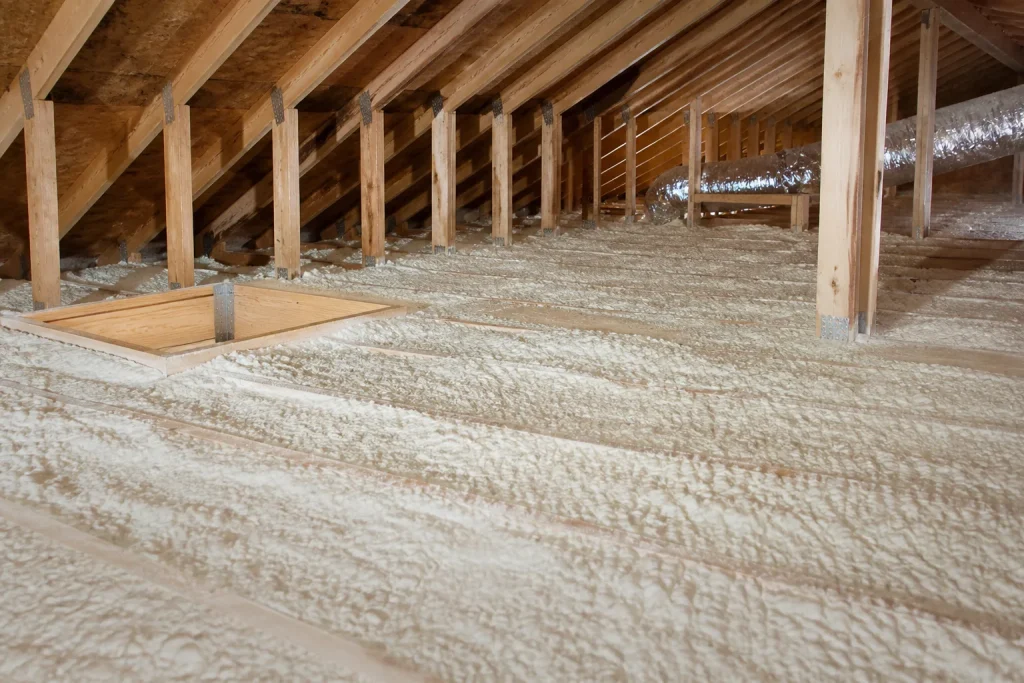
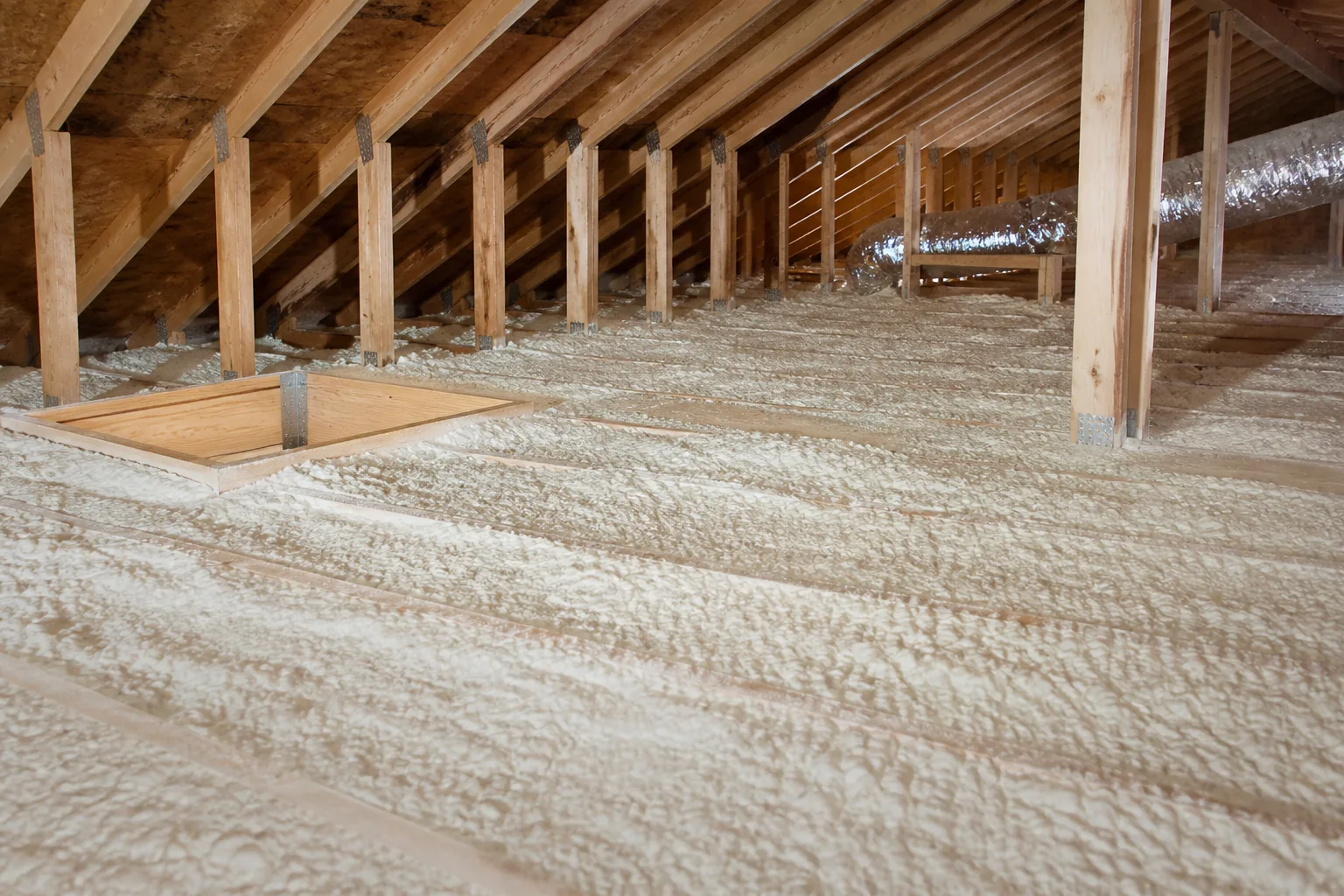
In an unvented attic assembly, closed-cell Demilec goes on the underside of the roof deck, not the attic floor. That placement pulls the insulation line and the air barrier into a single continuous layer at the roofline, which means the attic becomes conditioned space and your HVAC ducts and air handler – currently sitting in a 140-degree attic in July – suddenly live inside the envelope. In North Las Vegas, moving ducts inside conditioned space is often where the biggest comfort improvement comes from, not from adding R-value alone.
The IRC dew-point rule for Climate Zone 3B requires a minimum thickness of closed-cell foam before any other fill is added. In practice, that means roughly 2 inches of closed-cell foam – about R-13 – as the base layer. That 2-inch minimum acts as both the vapor retarder and the air barrier. Any additional R-value can come from open-cell foam, blown fiberglass, or blown cellulose on top, depending on the target R-value and budget. For a roof deck in North Las Vegas, we typically see total assemblies landing between R-20 and R-30 depending on how the ceiling plan is drawn and what’s already there.
Two things to know before you commit:
- An unvented attic requires that the HVAC equipment and any combustion appliances be inside the conditioned thermal envelope – or handled with a sealed combustion closet. If your furnace is in the attic, the assembly has to be designed around it.
- Any existing roof leaks have to be addressed first. Foam sprayed over a slow leak traps moisture and you’ll find out about it a year later, in the drywall.
This is a different philosophy than a standard floor-level attic insulation job. If you want the floor approach we use in vented attics, our Attic Insulation in North Las Vegas page lays out the assembly we build when the attic floor stays the insulation line, and our Spray Foam Insulation in North Las Vegas page covers the products and assemblies we run across town.
Are Demilec foams safe for indoor air quality?
Yes, when installed correctly and cured. Demilec’s Heatlok HFO and Sealection 500 both carry GREENGUARD Gold certification, which is a third-party standard for low chemical emissions in products used in environments where people spend extended time. Both products also use HFO blowing agents rather than the older HFC chemistry, which lowers the global warming potential of the foam itself. Those credentials matter if you’re sensitive to indoor air quality or you’re planning to rent the home out.
The practical question is re-occupancy timing. After the foam is sprayed, it needs time to cure. The off-gassing window for a typical attic application is roughly 24 hours for full cure, though that varies with temperature, humidity, and thickness. In North Las Vegas in July, an attic can hit 130 degrees during the day and the cure chemistry runs faster than it would in a cooler market. In winter, it can take closer to 24 to 48 hours. A good installer will tell you a specific re-entry time for your job and text you when the crew has finished the venting step.
What to ask about indoor air:
- Which formulation was specified, with the product data sheet in hand?
- What blowing agent was used – HFO or something older?
- What’s the recommended reoccupancy window for the thickness being installed at these temperatures?
- Is the crew using supplied air respirators during the spray? You can’t verify this directly, but a contractor who answers without hesitation usually means it.
If anyone tells you “there’s no off-gassing, you can go straight back in,” that’s worth a second question.
What blower-door number should a Demilec roofline job hit?
For a 1,800 square foot single-story home in North Las Vegas that was previously leaky, a reasonable post-install ACH50 target is below 3.0. ACH50 means “air changes per hour at 50 pascals,” and it’s the standard measure from a blower-door test – a pressurization reading that shows, in a single number, how much air your building envelope is losing. Before-and-after numbers tell you what you paid for in a way that no R-value claim can. If your house started at 7 ACH50 and lands at 2.6, you can see the change. If the contractor can’t produce a number, the claim is just words.
What a good blower-door protocol looks like:
- Pre-work test to establish the baseline. This should happen on the day of work, not from a previous visit.
- Air sealing of the top plates, can lights, and penetrations – completed before any foam is sprayed, so the foam isn’t doing sealing work it wasn’t priced for.
- Demilec closed-cell foam applied to spec on the roofline or other target areas.
- Post-work test with a printed report showing CFM50 (cubic feet per minute at 50 pascals) before and after, plus ACH50 for both.
One recent job we walked through in the Aliante area started at 4,700 CFM50 and finished at 2,900 – real, measured improvement. Most properly executed Demilec roofline jobs in a home this size fall in a range of 40 to 60 percent reduction in envelope leakage, depending on how leaky the starting point was and what else got sealed.
If you’re dealing with a crawl space below the attic that’s also leaking, sealing the attic without sealing the floor is like closing one window in a two-window room. Our Crawl Space Encapsulation & Vapor Barrier in North Las Vegas page covers that side of the job, and our Envelope Insulation North Las Vegas home page has the full picture of how we approach the building envelope as a system.
What documentation should you walk away with?
Three documents, minimum. If any is missing, the job isn’t complete. This is the part most homeowners don’t know to ask for, and the part that separates a spec-compliant install from a “trust us” install. At Envelope Insulation, the Documented Photo Record is included on every visit – not available on request – and we publish before-and-after blower-door numbers on applicable jobs so the performance change is verifiable.
The three documents:
- Product data sheet naming the exact Demilec formulation used – Heatlok HFO, Sealection 500, or a different line – with the lot and date of manufacture if possible.
- Installer’s yield log confirming the specified thickness was actually achieved. Foam thickness is measured in passes and board feet; a yield log shows how much material went in versus how much the spec called for. If the spec says 2 inches and the log shows a 1.5-inch average, that’s a conversation.
- Post-install blower-door report with the pre-work baseline, the post-work number, and the calculated ACH50 for both.
Under our Haven Standard, the price is written before any work starts, the scope is written, and the warranty is written. That’s clause one. If a contractor hands you a verbal scope and a handshake, you have no record to compare against when the job is done.
When to call a pro
If you’re reading this and thinking through your own attic, here’s the honest line: closed-cell spray foam applied to a roof deck requires specialized equipment, supplied-air respirators, and thermal barrier coverage per code. This isn’t a weekend project, and it’s not something to attempt because a video made it look manageable. If you just want to check what you have, go up with a flashlight and look at the attic floor or the roof deck – thickness, coverage, any visible gaps. But leave the spray to a trained installer.
Related services in North Las Vegas
If your attic already has old insulation that needs to come out before new material goes in, we handle insulation removal and replacement as a standalone scope. And if you’re not sure whether a vented or unvented assembly is right for your home, a home energy audit is the honest starting point – the blower-door baseline from that visit becomes the “before” number on your eventual install report.
The Bottom Line
Demilec makes two products that behave nothing alike, and matching the right one to your North Las Vegas attic assembly is the whole game. Closed-cell Heatlok HFO at 2 inches minimum on an unvented roof deck, open-cell Sealection 500 where a vapor-open fill makes sense, and a blower-door test on both sides of the job so you can see what changed.
Quick reference:
- Climate Zone 3B rule: roughly 2 inches of closed-cell foam (about R-13) as the base layer on any unvented roof deck before adding fill.
- Typical total assembly: R-20 to R-30 for a North Las Vegas roof deck job.
- Post-install ACH50 target: under 3.0 for a previously leaky 1,800 sq ft single-story home.
- Reoccupancy window: roughly 24 hours after spray, longer in cold weather.
- Documentation: product data sheet, yield log, post-install blower-door report.
If you’re in North Las Vegas and need help deciding which assembly is right for your home, Envelope Insulation North Las Vegas offers free estimates – call (833) 630-4008 for a written price before any work begins. Our technicians have up to 10 years of experience with closed-cell and open-cell foam, and we’ll walk you through the assembly line by line. Bring us a competing quote from another North Las Vegas contractor and we’ll read it with you – that’s the free second opinion, no strings.
Frequently Asked Questions
For an unvented roof-deck assembly in North Las Vegas, yes – closed-cell Heatlok HFO is the better fit because it acts as both the air barrier and the Class II vapor retarder at roughly R-6.5 per inch. Open-cell Sealection 500 is vapor permeable and belongs where you want a vapor-open assembly, such as certain interior walls. The right answer depends on your assembly, not on which one sounds stronger. Call (833) 630-4008 for an exact recommendation on your home.
Roughly 24 hours for a typical attic application, once the foam reaches full cure. In a North Las Vegas summer attic that window can run shorter because the heat accelerates the cure; in winter, allow up to 48 hours. Your installer should give you a specific re-entry time in writing. Call (833) 630-4008 to talk through timing for your job – estimates are free.
No – it makes it work less. When the attic becomes conditioned space, the ducts and air handler move inside the thermal envelope, which is where they belong. Ducts in a North Las Vegas attic regularly see 130-degree air around them in July; sealing the roofline with closed-cell Demilec brings that down to something close to indoor temperature. Call (833) 630-4008 to talk through your specific HVAC layout before committing.
Floor-level sealing and blown-in insulation is generally less expensive than a closed-cell roofline assembly in North Las Vegas, because it uses less foam and reuses the existing insulation line. The roofline approach costs more up front but pulls the HVAC and ducts into conditioned space, which often delivers more comfort improvement per dollar in our climate. Which makes sense for your home depends on your current attic and HVAC layout – call (833) 630-4008 for an exact quote, and estimates are free.
Written by the team at Envelope Insulation North Las Vegas.
Need Insulation Help?
Call Envelope Insulation North Las Vegas - the local pro we connect you with is licensed and insured, here with fast after-hours help in North Las Vegas.
(833) 630-4008