
Rockwool Attic Insulation in North Las Vegas: A Homeowner’s Guide
Rockwool (stone wool) batts cost more than fiberglass up front, and in most North Las Vegas attics that premium is hard to justify on performance alone. The exception is specific and worth understanding: attics with HVAC equipment, ductwork, or older wiring running through the assembly, where Rockwool’s noncombustible rating and roughly 1,000°C melt point add a safety margin no fiberglass product matches. Nevada is a wildfire-interface state, and North Las Vegas attics run from 1970s builds to new construction, often with aluminum branch wiring or aging air handlers sitting in the same space as the insulation. Getting this decision right starts with knowing what you’re actually buying.
What does “noncombustible” actually mean for Rockwool in a North Las Vegas attic?
Rockwool stone wool is classified as noncombustible under ASTM E136, a standard test that exposes a material to a furnace at 750°C and measures whether it ignites, supports combustion, or loses structural integrity. Fiberglass batts can also pass E136, but many faced and unfaced fiberglass products are rated differently depending on the facing and binder. Rockwool’s data sheets list the E136 classification directly, along with a melt point around 1,000°C – well above the temperatures a residential attic fire reaches in its early stages.
What that means in practice: if a wiring fault, a failing blower motor, or a recessed light fixture overheats, stone wool won’t feed the fire the way a paper-faced or foil-faced product can. It doesn’t prevent a fire. It removes one fuel source from the assembly.
Here’s where homeowners get confused. E136 noncombustibility does not replace the thermal barrier required under IRC Section R316. If you have recessed can lights or a mechanical unit in the attic, the code still requires a barrier between the heat source and combustible materials – typically a listed enclosure or an air-sealed, IC-rated fixture. Rockwool batts around those fixtures are a supplement to the barrier, not a substitute. In our experience across North Las Vegas, the number of attics we open where a can light sits directly against bare fiberglass with no barrier is higher than it should be.
Will Rockwool batts fit your North Las Vegas rafters? R-15, R-23, and the depth gap
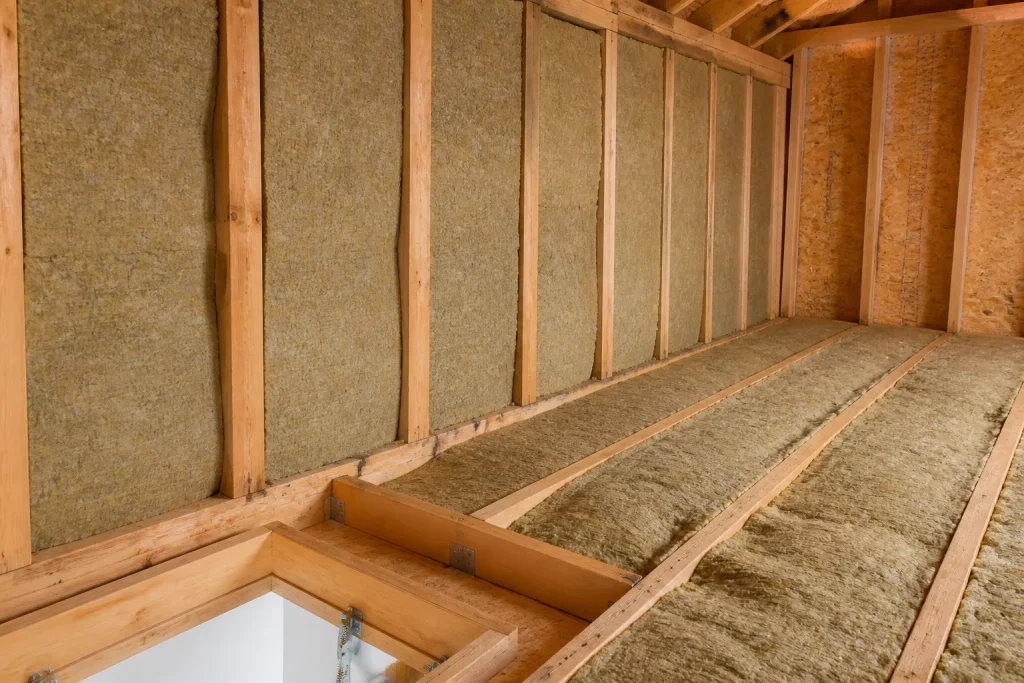
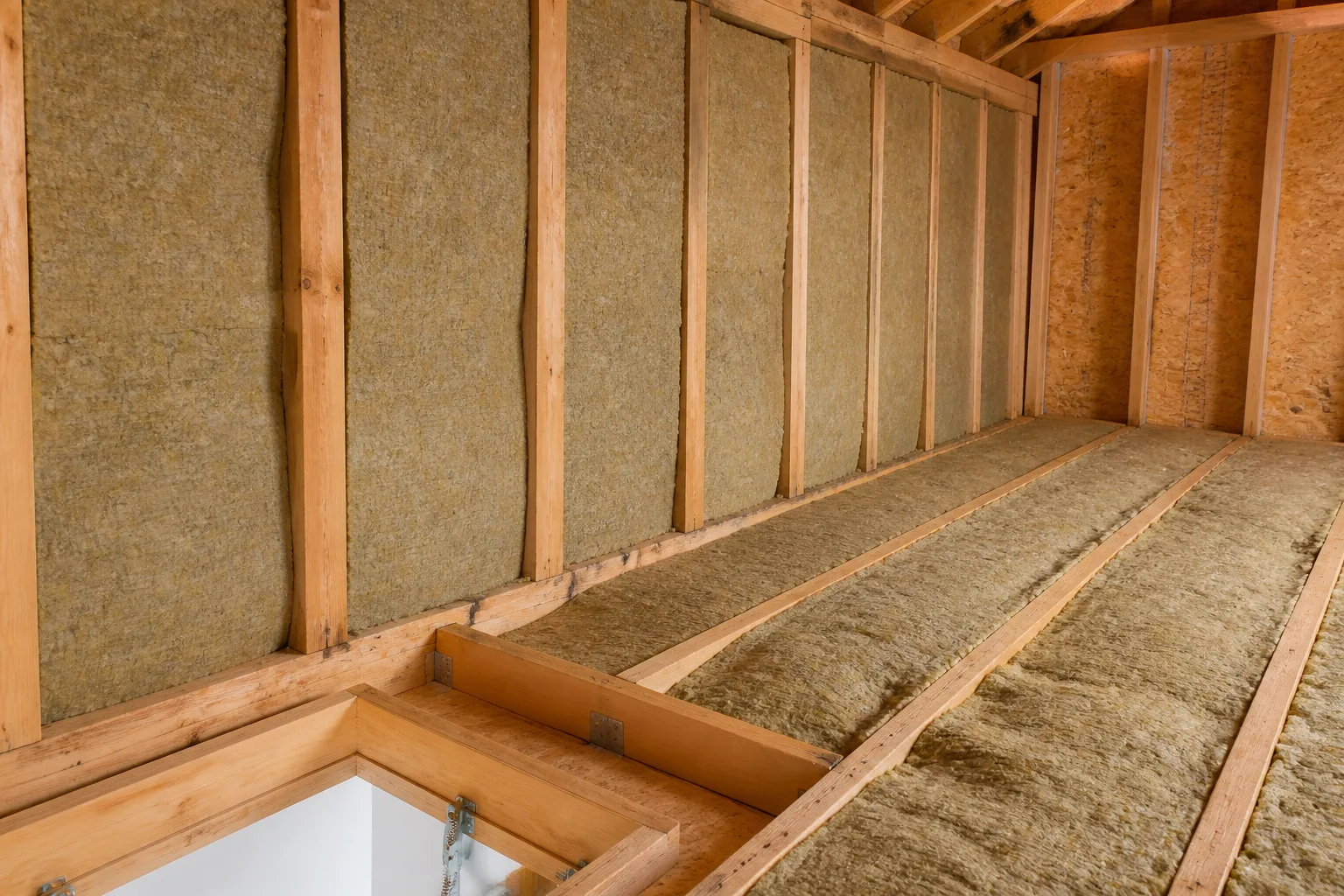
Most North Las Vegas homes built in the 1990s and 2000s use 2×6 or 2×8 ceiling joists. A 2×6 is actually 5.5 inches deep; a 2×8 is 7.25 inches. Rockwool ComfortBatt comes in R-15 (3.5-inch thickness, sized for 2×4 walls and shallow cavities) and R-23 (5.5-inch thickness, sized for a true 2×6 cavity). Neither product fills a 2×8 cavity to the code-recommended R-value for our climate zone without a strategy.
Our climate zone (IECC Zone 3) calls for roughly R-38 to R-49 in the ceiling. You can’t get there with 5.5 inches of any batt. The fix isn’t to compress the Rockwool – compression increases density and reduces R-value per inch. The options are:
- R-23 batts plus blown-in on top. Friction-fit R-23 into the 2×6 cavities, then blow loose-fill (fiberglass or cellulose) perpendicular across the joists to reach the target R-value. This is the most common approach in North Las Vegas homes we work in.
- Add depth with furring. Sister or fur out the joists to create a deeper cavity, then install a thicker Rockwool product. Higher labor cost, cleaner result.
- R-15 in shallow cavities only. Where joists are 2×4 or the space is tight, R-15 is the honest answer, and the ceiling assembly gets an air-sealing pass and a radiant barrier conversation instead.
Don’t let anyone tell you that stuffing a thicker batt into a shallower cavity gets you a higher R-value. It doesn’t.
Density matters: thermal and acoustic performance in North Las Vegas attics near Nellis
Rockwool batts run around 1.7 lb/ft³. Standard fiberglass batts run roughly 0.5 to 1.0 lb/ft³. That density difference shows up in two places:
Thermal. Stone wool resists convective looping (air moving through the batt itself) better than low-density fiberglass, which matters in vented attics where wind washing and stack effect move air across the top plate. In a North Las Vegas summer, when attic temperatures hit 140°F or higher, that resistance to internal air movement keeps the effective R-value closer to the rated number.
Acoustic. If your home sits under the Nellis Air Force Base flight paths – the stretches of North Las Vegas near Craig Road and the I-15 corridor where F-15 and F-35 traffic is regular – Rockwool’s density gives you a measurable sound-reduction benefit over fiberglass. We’ve had homeowners in the Aliante and Eldorado communities comment on this specifically after install. It isn’t the reason to choose Rockwool, but it’s a real secondary benefit.
Rockwool doesn’t air-seal. Here’s why that changes the order of work.
This is the part most insulation marketing skips. Rockwool batts are vapor-open and they do not stop air movement. Any stack-effect leakage through top plates, can lights, plumbing penetrations, and the attic hatch will carry warm, moisture-laden air up through the assembly and across the face of the batt. In a North Las Vegas attic, that moisture hits the cooler underside of the roof sheathing in winter and condenses. Over time you get staining, and eventually you get rot.
That’s why the order of work matters: seal first, insulate second. Before any batt goes down, the attic floor gets air-sealed – top plates, penetrations, can lights, the hatch. Then we run a blower-door test to measure where the home started. The blower-door test is a pressurization reading that shows, in a single number (CFM50 or ACH50), how much air the building envelope is losing. Once we know the baseline, we can tell you what the air sealing actually accomplished, and then the Rockwool goes in over a sealed surface.
We pulled an attic open in a 1998 build over near Lone Mountain last month where the previous install had been blown straight over unsealed top plates and two open can lights. The homeowner was paying to heat and cool the neighborhood. The Rockwool itself was fine. The order of work was wrong.
If you’d rather skip the trial-and-error and get a proper blower-door baseline, call (833) 630-4008. We’ll walk through what we found and what it means.
What documentation should you get after a Rockwool attic job in North Las Vegas?
A written scope of work, a blower-door reading, and photos are the minimum. When we finish a job, the homeowner walks away with:
- Depth and compression measurements at four corners and the center of each attic zone. This is how you verify that the installed R-value actually matches what was quoted.
- A before-and-after blower-door reading in ACH50 – the number that shows, in one figure, how much conditioned air the home was losing before the work and after. If the crew can’t produce this, ask why.
- The product data sheet with the ASTM E136 test reference – the specific listing that establishes the noncombustible classification for the product actually installed in your attic.
- A photo record of the sealed penetrations and the finished install – not a highlight reel, the actual attic floor before and after.
Under Haven Standard, every job starts with a written price, a written scope, and a written warranty before anyone lifts a tool. The 365-Day Done Right Promise applies to the completed work – if it’s not right, we make it right. If you have a competing estimate for Rockwool or any other product, we’ll read it with you as a free second opinion. Bring the estimate; we’ll line up the R-value and scope side by side.
When to call a pro instead of DIY-ing a North Las Vegas attic
We’re not going to talk you out of a weekend project you’re equipped to do, but a few situations call for a professional:
- Recessed can lights or a mechanical unit in the attic. The thermal barrier question under IRC R316 is a code compliance issue, not a DIY task, and getting it wrong is a fire risk.
- Aluminum branch wiring in a 1970s attic. Aluminum wiring is sensitive to connection integrity, and pinching it under a friction-fit batt or disturbing it while you install is the kind of mistake that shows up later.
- You don’t have a blower-door baseline. Without a before-and-after number, you can’t tell whether the air sealing worked or the Rockwool is doing more than the fiberglass it replaced.
- You’re going to skip air sealing to save money. Don’t. If the budget is tight, seal first and add insulation later. Blowing Rockwool over unsealed penetrations is the single most common mistake we correct.
Related services in North Las Vegas: for the full comparison across product lines, see our page on Attic Insulation in North Las Vegas. If you’re dealing with moisture from below, the crawl space encapsulation and vapor barrier work is part of the same envelope picture. And for cavities where batts won’t fit, spray foam insulation is worth reading about before you commit to Rockwool. Envelope Insulation brings the same blower-door documentation to every job under Envelope Insulation North Las Vegas.
The Bottom Line
Rockwool is a higher-cost product than fiberglass, and it earns that cost in specific North Las Vegas cases: attics with HVAC equipment, ductwork, or aging wiring in the conditioned space, where ASTM E136 noncombustibility and a roughly 1,000°C melt point add a safety margin fiberglass doesn’t match. In North Las Vegas homes near Nellis flight paths, the acoustic benefit of 1.7 lb/ft³ density is a real bonus. The higher density also resists convective looping better than low-density fiberglass in vented attics, which matters at 140°F attic temperatures in July.
What Rockwool doesn’t do is air-seal. It’s vapor-open, and any leakage through penetrations and top plates will carry moisture across the batt face – so a blower-door test before install isn’t a nice-to-have, it’s the baseline for knowing what you’re actually buying.
If you’re comparing Rockwool to fiberglass in a North Las Vegas attic and want a written price, a written scope, and the before-and-after blower-door numbers on the same page, call (833) 630-4008 for a free estimate. We’ll bring the blower door and show you the starting number before anyone lifts a tool.
Frequently Asked Questions
Sometimes. Rockwool earns its premium when your attic has HVAC equipment, ductwork, or older wiring in the conditioned space, because its ASTM E136 noncombustible rating and ~1,000°C melt point add a safety margin fiberglass doesn’t. In a plain vented attic with no equipment, fiberglass or cellulose at the same R-value will typically perform close enough that the Rockwool premium is hard to justify. Call (833) 630-4008 to talk through which case your home falls into – the estimate is free.
No. Rockwool’s noncombustible classification under ASTM E136 does not substitute for the thermal barrier required by IRC Section R316 where recessed can lights or mechanical equipment sit in the attic. The barrier is still required – typically a listed enclosure or an air-sealed, IC-rated fixture. Rockwool around those fixtures is a supplement, not a replacement. Call (833) 630-4008 for a walk-through of what your specific attic is required to have.
No. Rockwool batts are vapor-open and do not stop air movement. Stack-effect leakage through top plates, can lights, and penetrations will carry warm, moisture-laden air across the batt face, which can lead to condensation and eventually rot in a North Las Vegas attic. Air sealing the attic floor must happen before any insulation goes in – and a before-and-after blower-door reading is how you confirm it actually worked. Call (833) 630-4008 to schedule a blower-door baseline.
Our climate zone (IECC Zone 3) calls for roughly R-38 to R-49 at the ceiling. Most North Las Vegas 2×6 and 2×8 attic cavities cap out at R-23 with a single layer of Rockwool batts, so the usual approach is R-23 friction-fit in the joist bays plus blown-in insulation on top to reach the target. Compressing a thicker batt to fit a shallower cavity reduces R-value per inch, so don’t do it. Call (833) 630-4008 for a written R-value plan for your attic.
Written by the team at Envelope Insulation North Las Vegas.
Need Insulation Help?
Call Envelope Insulation North Las Vegas - the local pro we connect you with is licensed and insured, here with fast after-hours help in North Las Vegas.
(833) 630-4008