
Spray Foam Insulation: Repair or Replace? How North Las Vegas Homeowners Decide
The repair-or-replace call comes down to which failure you’re looking at. Closed-cell foam (2 lb/ft³) that has pulled into thermal shrinkage gaps can usually be repaired. Open-cell foam (0.5 lb/ft³) that has taken on moisture has to be replaced, because open-cell is vapor-permeable by design and won’t dry out once it’s wet. If you’d rather not probe your own attic to figure out which one you’ve got, call (833) 630-4008 and we’ll take a look.
Here’s the failure most people don’t see coming. Open-cell spray foam lets vapor through on purpose. In a North Las Vegas home where the HVAC system is undersized or short-cycling, the foam’s facing surface can drop below the dew point during a monsoon-season humidity spike. Once open-cell foam absorbs moisture, it doesn’t dry out. It holds that water against the framing and keeps holding it. We pulled a section out of a garage ceiling in Aliante last month where the foam read fine to the eye and 34% on a pin meter three inches in.
Open-Cell vs. Closed-Cell: Which Foam Did You Actually Get?
Before you can decide repair or replace, you need to know what’s on your framing. These two products fail differently, insulate differently, and cost differently.
- Open-cell spray foam runs about 0.5 lb/ft³, delivers roughly R-3.5 to R-4 per inch, and is vapor-permeable. It’s the common choice for interior wall cavities and sound control. Installed cost in the North Las Vegas market typically runs $1.50 to $2.50 per board foot.
- Closed-cell spray foam runs about 2 lb/ft³, delivers roughly R-6.5 to R-7 per inch, and acts as a vapor retarder. It’s what you want in rim joists, crawl space walls, and under-slab or exterior applications. Installed cost locally usually lands between $2.50 and $4.00 per board foot.
Those numbers matter because R-value per inch is a published spec, not a sales claim. Ask for the product data sheet on any job, and match the stated R-value per inch to the thickness you’re being quoted. A contractor quoting “R-21 in a 2×4 wall” with open-cell foam is selling you something the math doesn’t support. If you’re comparing products for a fresh install rather than a repair, our page on Spray Foam Insulation in North Las Vegas breaks down which application calls for which foam.
How Do You Diagnose Thermal Shrinkage in Closed-Cell Foam?
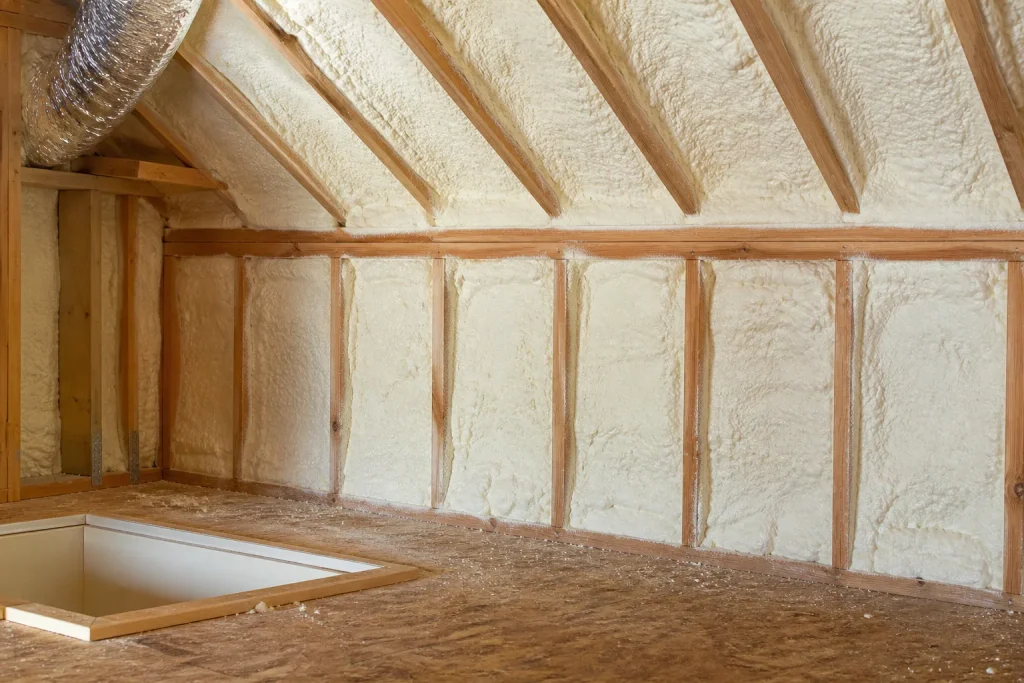
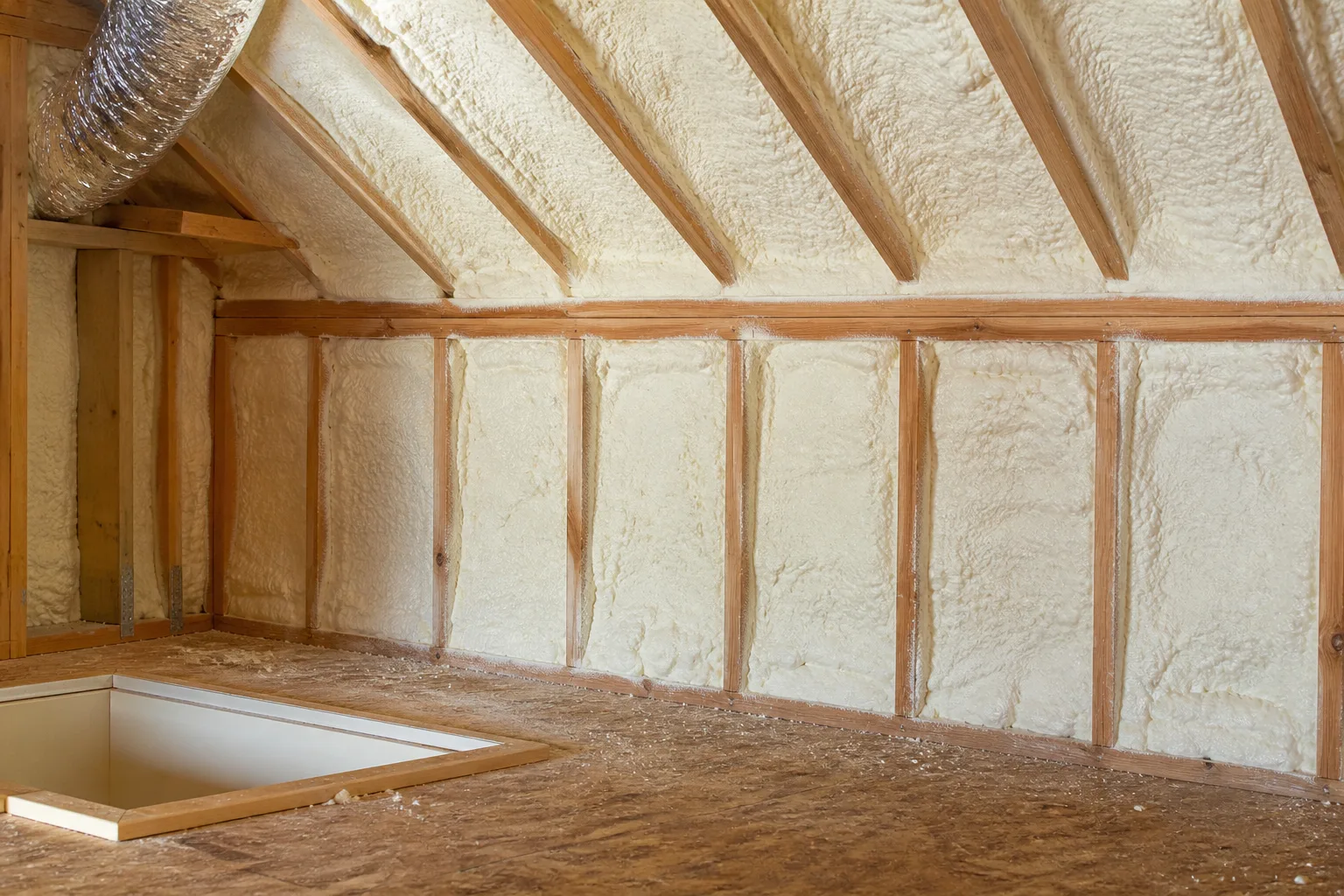
Closed-cell foam is dimensionally stable compared to open-cell, but it does shrink slightly as it cures, and over years it can pull away from framing. The failure shows up as a gap between the foam edge and the wood, and it lets air move exactly where you paid to stop it.
The inspection method is simple and low-tech. Take a utility knife and score a small notch at the foam-to-framing edge, then probe the gap with the blade tip or a feeler gauge. Measure the gap.
- Gaps under 1/8 inch: These can be patched. A bead of spray foam or an approved sealant applied at the joint re-establishes the air barrier. It’s a repair, and it’s worth doing before the gap widens.
- Gaps of 1/8 inch to 1/4 inch: Patch plus monitor. Re-probe the same spot in twelve months. This is where we see a lot of North Las Vegas homes sit, especially in attics that see big day-night temperature swings.
- Gaps over 1/4 inch, or foam that’s pulled away along more than a few linear feet: Full re-spray of the affected area is warranted. Patching a gap that size just hides the air leak behind a new bead.
If you’re not comfortable scoring your own foam, don’t guess. A blower-door test – a pressurization reading that shows, in one number, how much air your building envelope is losing – tells you whether the gaps are actually costing you. We read before-and-after numbers on every applicable job for exactly this reason.
When Does Wet Open-Cell Foam Mean Replacement?
This is the diagnosis that changes the whole conversation. Open-cell foam that has absorbed moisture is not a repair candidate, because patching over wet foam traps the water in place. You cap it, it keeps sitting against the framing, and you’ve now hidden the problem behind a fresh-looking surface.
The test is a core sample with a moisture meter. Push the pins into the body of the foam, not just the surface. Readings above 20% in the foam body mean replacement. Between 15% and 20% is a watch-and-recheck situation, usually after a dry stretch. Under 15% and the foam itself is likely fine – your problem is elsewhere.
Why does this happen so often in North Las Vegas? Two reasons. First, monsoon season pushes humidity up fast, and a short-cycling HVAC system doesn’t run long enough to pull that moisture out of the air. Second, an undersized system in a home that was insulated for a milder climate runs hot and cold, and the foam’s interior face cycles across the dew point repeatedly. We’ve seen this pattern in older North Las Vegas neighborhoods where a system was swapped without re-checking the envelope. If the wet foam is in a crawl space, the fix usually pairs with proper vapor control – see our Crawl Space Encapsulation & Vapor Barrier in North Las Vegas page for how that sequence works.
What About UV Degradation on Exposed Foam?
Spray foam left exposed to sunlight breaks down at the surface. In North Las Vegas, the places this shows up are crawl spaces and rim joist areas that catch any indirect light, plus the odd attic with a skylight shaft. UV turns the foam surface chalky and brittle, and it loses R-value at the skin.
The practical question is depth. Surface discoloration and a chalky skin of a few millimeters is cosmetic; the foam underneath is still doing its job, and coating it with an approved protective layer solves it. Once the degradation reaches roughly 1/8 inch or the foam crumbles under a finger probe, that’s past cosmetic and into replacement territory for the affected area.
Here’s the rule people miss: IRC Section R316 requires a thermal barrier or ignition barrier over spray foam in occupied spaces, and once the foam’s protective covering is compromised by UV damage, that requirement is back in play. Exposed, degraded foam in a crawl space isn’t just a performance issue – it’s a code issue at inspection. If you’re selling a North Las Vegas home and the buyer’s inspector flags it, that’s a real line item.
When to Call a Pro
Probing a gap with a utility knife is a reasonable homeowner check. Cutting into foam to take a moisture core sample, assessing whether a repair meets code, or re-spraying a failed section is not. Spray foam is applied with equipment that heats chemicals to high temperature and pressure, and an improper mix can leave you with foam that never cures right – a failure mode that’s far more expensive than the original job. This is not a weekend project.
That’s where the documentation matters. On any spray foam repair or replacement, you should walk away with four things:
- Pre-work photos showing the failure mode – the gap, the moisture reading, the UV damage
- A post-work blower-door reading so you can see the envelope performance change in one number
- Foam thickness measurements at a minimum of five points, so the R-value you paid for is verified
- The product data sheet confirming the R-value per inch of the specific product used – whether that’s an Icynene, Demilec, or another manufacturer’s product
If you’re also looking at the whole attic, our Attic Insulation in North Las Vegas page covers how air sealing and insulation sequence together. And for the broader picture of how we work, start at Envelope Insulation North Las Vegas home.
The Bottom Line
The decision tree is shorter than most people expect. Closed-cell foam with shrinkage gaps under 1/8 inch is a repair – patch and monitor. Open-cell foam reading above 20% on a moisture meter is a replace – patching over it traps the water. UV-degraded exposed foam gets a protective coating unless the surface is crumbling past about 1/8 inch deep. Everything else is a judgment call that a blower-door reading and a moisture probe will settle fast.
We’ve sealed and insulated more than 9,000 homes, and the ones that come back for a second visit are almost always the ones where someone insulated before they air-sealed. That’s the order that matters. Under our Haven Standard, every job starts with a written price and a written scope before anyone lifts a tool, and you get a Documented Photo Record on every visit. Our technicians have up to 10 years of experience, and a live person answers the phone at any hour. If you’re in North Las Vegas and want a straight answer on whether your foam needs a patch or a replacement, Envelope Insulation North Las Vegas offers free estimates – call (833) 630-4008.
Frequently Asked Questions
No. Patching over wet open-cell foam traps the moisture against the framing, and it won’t dry out from there. If a core sample reads above 20% in the foam body, the affected section needs to be removed and replaced. Call (833) 630-4008 for a moisture check if you’re not sure what you’re looking at.
Patching thermal shrinkage gaps typically runs a few hundred dollars for a small area, while a full re-spray of a failed attic section usually runs into the low thousands depending on square footage. Closed-cell re-spray locally runs about $2.50 to $4.00 per board foot installed. The exact number depends on the area and access, so call (833) 630-4008 for a written price before any work starts.
Three signs to check: a visible gap between foam and framing when you probe with a utility knife, a moisture meter reading above 20% in the foam body, or a chalky, crumbling surface on exposed foam. Any of those warrants a professional look. Call (833) 630-4008 and we’ll tell you which failure mode you’re dealing with.
Repair is cheaper when the foam is closed-cell with small shrinkage gaps – a patch runs a fraction of a full re-spray. Replacement is the only option when open-cell foam is wet or UV degradation has passed about 1/8 inch depth. Getting the diagnosis right the first time is what saves the money. Call (833) 630-4008 for a written estimate on either path.
Written by the team at Envelope Insulation North Las Vegas.
Need Insulation Help?
Call Envelope Insulation North Las Vegas - the local pro we connect you with is licensed and insured, here with fast after-hours help in North Las Vegas.
(833) 630-4008